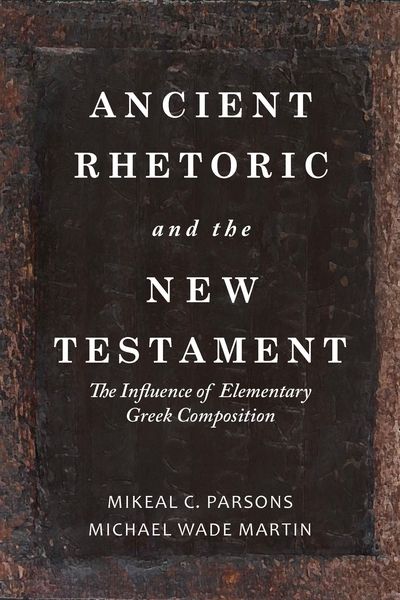
Ancient Rhetoric and the New Testament The Influence of Elementary Greek Composition
-
- Einzelkauf Download ausgewählt
-
Sprache:Englisch
43,99 €
inkl. gesetzl. MwSt.Beschreibung
Produktdetails
Format
Kopierschutz
Nein
Family Sharing
Nein
Text-to-Speech
Nein
Erscheinungsdatum
02.11.2018
Verlag
Baylor University PressSeitenzahl
336 (Printausgabe)
Sprache
Englisch
EAN
9781481308816
For the ancient Greeks and Romans, eloquence was essential to public life and identity, perpetuating class status and power. The three-tiered study of rhetoric was thus designed to produce sons worthy of and equipped for public service. Rhetorical competency enabled the elite to occupy their proper place in society.
The oracular and literary techniques represented in Greco-Roman education proved to be equally central to the formation of the New Testament. Detailed comparisons of the sophisticated rhetorical conventions, as cataloged in the ancient rhetorical handbooks (e.g., Quintilian), reveal to what degree and frequency the New Testament was shaped by ancient rhetoric's invention, argument, and style.
But Ancient Rhetoric and the New Testament breaks new ground. Instead of focusing on more advanced rhetorical lessons that elite students received in their school rooms, Michael Martin and Mikeal Parsons examine the influence of the progymnasmata--the preliminary compositional exercises that bridge the gap between grammar and rhetoric proper--and their influence on the New Testament.
Martin and Parsons use Theon's (50-100 CE) compendium as a baseline to measure the way primary exercises shed light on the form and style of the New Testament's composition. Each chapter examines a specific rhetorical exercise and its unique hortatory or instructional function, and offers examples from ancient literature before exploring the use of these techniques in the New Testament.
By studying the rhetoric of beginners rather than experts, Martin and Parsons demonstrate that the New Testament was not simply the product of an elite scholastic culture. "Rhetoric was in the air," acting as a stock feature of the public discourse from which the New Testament arose. Martin and Parsons demonstrate that attention to the intimate relationship between medium (the how) and message (the what) is not new. The New Testament used common strategies to communicate its uncommon Gospel.
Kundinnen und Kunden meinen
Verfassen Sie die erste Bewertung zu diesem Artikel
Helfen Sie anderen Kund*innen durch Ihre Meinung
Kurze Frage zu unserer Seite
Vielen Dank für dein Feedback
Wir nutzen dein Feedback, um unsere Produktseiten zu verbessern. Bitte habe Verständnis, dass wir dir keine Rückmeldung geben können. Falls du Kontakt mit uns aufnehmen möchtest, kannst du dich aber gerne an unseren Kund*innenservice wenden.
zum Kundenservice