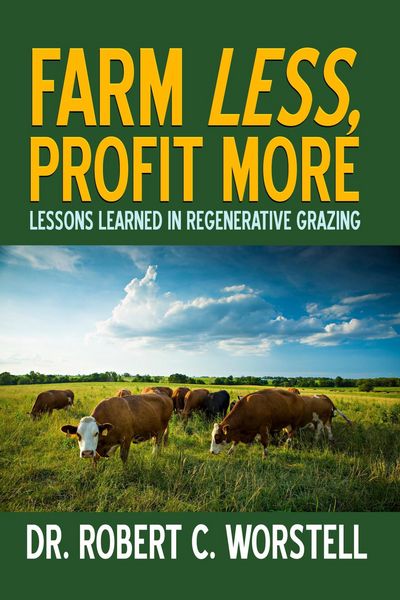
It took a crop failure to learn my biggest lesson in farming:
Row-cropping was an expensive gamble - but raising cattle on grass alone is almost guaranteed income.
The next couple of decades proved my observation right.
What people think is modern farming can lead them to bankruptcy, but grazing cattle according to Nature's principles makes farming income - and profits - predictable.
In this short volume are the condensed lessons on how rotational grazing - with inexpensive portable electric fencing - has made farming easier, more enjoyable, and completely sustainable.
The land is gradually producing more and more each year, while the soil beneath it regains its life. More grass means more cattle it can support, and means more profit every year.
You get to walk in Nature every day, while your farming "job" requires few machines or chemicals, and while that farm pays you with fresh air, exercise, healthy food, and enough income to farm worry-free. Almost regardless of the weather or market prices.
If - you study the land, and its grass, and its animals.
Here is a condensed set of lessons I've learned over two decades. More than I've told anyone - even those who have gone along this journey with me. Compiled into a single book for you to read. Compare your notes with mine. I've found sustainable, eco-positive way to heal the earth and make a decent living without stress.
You can, too.
Excerpt:
Some two decades ago, I escaped the big city and returned to our family farm to take over running it. We were doing corn-soybean row-cropping and "fat" cattle as a side operation. Once I worked out that the farm had to have external income to pay its bills, I started working backward to find out what we had to do to make the farm actually sustainable on its own.
Row-cropping didn't bring enough grain in to fatten steers for market. So we would sell our grain crops and buy feed. We had "bad years" and even outright crop failures occasionally, where the cows "cleaned up" by eating the residue stalks. That's when I first saw that you didn't have "crop failures" with cattle on the land.
As I then examined the various parts of our cattle farming methods, I found that working to fatten steers on for market ground corn and protein wasn't as profitable as just selling the yearling calves themselves. Far less inputs, but only slightly lower prices. Much higher profits. Far more sustainable.
Cutting and baling hay was a trade-off, since we could graze the ground we used to grow hay on to expand our available grazing paddocks, and then reallocate the money and time we invested in getting our hay cut and baled. Plus, we were bringing someone else's minerals onto our farm through purchased hay. However, this added another 25% to the cost of the needed winter bales, which should be offset by the extra grazing.
So we were now over to a simple cow-calf operation, and out of row cropping. But we still needing hay supplements to make ends meet for a third of the year when the grass didn't grow. The next focus after that was to cut down our hay costs. So we had to learn to graze better.
As we did, we found ourselves answering the question of how to improve the ground from year to year to raise more grass on the same land - instead of slowly (and expensively) mining it through row-cropping or over-grazing.
This is the core of regenerative grazing...
Scroll Up and Get Your Copy Now.