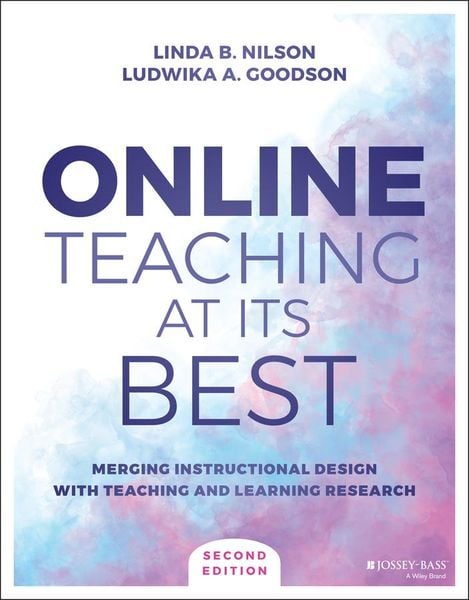
Online Teaching at Its Best Merging Instructional Design with Teaching and Learning Research
-
- Taschenbuch ausgewählt
- eBook
-
Sprache:Englisch
41,99 €
inkl. gesetzl. MwSt.,
Lieferung nach Hause
Beschreibung
Produktdetails
Einband
Taschenbuch
Erscheinungsdatum
12.07.2021
Verlag
John Wiley & Sons IncSeitenzahl
304
Maße (L/B/H)
21,6/27,6/2 cm
Gewicht
710 g
Auflage
2. Auflage
Sprache
Englisch
ISBN
978-1-119-76501-1
Bring pedagogy and cognitive science to online learning environments
Online Teaching at Its Best: Merging Instructional Design with Teaching and Learning Research, 2nd Edition, is the scholarly resource for online learning that faculty, instructional designers, and administrators have raved about. This book addresses course design, teaching, and student motivation across the continuum of online teaching modes--remote, hybrid, hyflex, and fully online--integrating these with pedagogical and cognitive science, and grounding its recommendations in the latest research. The book will help you design or redesign your courses to ensure strong course alignment and effective student learning in any of these teaching modes. Its emphasis on evidence-based practices makes this one of the most scholarly books of its kind on the market today.
This new edition features significant new content including more active learning formats for small groups across the online teaching continuum, strategies and tools for scripting and recording effective micro-lectures, ways to integrate quiz items within micro-lectures, more conferencing software and techniques to add interactivity, and a guide for rapid transition from face-to-face to online teaching. You'll also find updated examples, references, and quotes to reflect more evolved technology.
* Adopt new pedagogical techniques designed specifically for remote, hybrid, hyflex, and fully online learning environments
* Ensure strong course alignment and effective student learning for all these modes of instruction
* Increase student retention, build necessary support structures, and train faculty more effectively
* Integrate research-based course design and cognitive psychology into graduate or undergraduate programs
Distance is no barrier to a great education. Online Teaching at Its Best provides practical, real-world advice grounded in educational and psychological science to help online instructors, instructional designers, and administrators deliver an exceptional learning experience even under emergency conditions.
Online Teaching at Its Best: Merging Instructional Design with Teaching and Learning Research, 2nd Edition, is the scholarly resource for online learning that faculty, instructional designers, and administrators have raved about. This book addresses course design, teaching, and student motivation across the continuum of online teaching modes--remote, hybrid, hyflex, and fully online--integrating these with pedagogical and cognitive science, and grounding its recommendations in the latest research. The book will help you design or redesign your courses to ensure strong course alignment and effective student learning in any of these teaching modes. Its emphasis on evidence-based practices makes this one of the most scholarly books of its kind on the market today.
This new edition features significant new content including more active learning formats for small groups across the online teaching continuum, strategies and tools for scripting and recording effective micro-lectures, ways to integrate quiz items within micro-lectures, more conferencing software and techniques to add interactivity, and a guide for rapid transition from face-to-face to online teaching. You'll also find updated examples, references, and quotes to reflect more evolved technology.
* Adopt new pedagogical techniques designed specifically for remote, hybrid, hyflex, and fully online learning environments
* Ensure strong course alignment and effective student learning for all these modes of instruction
* Increase student retention, build necessary support structures, and train faculty more effectively
* Integrate research-based course design and cognitive psychology into graduate or undergraduate programs
Distance is no barrier to a great education. Online Teaching at Its Best provides practical, real-world advice grounded in educational and psychological science to help online instructors, instructional designers, and administrators deliver an exceptional learning experience even under emergency conditions.
Kundinnen und Kunden meinen
Verfassen Sie die erste Bewertung zu diesem Artikel
Helfen Sie anderen Kund*innen durch Ihre Meinung
Kurze Frage zu unserer Seite
Vielen Dank für dein Feedback
Wir nutzen dein Feedback, um unsere Produktseiten zu verbessern. Bitte habe Verständnis, dass wir dir keine Rückmeldung geben können. Falls du Kontakt mit uns aufnehmen möchtest, kannst du dich aber gerne an unseren Kund*innenservice wenden.
zum Kundenservice