KI-Beratung Beta

Gutscheinbedingungen

**Gültig vom 23.11. bis 30.11.2026 | Gültig für nicht preisgebundene fremdsprachige Bücher | Einzelne Artikel können ausgeschlossen sein | Online auf www.bücher.de einlösbar | Click & Collect nur mit Online-Zahlung (Paypal/Kreditkarte) vorab | Nicht kombinierbar mit anderen Gutscheinen oder Preisaktionen | Nur einmal pro Einkauf einlösbar | Gutschein wird auf max. 500€ Bestellwert angerechnet | Keine Barauszahlung | Nicht gültig für Versandkosten und Services

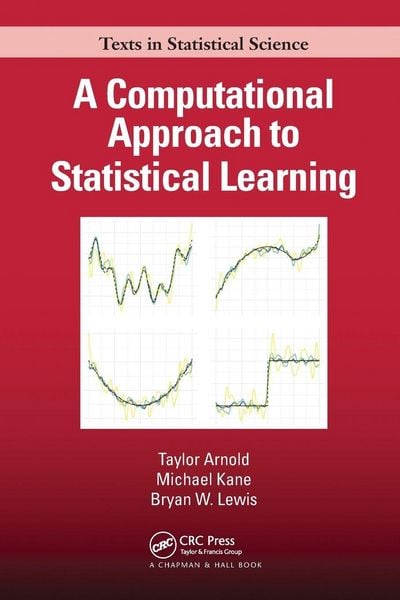
  • Produktbild: A Computational Approach to Statistical Learning
  • Produktbild: A Computational Approach to Statistical Learning

A Computational Approach to Statistical Learning

83,99 €

inkl. gesetzl. MwSt., Versandkostenfrei


Beschreibung

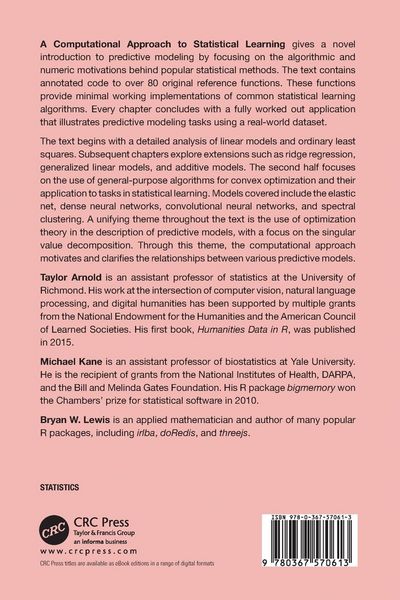
A Computational Approach to Statistical Learning gives a novel introduction to predictive modeling by focusing on the algorithmic and numeric motivations behind popular statistical methods. The text contains annotated code to over 80 original reference functions. These functions provide minimal working...

Beschreibung

A Computational Approach to Statistical Learning gives a novel introduction to predictive modeling by focusing on the algorithmic and numeric motivations behind popular statistical methods. The text contains annotated code to over 80 original reference functions. These functions provide minimal working implementations of common statistical learning algorithms. Every chapter concludes with a fully worked out application that illustrates predictive modeling tasks using a real-world dataset. The text begins with a detailed analysis of linear models and ordinary least squares. Subsequent chapters explore extensions such as ridge regression, generalized linear models, and additive models. The second half focuses on the use of general-purpose algorithms for convex optimization and their application to tasks in statistical learning. Models covered include the elastic net, dense neural networks, convolutional neural networks (CNNs), and spectral clustering. A unifying theme throughout the text is the use of optimization theory in the description of predictive models, with a particular focus on the singular value decomposition (SVD). Through this theme, the computational approach motivates and clarifies the relationships between various predictive models. Taylor Arnold is an assistant professor of statistics at the University of Richmond. His work at the intersection of computer vision, natural language processing, and digital humanities has been supported by multiple grants from the National Endowment for the Humanities (NEH) and the American Council of Learned Societies (ACLS). His first book, Humanities Data in R, was published in 2015. Michael Kane is an assistant professor of biostatistics at Yale University. He is the recipient of grants from the National Institutes of Health (NIH), DARPA, and the Bill and Melinda Gates Foundation. His R package bigmemory won the Chamber's prize for statistical software in 2010. Bryan Lewis is an applied mathematician and author of many popular R packages, including irlba, doRedis, and threejs.

Produktdetails

Einband

Taschenbuch

Erscheinungsdatum

30.06.2020

Verlag Taylor and Francis
Seitenzahl

376

Produktdetails

Einband

Taschenbuch

Erscheinungsdatum

30.06.2020

Verlag Taylor and Francis
Seitenzahl

376

Maße (L/B/H)

23,4/15,6/2 cm

Gewicht

570 g

Sprache

Englisch

ISBN

978-0-367-57061-3

Herstelleradresse

Libri GmbH
Europaallee 1
36244 Bad Hersfeld
DE

Email: gpsr@libri.de

Noch keine Bewertungen vorhanden

Verfassen Sie die erste Bewertung zu diesem Artikel

Helfen Sie anderen Kundinnen und Kunden durch Ihre Meinung.

Kundinnen und Kunden meinen

Bewertungen (0)

Die Leseprobe wird geladen.
  • Produktbild: A Computational Approach to Statistical Learning
  • Produktbild: A Computational Approach to Statistical Learning
  • Matrix Methods. Direct solutions to linear systems. Iterative linear model solutions. Iteratively reweighted least squares. Blockwise techniques. Convex optimization. Quasi-Newton and gradient descent. Interior point method. Proximal algorithms. Coordinate descent. Active sets and path solutions. Other techniques. Expectation maximization. Model featurization. Neighborhood prediction. Spectral learning. Stochastic techniques.