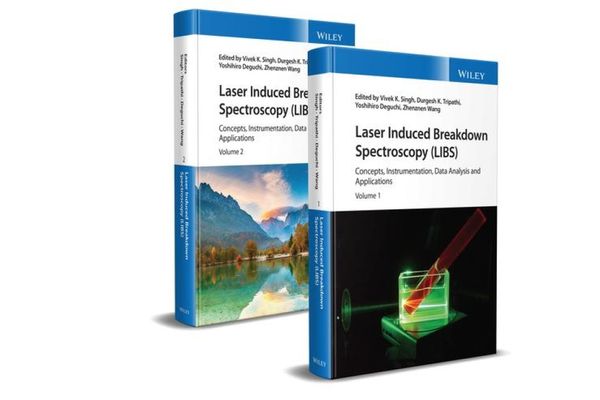
Produktbild: Laser Induced Breakdown Spectroscopy (Libs)

Laser Induced Breakdown Spectroscopy (Libs) Concepts, Instrumentation, Data Analysis and Applications, 2 Volume Set

441,99 €

inkl. gesetzl. MwSt., Versandkostenfrei

Lieferung nach Hause

Beschreibung

Produktdetails

Einband

Gebundene Ausgabe

Erscheinungsdatum

08.03.2023

Herausgeber

Singh Vivek K. + weitere

Verlag

John Wiley & Sons

Seitenzahl

1008

Maße (L/B/H)

24,4/17/5,9 cm

Gewicht

2183 g

Auflage

1. Auflage

Sprache

Englisch

ISBN

978-1-119-75840-2

Beschreibung

Produktdetails

Einband

Gebundene Ausgabe

Erscheinungsdatum

08.03.2023

Herausgeber

Verlag

John Wiley & Sons

Seitenzahl

1008

Maße (L/B/H)

24,4/17/5,9 cm

Gewicht

2183 g

Auflage

1. Auflage

Sprache

Englisch

ISBN

978-1-119-75840-2

Kundinnen und Kunden meinen

0 Bewertungen

Informationen zu Bewertungen

Zur Abgabe einer Bewertung ist eine Anmeldung im Konto notwendig. Die Authentizität der Bewertungen wird von uns nicht überprüft. Wir behalten uns vor, Bewertungstexte, die unseren Richtlinien widersprechen, entsprechend zu kürzen oder zu löschen.

Die Bewertungen sind nach Format, Anzahl Sterne und Datum sortiert.

Verfassen Sie die erste Bewertung zu diesem Artikel

Helfen Sie anderen Kund*innen durch Ihre Meinung

Kundinnen und Kunden meinen

0 Bewertungen filtern

Die Leseprobe wird geladen.
  • Produktbild: Laser Induced Breakdown Spectroscopy (Libs)
  • Volume 1

    Preface xix

    Part I Fundamental Aspects of LIBS and Laser-Induced Plasma 1

    1 Nanosecond and Femtosecond Laser-Induced Breakdown Spectroscopy: Fundamentals and Applications 3
    K. M. Muhammed Shameem, Swetapuspa Soumyashree, P. Madhusudhan, Vinitha Nimma, Rituparna Das, Pranav Bhardwaj, Prashant Kumar and Rajesh K. Kushawaha

    1.1 Introduction 3

    1.2 LIBS: ns-LIBS and fs-LIBS 5

    1.3 Plasma-Plume Dynamics 10

    1.4 Filamentation 14

    1.5 Signal-Enhancing Strategies in LIBS 17

    1.6 Applications 20

    1.7 Summary 21

    2 Elementary Processes and Emission Spectra in Laser-Induced Plasma 33
    V. Gardette, Z. Salajkova, M. Dell'Aglio and A. De Giacomo

    2.1 Introduction 33

    2.2 Laser-Ablation Mechanism 33

    2.3 Plasma Characteristics and Elementary Processes 35

    2.4 Plasma in Thermodynamic Equilibrium 37

    2.5 Plasma Emission Features 39

    2.6 Conclusion 41

    3 Diagnostics of Laser-Induced Plasma 45
    Charles Ghany, Kyung-Min Lee, Herve K. Sanghapi and Vivek K. Singh

    3.1 Introduction 45

    3.2 LIBS Plasmas and Its Characteristics 46

    3.3 Factors Affecting the LIBS Plasma 49

    3.4 Methods of Enhancing LIBS Sensitivity 51

    3.5 LTE Plasmas and Non-LTE Plasmas 52

    3.6 Laser-Plasma Expansion in Gas and Liquids: Modeling and Validation 54

    3.7 Chemistry in Laser Plasmas (Biological, Medical, and Isotopic Applications) 57

    3.8 Conclusion 58

    4 Double and Multiple Pulse LIBS Techniques 65
    Francesco Poggialini, Asia Botto, Beatrice Campanella, Simona Raneri, Vincenzo Palleschi and Stefano Legnaioli

    4.1 Introduction 65

    4.2 Double-Pulse LIBS: Geometries and Configurations 67

    4.3 Signal Enhancement in DP-LIBS: Principles and Theory 77

    4.4 Applications of DP-LIBS 80

    4.5 Conclusions 83

    5 Calibration-Free Laser-Induced Breakdown Spectroscopy 89
    Jörg Hermann

    5.1 Introduction 89

    5.2 Validity Conditions of the Physical Model 90

    5.3 Methods of Calibration-Free Measurements 98

    5.4 Critical Review of Analytical Performance 107

    5.5 Conclusion 115

    Part II Molecular LIBS and Instrumentation Developments 123

    6 Molecular Species Formation in Laser-Produced Plasma 125
    K. M. Muhammed Shameem, Swetapuspa Soumyashree, P. Madhusudhan, Vinitha Nimma, Rituparna Das, Pranav Bhardwaj and Rajesh K. Kushawaha

    6.1 Introduction 125

    6.2 Atmospheric Contribution in LIBS Spectra 127

    6.3 CN and C2 Molecular Formation in LIP 127

    6.4 Summary 134

    7 Recent Developments in Standoff Laser-Induced Breakdown Spectroscopy 137
    Linga Murthy Narlagiri and Venugopal Rao Soma

    7.1 Introduction 137

    7.2 Laser Systems Used 137

    7.3 Instrumentation in Standoff LIBS 138

    7.4 Gated and Non-Gated CCDs/Spectrometers 139

    7.5 Experimental Setup 139

    7.6 Reviews on Standoff LIBS 140

    7.7 Studies in Standoff LIBS 140

    7.8 Variants in Standoff LIBS 146

    7.9 Machine-Learning for Data Analysis in Standoff Mode 149

    7.10 Advancements in Standoff LIBS Methods 150

    7.11 Ongoing Study at ACRHEM, University of Hyderabad 153

    7.12 Conclusions and Outlook 158

    8 Nanoparticle-Enhanced Laser-Induced Breakdown Spectroscopy 165
    Zita Salajková, Marcella Dell'Aglio, Vincent Gardette and Alessandro De Giacomo

    8.1 Introduction 165

    8.2 Fundamentals 166

    8.3 Applications 174

    8.4 Conclusion 179

    9 Nanoparticle-Enhanced Laser-Induced Breakdown Spectroscopy for Sensing Applications 183
    Linga Murthy Narlagiri and Venugopal Rao Soma

    9.1 Introduction 183

    9.2 Previous Reviews 183

    9.3 Experimental Setup 184

    9.4 Enhancement Via Different Conditions 185

    9.5 Perspectives on the Mechanism(s) of Enhancement 191

    9.6 Variations in NE-LIBS 199

    9.7 Beyond NE-LIBS 200

    9.8 Further Application of Nanoparticles in LIBS 202

    9.9 Ongoing Study in the Lab 203

    9.10 Conclusions 204

    Part III Data Analysis and Chemometrics in LIBS 211

    10 Full-Spectrum Multivariate Analysis of LIBS Data 213
    Catherine E. McManus and Nancy J. McMillan

    10.1 Introduction 213

    10.2 Full-Spectrum Multivariate Analysis 215

    10.3 Analysis of Geologic Samples 216

    10.4 Identification of Pharmaceuticals 218

    10.5 Conclusions 224

    11 Chemometrics for Data Analysis 229
    Manoj Kumar Gundawar and Rajendhar Junjuri

    11.1 Introduction 229

    11.2 Data 230

    11.3 Machine Learning 231

    11.4 Classification of the Data 236

    11.5 Conclusion 237

    12 Chemometric Processing of LIBS Data 241
    J. El Haddad, A. Harhira, E. Képeš, J. Vrábel, J. Kaiser and P. Poøízka

    12.1 Introduction 241

    12.2 Exploratory Analysis Methods for Visualization 243

    12.3 Quantitative Analysis Methods 249

    12.4 Classification 254

    12.5 Data Preprocessing 257

    12.6 Validation and Generalization 261

    12.7 Conclusions 268

    13 How Chemometrics Allowed the Development of LIBS in the Quantification and Detection of Isotopes: A Case Study of Uranium 277
    Carlos A. Rinaldi, Norberto Boggio and Juan Vorobioff

    13.1 Introduction 277

    13.2 The LIBS Method 278

    13.3 Detection and Quantification 279

    13.4 Chemometrics Solution 279

    13.5 Conclusions 285

    14 Application of Multivariate Analysis to the Problem of the Provenance of Gem Stones (Ruby, Sapphire, Emerald, Diamond) 287
    Nancy J. McMillan and Catherine E. McManus

    14.1 Introduction 287

    14.2 Gem Mineral Genesis 289

    14.3 Laser-Induced Breakdown Spectroscopy and Multivariate Analysis 293

    14.4 Gem Provenance Studies 294

    14.5 Conclusions 300

    15 Machine Learning in the Context of Laser-Induced Breakdown Spectroscopy 305
    E. Képeš, J. Vrábel, J. El Haddad, A. Harhira, P. Poøízka and J. Kaiser

    15.1 Introduction 305

    15.2 Fundamental Concepts of Machine Learning 306

    15.3 Decision Trees and Related Ensemble Methods 307

    15.4 Support Vector Machines 311

    15.5 Artificial Neural Networks 314

    15.6 Unsupervised Learning 318

    15.7 Self-Organizing Maps 319

    15.8 Concluding Remarks 320

    16 Analysis of LIBS Data from Coal and Biomass Using Artificial Intelligence Techniques 331
    Carlos E. Romero and Robert De Saro

    16.1 Introduction 331

    16.2 LIBS Coal and Biomass Laboratory Experimental Results 334

    16.3 Application of Artificial Intelligence Techniques to LIBS Spectral Data 337

    16.4 Conclusions 349

    Part IV Special Topics and Comparison with Other Methods 353

    17 Lasing in Optically Pumped Laser-Induced Plasma 355
    Lev Nagli, Michael Gaft and Yosef Raichlin

    17.1 Introduction 355

    17.2 Experimental Setups and Samples 357

    17.3 Lasing Effects in a LIP Plume; 13 th Group Elements 360

    17.4 Polarization of the LIPLs: the UV-VIS Generation 370

    17.5 External Magnetic Field Effects 376

    17.6 Fourteenth GROUP Elements LIPL (Ground-State Configuration 4s2np23P0 , n = 4,5,6) 377

    17.7 LIPLs Tunability 379

    17.8 Conclusions 382

    18 LIBS Analysis of Optical Surfaces and Thin Films 387
    Christoph Gerhard and Jörg Hermann

    18.1 Introduction 387

    18.2 Sensitivity-Improved Calibration-Free LIBS 389

    18.3 Analysis of Optical Materials and Surfaces 392

    18.4 Elemental Analysis of Thin Films 395

    18.5 Conclusion 407

    19 LIBS Detection of Rare-Earth Elements and Comparison with Other Techniques 415
    Yashashchandra Dwivedi

    19.1 Introduction 415

    19.2 Importance of Rare Earth 416

    19.3 Technological Challenges 417

    19.4 Detection of RE Using LIBS 418

    19.5 Detection of RE Using Other Techniques 423

    20 Marine Biofouling Analysis by Laser-Induced Breakdown Spectroscopy 431
    Della Thomas

    20.1 Introduction 431

    20.2 Biofouling Sample Preparation 431

    20.3 Experimental LIBS Setup 432

    20.4 Analysis and Discussion 432

    20.5 Biomineralization and Elemental Mapping Studies 437

    20.6 LIBS Spectra for Biofouling Sample 437

    20.7 LIBS Spatial Elemental Mapping 440

    20.8 Conclusion 444

    21 Hyphenated LIBS Techniques 447
    U. K. Adarsh, V. S. Dhanada, Santhosh Chidangil and V. K. Unnikrishnan

    21.1 Introduction 447

    21.2 Why Hyphenate Spectroscopic Methods? 449

    21.2.1 Significance 449

    21.2.2 Developmental Strategies 451

    21.2.3 Hyphenated LIBS Systems 452

    21.3 Conclusion and Future Directions 457

    22 Comparison of LIBS with Other Analytical Techniques 461
    Muhammad Aslam Baig, Rizwan Ahmed and Zeshan Adeel Umar

    22.1 Introduction 461

    22.2 Quantitative Analysis by LIBS 462

    22.3 Laser-Ablation Time-of-Flight Mass Spectrometry 476

    22.4 Conclusion 482

    23 Combining Laser-Induced Breakdown Spectroscopy and Raman Spectroscopy: Instrumentation and Applications 487
    Vasily N. Lednev

    23.1 Introduction 487

    23.2 Instrumentation 489

    23.3 Applications 502

    23.4 Conclusions 520

    Acknowledgments 521

    References 521

    Volume 2

    Preface xix

    Part V Novel Applications of LIBS 531

    24 Application of LIBS to the Analysis of Metals 533
    Francesco Poggialini, Asia Botto, Beatrice Campanella, Vincenzo Palleschi, Simona Raneri and Stefano Legnaioli

    25 LIBS Analysis of Metals Under Extreme Conditions 551
    Mohamed Abdel-Harith and Raghda Hosny El-Saeid

    26 LIBS Applications to Liquids and Solids in Liquids 559
    Chet R. Bhatt, Daniel Hartzler, Jinesh Jain and Dustin L. McIntyre

    27 Coal Analysis by Laser-Induced Breakdown Spectroscopy 581
    Shunchun Yao

    28 Application of LIBS to Terrestrial Geological Research 593
    Giorgio S. Senesi and Russell S. Harmon

    29 Plastic Waste Identification Using Laser-Induced Breakdown Spectroscopy 615
    Rajendhar Junjuri and Manoj Kumar Gundawar

    30 Cultural Heritage Applications of Laser-Induced Breakdown Spectroscopy 623
    Duixiong Sun and Yaopeng Ying

    31 Nuclear Applications of Laser-Induced Breakdown Spectroscopy 643
    Gábor Galbács and Éva Kovács-Széles

    32 Applications of Laser-Induced Breakdown Spectroscopy for Trace Detection in Explosives 667
    Qianqian Wang and Geer Teng

    33 Geochemical Fingerprinting Using Laser-Induced Breakdown Spectroscopy 683
    Pengju Xing and Zhenli Zhu

    34 Laser-Induced Breakdown Spectroscopy for the Analysis of Chemical and Biological Hazards 701
    Lianbo Guo

    35 Development of a Simple, Low-Cost, and On-Site Deployable LIBS Instrument for the Quantitative Analysis of Edible Salts 715
    Sandeep Kumar, Hyang Kim, Jeong Park, Kyung-Sik Ham, Song-Hee Han, Sang-Ho Nam and Yonghoon Lee

    36 Bioimaging in Laser-Induced Breakdown Spectroscopy 729
    Pavlina Modlitbová, Pavel Poøízka and Jozef Kaiser

    37 Laser-Induced Breakdown Spectroscopy for the Identification of Bacterial Pathogens 745
    Somenath Ghatak, Gaurav Sharma, Prashant Kumar Rai, Suman Yadav and Geeta Watal

    38 Phase-Selective Laser-Induced Breakdown Spectroscopy of Metal-Oxide Nanoaerosols 755
    Gang Xiong and Stephen D. Tse

    39 Laser-Induced Breakdown Spectroscopy for the Analysis of Cultivated Soil 767
    R. K. Aldakheel, M. A. Gondal and M. A. Almessiere

    40 Laser-Induced Breakdown Spectroscopy in Food Sciences 781
    J. Naozuka and A. P. Oliveira

    41 Capabilities and Limitations of Laser-Induced Breakdown Spectroscopy for Analyzing Food Products 807
    R. K. Aldakheel, M. A. Gondal and M. A. Almessiere

    42 Laser-Induced Breakdown Spectroscopy and Its Application Perspectives in Industry and Recycling 823
    Reinhard Noll

    43 Development of Laser-Induced Breakdown Spectroscopy for Application to Space Exploration 851
    Zhenzhen Wang and Han Luo

    44 Femtosecond Laser-Induced Breakdown Spectroscopy of Complex Materials 863
    Mathi Pandiyathuray

    45 Application of LIBS for the Failure Characteristics Prediction of Heat-Resistant Steel 883
    Meirong Dong, Junbin Cai, Shunchun Yao and Jidong Lu

    46 Scope for Future Development in Laser-Induced Breakdown Spectroscopy 939
    Yoshihiro Deguchi

    Index 947