Beschreibung
Produktdetails
Einband
Taschenbuch
Erscheinungsdatum
01.09.2020
Verlag
Ingram Publishers ServicesSeitenzahl
320
Maße (L/B/H)
25,4/17,7/1,9 cm
Gewicht
638 g
Sprache
Englisch
ISBN
978-1-64712-011-5
Intelligence / Technology & Engineering
"Robert Clark has compiled an informative and interesting chronicle of the newest intelligence discipline, GEOINT. I would recommend this well-organized and readable treatise to anyone interested in the evolution of intelligence in this country."
--James Clapper, former Director of National Intelligence, the Defense Intelligence Agency, and the National Geospatial-Intelligence Agency
"Clark brings to the reader both GEOINT's fascinating history and an introduction to the fundamental domain concepts. The book is a needed and essential primer to the profession that transcends the technical and prepares the professional to think critically about the art and science of GEOINT."
--Todd S. Bacastow, teaching professor of practice for geospatial intelligence, Department of Geography, Pennsylvania State University
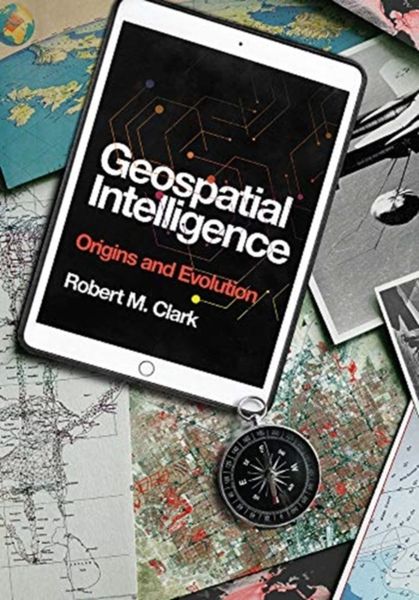
Although geospatial intelligence is a recent term, its underpinnings have a long and fascinating history. Geospatial Intelligence: Origins and Evolution shows how the current age of geospatial knowledge evolved from its ancient origins to become ubiquitous in daily life across the globe. Within that framework, this book weaves a tapestry of stories about the people, events, ideas, and technologies that affected the trajectory of what has become known as GEOINT.
Author Robert M. Clark explores the historical background and subsequent influence of geography, cartography, remote sensing, photogrammetry, geopolitics, geophysics, and geographic information systems on the field of GEOINT. Although its modern use began in national security communities, Clark shows how GEOINT has rapidly extended its reach to other government agencies, NGOs, and corporations. This global explosion in the use of geospatial intelligence has far-reaching implications not only for scientific, academic, and commercial communities but for a society increasingly reliant upon emerging technologies. Drones, the Internet of Things, and cellular devices transform how we gather information and how others can collect that information, to our benefit or detriment.
Robert M. Clark is an expert in national intelligence and has authored or coauthored six books on the subject, including Intelligence Analysis: A Target-Centric Approach. He is currently an adjunct professor at Johns Hopkins University and an adjunct faculty member at the University of North Carolina Wilmington. Clark has previously served as a CIA senior analyst and group chief and as cofounder and CEO of the Scientific and Technical Analysis Corporation.
Noch keine Bewertungen vorhanden
Verfassen Sie die erste Bewertung zu diesem Artikel
Helfen Sie anderen Kundinnen und Kunden durch Ihre Meinung.
Kurze Frage zu unserer Seite
Vielen Dank für dein Feedback
Wir nutzen dein Feedback, um unsere Produktseiten zu verbessern. Bitte habe Verständnis, dass wir dir keine Rückmeldung geben können. Falls du Kontakt mit uns aufnehmen möchtest, kannst du dich aber gerne an unseren Kund*innenservice wenden.
zum Kundenservice