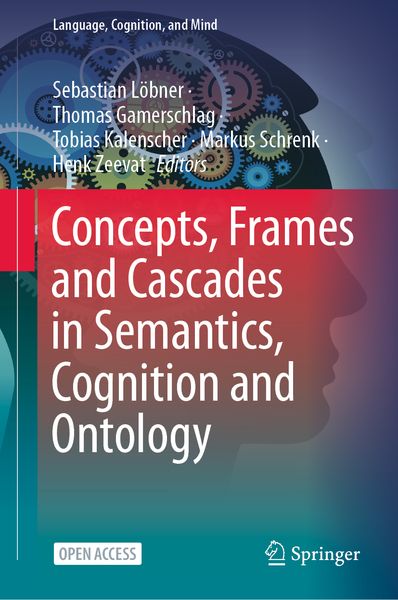
Concepts, Frames and Cascades in Semantics, Cognition and Ontology
-
- Englisch ausgewählt
49,99 €
inkl. gesetzl. MwSt.,
Beschreibung
Produktdetails
Einband
Gebundene Ausgabe
Erscheinungsdatum
29.05.2021
Abbildungen
IX, 486 p. 263 illus., 33 illus. in color.
Herausgeber
Sebastian Löbner + weitereVerlag
SpringerSeitenzahl
486
Maße (L/B/H)
24,1/16/3,3 cm
Gewicht
904 g
Auflage
1st ed. 2021
Sprache
Englisch
ISBN
978-3-030-50199-0
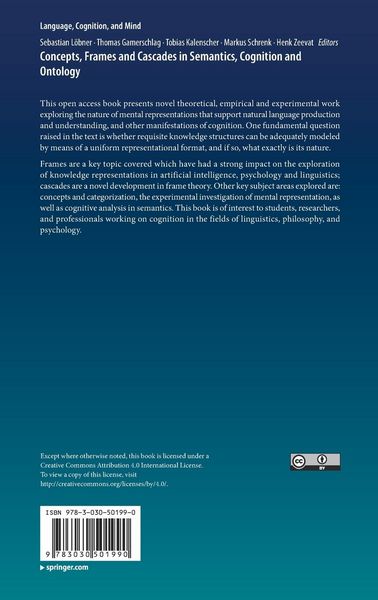
This open access book presents novel theoretical, empirical and experimental work exploring the nature of mental representations that support natural language production and understanding, and other manifestations of cognition. One fundamental question raised in the text is whether requisite knowledge structures can be adequately modeled by means of a uniform representational format, and if so, what exactly is its nature.
Frames are a key topic covered which have had a strong impact on the exploration of knowledge representations in artificial intelligence, psychology and linguistics; cascades are a novel development in frame theory. Other key subject areas explored are: concepts and categorization, the experimental investigation of mental representation, as well as cognitive analysis in semantics. This book is of interest to students, researchers, and professionals working on cognition in the fields of linguistics, philosophy, and psychology.
Noch keine Bewertungen vorhanden
Verfassen Sie die erste Bewertung zu diesem Artikel
Helfen Sie anderen Kundinnen und Kunden durch Ihre Meinung.
Kurze Frage zu unserer Seite
Vielen Dank für dein Feedback
Wir nutzen dein Feedback, um unsere Produktseiten zu verbessern. Bitte habe Verständnis, dass wir dir keine Rückmeldung geben können. Falls du Kontakt mit uns aufnehmen möchtest, kannst du dich aber gerne an unseren Kund*innenservice wenden.
zum Kundenservice