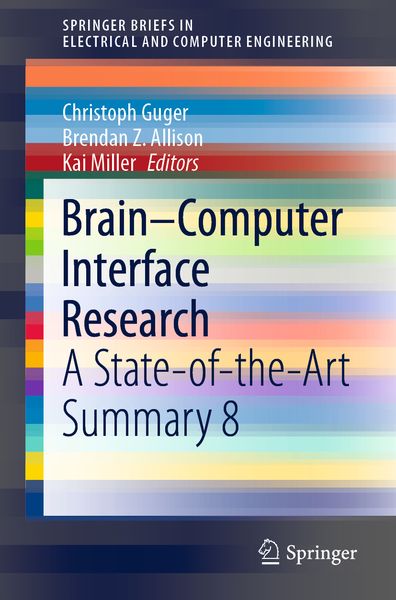
Brain–Computer Interface Research A State-of-the-Art Summary 8
-
- Hardcover
- Taschenbuch ausgewählt
- eBook
-
Sprache:Englisch
-
Verlag:Springer
- Springer 49,99 € ausgewählt
- Springer Berlin 49,99 €
49,99 €
inkl. gesetzl. MwSt.,
Lieferung nach Hause
Beschreibung
Produktdetails
Einband
Taschenbuch
Erscheinungsdatum
18.10.2020
Herausgeber
Christoph Guger + weitereVerlag
SpringerSeitenzahl
121
Maße (L/B/H)
23,5/15,5/0,8 cm
Gewicht
207 g
Auflage
1st edition 2020
Sprache
Englisch
ISBN
978-3-030-49582-4
The Annual BCI Research Awards are international prizes that recognize the top new projects in brain-computer interface (BCI) research. This book contains summaries of the key projects from the 2018 BCI Research Award. Each article is authored by the group of researchers who developed the project, and articles have been updated with new progress achieved since 2018. They are complemented by an introduction by the editors together with a chapter of highlights and interviews with the 2018 award winners. One of the prominent trends in recent years has been the development of BCIs for new patient groups; many chapters in this book present emerging and novel research directions likely to become more prevalent in the near future.
Noch keine Bewertungen vorhanden
Verfassen Sie die erste Bewertung zu diesem Artikel
Helfen Sie anderen Kundinnen und Kunden durch Ihre Meinung.
Kurze Frage zu unserer Seite
Vielen Dank für dein Feedback
Wir nutzen dein Feedback, um unsere Produktseiten zu verbessern. Bitte habe Verständnis, dass wir dir keine Rückmeldung geben können. Falls du Kontakt mit uns aufnehmen möchtest, kannst du dich aber gerne an unseren Kund*innenservice wenden.
zum Kundenservice