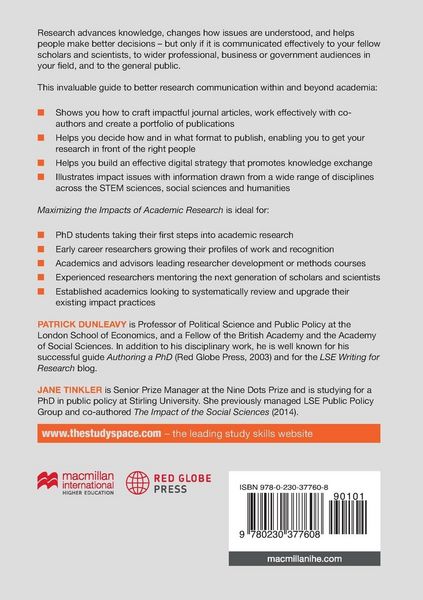
• Produktbild: Maximizing the Impacts of Academic Research
  • Produktbild: Maximizing the Impacts of Academic Research

Maximizing the Impacts of Academic Research

58,99 €

inkl. gesetzl. MwSt., Versandkostenfrei

Lieferung nach Hause

Beschreibung

Produktdetails

Einband

Taschenbuch

Erscheinungsdatum

10.10.2020

Verlag

Macmillan Education Elt

Seitenzahl

409

Maße (L/B/H)

21,6/14/2,3 cm

Gewicht

513 g

Auflage

1st ed. 2021

Sprache

Englisch

ISBN

978-0-230-37760-8

Beschreibung

Produktdetails

Einband

Taschenbuch

Erscheinungsdatum

10.10.2020

Verlag

Macmillan Education Elt

Seitenzahl

409

Maße (L/B/H)

21,6/14/2,3 cm

Gewicht

513 g

Auflage

1st ed. 2021

Sprache

Englisch

ISBN

978-0-230-37760-8

Herstelleradresse

Macmillan Education
Tiergartenstr. 17
69121 Heidelberg
DE

Email: ProductSafety@springernature.com

Noch keine Bewertungen vorhanden

Verfassen Sie die erste Bewertung zu diesem Artikel

Helfen Sie anderen Kundinnen und Kunden durch Ihre Meinung.

Kundinnen und Kunden meinen

Bewertungen (0)

Die Leseprobe wird geladen.
  • Produktbild: Maximizing the Impacts of Academic Research
  • Produktbild: Maximizing the Impacts of Academic Research
  • PART 1: ACADEMIC IMPACTS
    Chapter 1: How citations work
    1.1 The role citations play
    1.2 Citation rates across disciplines
    1.3 Time lags and citation profiles
    1.4 What shapes researchers' overall citation profiles across their careers?
    1.5 Handling self-citation
    Chapter 2: Tracking and understanding your citations
    2.1 The 'legacy' citation tracking systems
    2.2 Google Scholar's tracking systems
    2.3 Web-based citation plus full text
    2.4 Altmetrics
    2.5 Digital metrics and academic citing behaviours
    Chapter 3: Planning journal articles
    3.1 Getting papers from research projects
    3.2 Working with co-authors and research teams
    3.3 Deciding where to submit an article
    3.4 Understanding the peer review process
    3.5 Maintaining a flow of research and papers
    Chapter 4: Crafting better journal articles
    4.1 Choosing an article structure suitable for each discipline
    4.2 Writing better -avoiding 'academese'
    4.3 Helping other researchers to cite you
    4.4 Writing informative titles and abstracts for journal articles
    Chapter 5: Producing books and chapters
    5.1 Books as academic outputs and their citation rates
    5.2 Getting your book known
    5.3 Edited books
    5.4 Chapters in books
    PART 2: ACADEMIC AND EXTERNAL IMPACTS
    Chapter 6: Applied work, 'grey' literature and choosing across projects
    6.1 Applied work
    6.2 'Grey' literature and other publications
    6.3 A choice canvass for research and publications options
    Chapter 7: Digital era scholarship- bigger, better, shorter, faster, free
    7.1 Bigger data
    7.2 Bigger search
    7.3 Better communicated
    7.4 Shorter publication forms
    7.5 Faster research
    7.6 Free access and open access to knowledge
    Chapter 8: Improving impacts at department and university level
    8.1 Committing to knowledge exchange
    8.2 Choosing a blogging/digital strategy
    8.3 Integrating department and university impact efforts
    8.4 University leadership and information flows
    PART 3: EXTERNAL IMPACTS
    Chapter 9: Impacts, intermediaries and academic purpose
    9.1 What an external impact is (and is not)
    9.2 Academia and modern professions
    9.3 The impacts interface
    Chapter 10: Working with other organizations. 10.1 Which academics can link to outside bodies. 10.2 The variety of university links to businesses and other organizations
    10.3 How working with outside organizations can benefit research
    10.4 The costs and possible risks of working externally
    Chapter 11: Public engagement and impacts
    11.1 Intuitive explanations, research narrative and 'maths dread'
    11.2 Who can do public engagement?
    11.3 The benefits of getting involved
    11.4 Mitigating costs and potential risks
    Afterword: How the impacts agenda boosts academic progress and democratizes knowledge
    References.