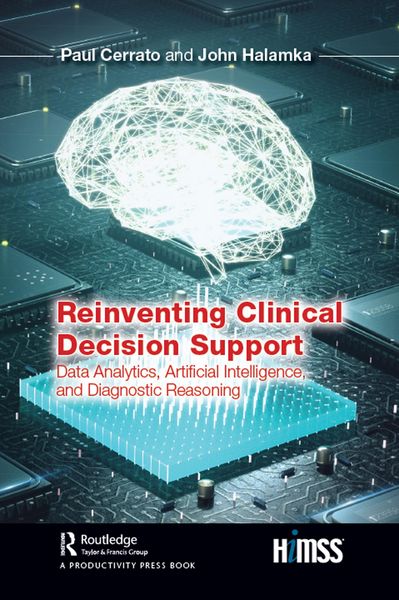
Reinventing Clinical Decision Support Data Analytics, Artificial Intelligence, and Diagnostic Reasoning
-
- Taschenbuch
- eBook ausgewählt
-
Form:Einzelkauf Download
-
Sprache:Englisch
-
eBook Format:PDF
- PDF 67,49 € ausgewählt
- ePUB 67,49 €
67,49 €
inkl. gesetzl. MwSt.Beschreibung
Produktdetails
Format
Kopierschutz
Ja
Family Sharing
Nein
Text-to-Speech
Nein
Erscheinungsdatum
06.01.2020
Verlag
Taylor & Francis eBooksSeitenzahl
184 (Printausgabe)
Auflage
1. Auflage
Sprache
Englisch
EAN
9781000055535
This book takes an in-depth look at the emerging technologies that are transforming the way clinicians manage patients, while at the same time emphasizing that the best practitioners use both artificial and human intelligence to make decisions.
AI and machine learning are explored at length, with plain clinical English explanations of convolutional neural networks, back propagation, and digital image analysis. Real-world examples of how these tools are being employed are also discussed, including their value in diagnosing diabetic retinopathy, melanoma, breast cancer, cancer metastasis, and colorectal cancer, as well as in managing severe sepsis.
With all the enthusiasm about AI and machine learning, it was also necessary to outline some of criticisms, obstacles, and limitations of these new tools. Among the criticisms discussed: the relative lack of hard scientific evidence supporting some of the latest algorithms and the so-called black box problem. A chapter on data analytics takes a deep dive into new ways to conduct subgroup analysis and how it's forcing healthcare executives to rethink the way they apply the results of large clinical trials to everyday medical practice. This re-evaluation is slowly affecting the way diabetes, heart disease, hypertension, and cancer are treated. The research discussed also suggests that data analytics will impact emergency medicine, medication management, and healthcare costs.
An examination of the diagnostic reasoning process itself looks at how diagnostic errors are measured, what technological and cognitive errors are to blame, and what solutions are most likely to improve the process. It explores Type 1 and Type 2 reasoning methods; cognitive mistakes like availability bias, affective bias, and anchoring; and potential solutions such as the Human Diagnosis Project. Finally, the book explores the role of systems biology and precision medicine in clinical decision support and provides several case studies of how next generation AI is transforming patient care.
Noch keine Bewertungen vorhanden
Verfassen Sie die erste Bewertung zu diesem Artikel
Helfen Sie anderen Kundinnen und Kunden durch Ihre Meinung.
Kurze Frage zu unserer Seite
Vielen Dank für dein Feedback
Wir nutzen dein Feedback, um unsere Produktseiten zu verbessern. Bitte habe Verständnis, dass wir dir keine Rückmeldung geben können. Falls du Kontakt mit uns aufnehmen möchtest, kannst du dich aber gerne an unseren Kund*innenservice wenden.
zum Kundenservice