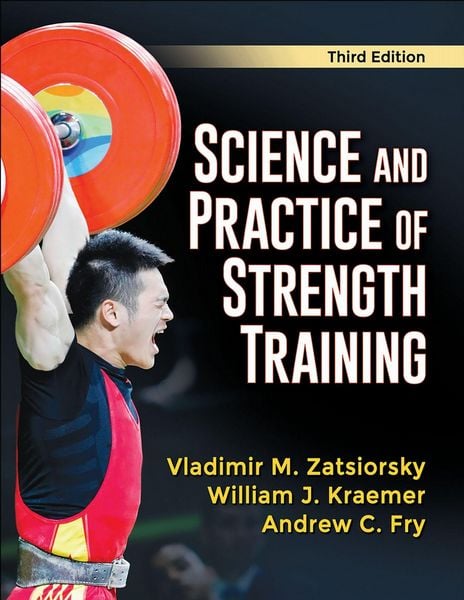
Science and Practice of Strength Training
-
- Englisch ausgewählt
105,99 €
inkl. gesetzl. MwSt.,
Lieferung nach Hause
Beschreibung
Produktdetails
Einband
Gebundene Ausgabe
Erscheinungsdatum
09.04.2020
Verlag
Human Kinetics PublishersSeitenzahl
344
Maße (L/B/H)
28,9/22/2,7 cm
Gewicht
1198 g
Sprache
Englisch
ISBN
978-1-4925-9200-6
Science and Practice of Strength Training is a favorite book among strength and conditioning professionals. Now in a third edition, it offers upgraded artwork, updates based on current science, and new information to enhance the practical application of the concepts presented. A new coauthor, Dr. Andrew Fry, joins the already-popular author team of Dr. Vladimir Zatsiorsky and Dr. William Kraemer to make this third edition even better than its predecessors. Together the authors have trained more than 1,000 elite athletes, including Olympic medal winners, world champions, and national record holders. Influenced by both Eastern European and North American perspectives, their experience and expertise are integrated into solid principles, practical insights, and directions based on scientific findings.
Science and Practice of Strength Training, Third Edition, shows that there is no single program that works for everyone, at all times and in all conditions. It addresses the complexity of strength training programs while providing straightforward approaches to take under specific circumstances. Those approaches are backed with physiological concepts, ensuring readers gain a full understanding of the science behind the practice of strength training. In addition, the authors provide examples of strength training programs to demonstrate the principles and concepts they explain in the book. The third edition features more detailed artwork and has three new chapters on velocity in the weight room, overtraining and recovery, and athlete monitoring.
The book is divided into three parts. Part I focuses on the basis of strength training, detailing basic concepts, task-specific strength, and athlete-specific strength. Part II covers methods of strength training, delving into velocity training, training intensity, timing, exercises used for strength training, injury prevention, overtraining, athlete monitoring, and goal-specific strength training. Part III offers even more practical applications, exploring training for specific populations, including women, young athletes, and senior athletes. The book also includes suggested readings that can further aid readers in developing strength training programs.
This expanded and updated coverage of strength training concepts will ground readers in the understanding they need to develop appropriate strength training programs for each person that they work with.
Earn continuing education credits/units! A continuing education exam that uses this book is also available. It may be purchased separately or as part of a package that includes both the book and exam.
Science and Practice of Strength Training, Third Edition, shows that there is no single program that works for everyone, at all times and in all conditions. It addresses the complexity of strength training programs while providing straightforward approaches to take under specific circumstances. Those approaches are backed with physiological concepts, ensuring readers gain a full understanding of the science behind the practice of strength training. In addition, the authors provide examples of strength training programs to demonstrate the principles and concepts they explain in the book. The third edition features more detailed artwork and has three new chapters on velocity in the weight room, overtraining and recovery, and athlete monitoring.
The book is divided into three parts. Part I focuses on the basis of strength training, detailing basic concepts, task-specific strength, and athlete-specific strength. Part II covers methods of strength training, delving into velocity training, training intensity, timing, exercises used for strength training, injury prevention, overtraining, athlete monitoring, and goal-specific strength training. Part III offers even more practical applications, exploring training for specific populations, including women, young athletes, and senior athletes. The book also includes suggested readings that can further aid readers in developing strength training programs.
This expanded and updated coverage of strength training concepts will ground readers in the understanding they need to develop appropriate strength training programs for each person that they work with.
Earn continuing education credits/units! A continuing education exam that uses this book is also available. It may be purchased separately or as part of a package that includes both the book and exam.
Kundinnen und Kunden meinen
Verfassen Sie die erste Bewertung zu diesem Artikel
Helfen Sie anderen Kund*innen durch Ihre Meinung
Kurze Frage zu unserer Seite
Vielen Dank für dein Feedback
Wir nutzen dein Feedback, um unsere Produktseiten zu verbessern. Bitte habe Verständnis, dass wir dir keine Rückmeldung geben können. Falls du Kontakt mit uns aufnehmen möchtest, kannst du dich aber gerne an unseren Kund*innenservice wenden.
zum Kundenservice