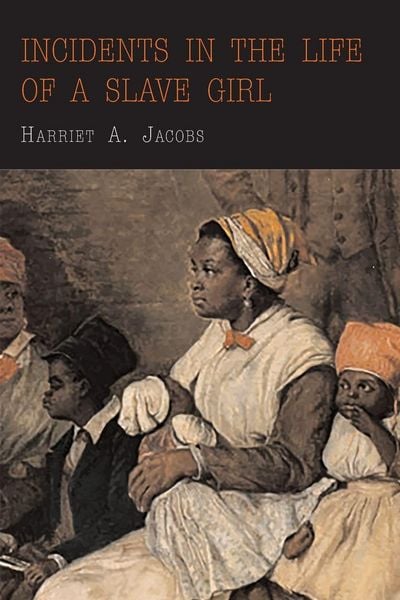
Incidents in the Life of a Slave Girl
-
- Hardcover
- Taschenbuch ausgewählt
- eBook
- Hörbuch
-
Sprache:Englisch
-
Verlag:Martino Fine Books
- Skyhorse Publishing 13,99 €
- Tredition 12,90 €
- Lushena Books 17,99 €
- Houghton Mifflin Company 17,99 €
- Oxford University Press 9,69 €
- Sharp Ink 11,00 €
- Dover Publications Inc 6,99 €
- Random House N.Y. 6,99 €
- Martino Fine Books 11,99 € ausgewählt
- Digireads.com 12,99 €
- Clydesdale 7,99 €
- Benediction Classics 15,99 €
- Simon & Brown 9,99 €
- Carlton Publishing 11,99 €
- Ingram Publishers Services 11,99 €
- E-artnow 11,50 €
- Chump Change 12,99 €
11,99 €
inkl. gesetzl. MwSt.,
Beschreibung
Produktdetails
Einband
Taschenbuch
Erscheinungsdatum
27.11.2019
Verlag
Martino Fine BooksSeitenzahl
174
Maße (L/B/H)
22,9/15,2/1 cm
Gewicht
262 g
Sprache
Englisch
ISBN
978-1-68422-417-3
2019 Reprint of 1861 Edition. A haunting, evocative recounting of her life as a slave in North Carolina and of her final escape and emancipation, Harriet Jacobs’s classic narrative, written between 1853 and 1858 and published in 1861, tells firsthand of the horrors inflicted on female slaves. In writing this extraordinary memoir, which culminates in the seven years she spent hiding in a crawl space in her grandmother’s attic, Jacobs skillfully used the literary genres of her time, presenting a thoroughly feminist narrative that portrays the evils and traumas of slavery, particularly for women and children. As an African-American novel and historical artifact, Incidents constituted a critical intervention into the early African-American literary canon and African-American historiographies of slavery by highlighting the experiences of black women under slavery. Before black feminist challenges to the African-American literary and historiographic canons in the 1970s and '80s, the former and the latter foregrounded themes of slavery, racism, social inequality, and black cultural resistance, but failed to highlight the specific exigencies faced by black women under slavery; namely, institutionalized rape and reproductive violence. Thus, Incidents, along with other black women's novels and historiographies, directed critical attention to the ways in which race and gender interacted in the lives of black bondswomen to produce gender-specific conditions of unfreedom.2019 Reprint of 1861 Edition. A haunting, evocative recounting of her life as a slave in North Carolina and of her final escape and emancipation, Harriet Jacobs’s classic narrative, written between 1853 and 1858 and published in 1861, tells firsthand of the horrors inflicted on slaves. In writing this extraordinary memoir, which culminates in the seven years she spent hiding in a crawl space in her grandmother’s attic, Jacobs skillfully used the literary genres of her time, presenting a thoroughly feminist narrative that portrays the evils and traumas of slavery, particularly for women and children. As an African-American novel and historical artifact, Incidents constituted a critical intervention into the early African-American literary canon and African-American historiographies of slavery by highlighting the experiences of black women under slavery. Before black feminist challenges to the African-American literary and historiographic canons in the 1970s and '80s, the former and the latter foregrounded themes of slavery, racism, social inequality, and black cultural resistance, but failed to highlight the specific exigencies faced by black women under slavery; namely, institutionalized rape and reproductive violence. Thus, Incidents, along with other black women's novels and historiographies, directed critical attention to the ways in which race and gender interacted in the lives of black bondswomen to produce gender-specific conditions of unfreedom.
Noch keine Bewertungen vorhanden
Verfassen Sie die erste Bewertung zu diesem Artikel
Helfen Sie anderen Kundinnen und Kunden durch Ihre Meinung.
Kurze Frage zu unserer Seite
Vielen Dank für dein Feedback
Wir nutzen dein Feedback, um unsere Produktseiten zu verbessern. Bitte habe Verständnis, dass wir dir keine Rückmeldung geben können. Falls du Kontakt mit uns aufnehmen möchtest, kannst du dich aber gerne an unseren Kund*innenservice wenden.
zum Kundenservice