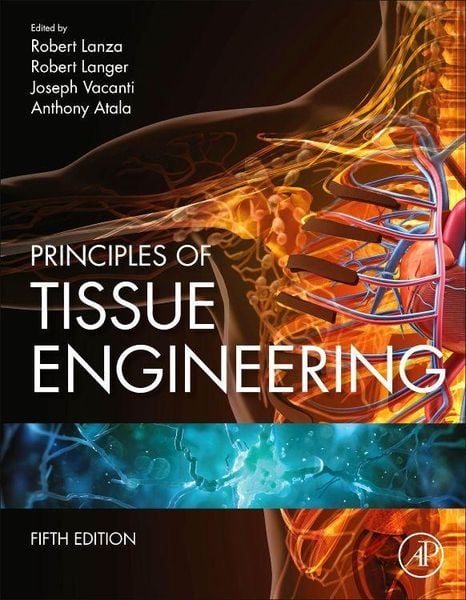
Produktbild: Principles of Tissue Engineering

Principles of Tissue Engineering

261,99 €

inkl. gesetzl. MwSt., Versandkostenfrei


Beschreibung

Produktdetails

Einband

Gebundene Ausgabe

Erscheinungsdatum

27.04.2020

Herausgeber

Robert Lanza + weitere

Verlag

Elsevier

Seitenzahl

1678

Maße (L/B/H)

27,9/21,9/6,6 cm

Gewicht

3444 g

Auflage

5th edition

Sprache

Englisch

ISBN

978-0-12-818422-6

Beschreibung

Portrait

Robert Lanza is an American scientist and author whose research spans the range of natural science, from biology to theoretical physics. TIME magazine recognized him as one of the “100 Most Influential People in the World,” and Prospect magazine named him one of the Top 50 “World Thinkers.” He has hundreds of scientific publications and over 30 books, including definitive references in the fields of stem cells, tissue engineering, and regenerative medicine. He’s a former Fulbright Scholar and studied with polio-pioneer Jonas Salk and Nobel laureates Gerald Edelman (known for his work on the biological basis of consciousness) and Rodney Porter. He also worked closely (and co-authored papers in Science on self-awareness and symbolic communication) with noted Harvard psychologist BF Skinner. Dr. Lanza was part of the team that cloned the world’s first human embryo, the first endangered species, and published the first-ever reports of pluripotent stem cell use in humans.

Robert Langer received honorary doctorates from the ETH (Switzerland) in 1996 and the Technion (Israel) in 1997. Dr. Langer is the Kenneth J. Germeshausen Professor of Chemical and Biomedical Engineering at MIT. He received a Bachelor’s Degree from Cornell University in 1970 and a Sc.D. from MIT in 1974, both in chemical engineering. Dr. Langer has written 590 articles, 400 abstracts, 350 patents, and has edited 12 books.Dr. Langer has received over 70 major awards, including the Gairdner Foundation International Award, the Lemelson-MIT prize, the American Chemical Society (ACS) Polymer Chemistry and Applied Polymer Science Awards, Creative Polymer Chemistry Award (ACS, Polymer Division), the Pearlman Memorial Lectureship Award (ACD, Biochemical Technology Division), and the A.I.Ch.E’s Walker, Professional Progress, Bioengineering, and Stine Materials Science and Engineering Awards. In 1989, Dr. Langer was elected to the Institute of Medicine and the National Academy of Sciences, and in 1992 he was elected to both the National Academy of Engineering and to the National Academy of Sciences. He is the only active member of all 3 United States National Academies.

Dr. Joseph P. Vacanti received his M.D. degree from the university of Nebraska in 1974. He received his training in general surgery at the Massachusetts General Hospital from 1974 through 1981 and in pediatric surgery at The Children’s Hospital, Boston from 1981 through 1983. He then received clinical training in transplantation from the University of Pittsburgh. He spent two years in the laboratories of Dr. M. Judah Folkman working in the filed on angiogenesis from 1977 through 1979. Upon completion of his training, Dr. Vacanti joined the staff in surgery at children’s Hospital in Boston and began clinical programs in pediatric liver transplantation and extracorporeal membrane oxygenation. In the laboratory, he continued studies in and began work in the filed of tissue engineering in 1985. Dr. Vacanti is now John Homans Professor of Surgery at Harvard Medical School, Visiting surgeon at Massachusetts General Hospital, director of the Wellman 6 Surgical laboratories, director of the Laboratory of Tissue Engineering and Organ Fabrication and Director of Pediatric Transplantation at Massachusetts General Hospital, Boston. He has authored more than 120 original reports, 30 book chapters, and 197 abstracts. He has more than 25 patents or patents pending in the United States, Europe, and Japan.

Anthony Atala, MD, is the G. Link Professor and Director of the Wake Forest Institute for Regenerative Medicine, and the W. Boyce Professor and Chair of Urology. Dr. Atala is a practicing surgeon and a researcher in the area of regenerative medicine. Fifteen applications of technologies developed in Dr. Atala's laboratory have been used clinically. He is Editor of 25 books and 3 journals. Dr. Atala has published over 800 journal articles and has received over 250 national and international patents. Dr. Atala was elected to the Institute of Medicine of the National Academies of Sciences, to the National Academy of Inventors as a Charter Fellow, and to the American Institute for Medical and Biological Engineering.

Dr. Atala has led or served several national professional and government committees, including the National Institutes of Health working group on Cells and Developmental Biology, the National Institutes of Health Bioengineering Consortium, and the National Cancer Institute’s Advisory Board. He is a founding member of the Tissue Engineering Society, Regenerative Medicine Foundation, Regenerative Medicine Manufacturing Innovation Consortium, Regenerative Medicine Development Organization, and Regenerative Medicine Manufacturing Society.

Produktdetails

Einband

Gebundene Ausgabe

Erscheinungsdatum

27.04.2020

Herausgeber

Verlag

Elsevier

Seitenzahl

1678

Maße (L/B/H)

27,9/21,9/6,6 cm

Gewicht

3444 g

Auflage

5th edition

Sprache

Englisch

ISBN

978-0-12-818422-6

Herstelleradresse

Libri GmbH
Europaallee 1
36244 Bad Hersfeld
DE

Email: gpsr@libri.de

Noch keine Bewertungen vorhanden

Verfassen Sie die erste Bewertung zu diesem Artikel

Helfen Sie anderen Kundinnen und Kunden durch Ihre Meinung.

Kundinnen und Kunden meinen

Bewertungen (0)

Weitere Artikel findest du in

Die Leseprobe wird geladen.
  • Produktbild: Principles of Tissue Engineering
  • PART I - Foundations

    Chapter 1 - Introduction

    Bedir Tekinerdogan, Dominique Blouin, Hans Vangheluwe, Miguel Goulão, Paulo Carreira, Vasco Amaral

    Chapter 2

    An Ontological Foundation for Understanding Multi-Paradigm Modeling for Cyber-Physical Systems R. Paige, M. van den Brand

    Chapter 3

    Feature-based Survey of Cyber-Physical Systems

    B. Akesson, J. Hooman, R. Dekker, W. Ekkelkamp, B. Stottelaar


    PART II - Techniques

    Chapter 4

    Current standards and best practices used in CPSG. Orhan & M. Aksit

    Chapter 5

    Tools and techniques used in different disciplines for CPS development: Modeling languagesS. Schuster, I. Schaefer, C. Seidl

    Chapter 6

    Tools and techniques used in different disciplines for CPS development: Interfaces for InteroperabilityO. Al-wadeai, A. García-Domínguez, A. Bagnato, A. Abhervé, K. Barmpis

    Chapter 7

    Tools and techniques used in different disciplines for CPS development: ProcessesY. Luo, J. Mengerink, M. van den Brand, R. Schiffelers

    Chapter 8

    Requirements for future MPM4CPS modelling tools and techniquesB. Tekinerdogan, D. Blouin


    PART III - Application Domains

    Chapter 9

    Case Study: Alarm Detection and Monitoring of Smart Factory Environment using Hybrid Sensor Network L. Banjanovic-Mehmedovic, D. Blouin, F. Mehmedovic, M. Zukic

    Chapter 10

    Case Study: Embedded Devices

    Constantin-Bala Zamfirescu and Peter Larsen

    Chapter 11

    Case Study: SmartLab Cloud System for IoT

    H. Vangheluwe

    Chapter 12

    Automated Analysis of Model-Driven Artifacts in Industry - Big Data Analytics

    Y. Luo, J. Mengerink, M. van den Brand, R. Schiffelers


    PART IV - Education

    Chapter 13

    On a MPM4CPS CurriculaV. Amaral, M. Goulão

    Chapter 14Developing a mutually-recognized cross-domain study program in cyber-physical systems

    Paulo Carreira

    Glossary

    Author Index

    Subject Index