• Produktbild: Microorganisms for Sustainable Environment and Health
  • Produktbild: Microorganisms for Sustainable Environment and Health

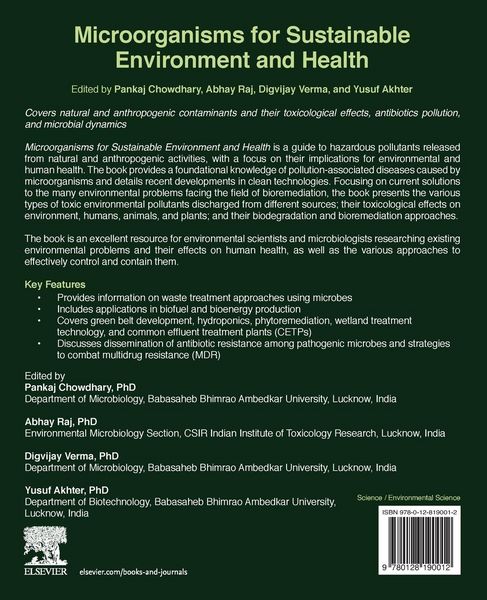
Microorganisms for Sustainable Environment and Health

147,99 €

inkl. gesetzl. MwSt., Versandkostenfrei


Beschreibung

Produktdetails

Einband

Taschenbuch

Erscheinungsdatum

03.08.2020

Herausgeber

Pankaj Chowdhary + weitere

Verlag

Elsevier Science & Technology

Seitenzahl

540

Maße (L/B/H)

23,5/19,1/2,8 cm

Gewicht

919 g

Sprache

Englisch

ISBN

978-0-12-819001-2

Beschreibung

Portrait

Pankaj Chowdhary currently works at the Department of Microbiology, at Babasaheb Bhimrao Ambedkar University (A Central University), Lucknow India. He received his Ph.D. in Environmental Microbiology from Department of Microbiology, at Babasaheb Bhimrao Ambedkar University (A Central University), Lucknow India. The focus of his research is the role of ligninolytic enzyme producing bacterial in the degradation of coloring compounds from distillery wastewater. He has published original research and review articles in peer-reviewed journals of high impact. He has also published many National and International book chapters & magazine articles on the biodegradation and bioremediation.
Dr. Abhay Raj is currently as Principal Scientist at CSIR-Indian Institute of Toxicology Research, Lucknow India. His R&D work focused mainly on development of microbial process for bioremediation of the industrial wastewaters mainly pulp and paper, tannery, and textile industries. His team had primarily engaged on screening and evaluation of bacterial strains for ligninolytic enzymes (LiP & Lac), basic mechanisms behind treatment and changes in the paper mill effluent toxicity after treatment. The developed bacterial consortium is being used to evaluate their feasibility for the treatment of pulp and paper mill effluent on bioreactor in an industrial set-up. Also, we are using bacterial biofilm approach to improve the tannery effluent treatment process. Abhay Raj is also working on development of an eco-friendly pulp bio-bleaching combination for application in paper industry. He is also working on the biochar technology for environmental remediation.
Digvijay Verma has been working in the field of genomics and metagenomics for the last 10 years. He has expertise in heterologous expression of genes from extreme environments into the various Gram-negative and Gram-positive bacterial hosts. His research work on proteins reflects his extensive understanding of industrial biotechnology and extremophilic microorganisms. His laboratory is engaged in exploiting therapeutic bioactive molecules from extreme habitats using metagenomic approaches. He is also in a phase of developing pipelines for robust microbiome analysis. Dr. Verma has also been working on analyzing the oral microbiome from the Indian community and the influence of external risk factors on the overall oral bacterial composition. He is a life member of many scientific organizations like the Association of Microbiologists of India (AMI), Biotech Research Society of India (BRSI), and Indian Science Congress (ISC). He is coauthor of Microorganisms for Sustainable Environment and Health (Elsevier, 2020).
Yusuf Akhter is an Assistant Professor at Babsaheb Bhimrao Ambedkar University, Lucknow, India. He received his PhD in Biochemistry from University of Hyderabad. Dr Dr. Akhter has carried out his research at the European Molecular Biology Laboratory-Hamburg (Germany) and the Centre for DNA Fingerprinting and Diagnostics (India) in the laboratories of biochemistry and structural biology. He was awarded with a DAAD fellowship for his doctoral studies and an EMBO long term fellowship for his post-doctoral research at EMBL-Hamburg. He also serves as an editorial board member/reviewer for several international journals published by Nature publishing group, Biomed central, PLoS, Elsevier, Taylor & Francis, Bentham Science Publishers, and Springer. He was a visiting lecturer at Universiti Technology Malaysia. His research interests are focused on therapeutic targets from microbial pathogens and microbes for sustainable development. His research group uses computational and molecular biology techniques to analyze biomolecular patterns and structures and their functional mechanisms.

Produktdetails

Einband

Taschenbuch

Erscheinungsdatum

03.08.2020

Herausgeber

Verlag

Elsevier Science & Technology

Seitenzahl

540

Maße (L/B/H)

23,5/19,1/2,8 cm

Gewicht

919 g

Sprache

Englisch

ISBN

978-0-12-819001-2

Herstelleradresse

Libri GmbH
Europaallee 1
36244 Bad Hersfeld
DE

Email: gpsr@libri.de

Noch keine Bewertungen vorhanden

Verfassen Sie die erste Bewertung zu diesem Artikel

Helfen Sie anderen Kundinnen und Kunden durch Ihre Meinung.

Kundinnen und Kunden meinen

Bewertungen (0)

Die Leseprobe wird geladen.
  • Produktbild: Microorganisms for Sustainable Environment and Health
  • Produktbild: Microorganisms for Sustainable Environment and Health
  • 1. Recent advancement in the biotechnological application of lignin Peroxidase and its future prospects

    2. Microbes mediated approaches for environmental waste management

    3. Actinobacteria for the effective removal of toxic dyes

    4. Arsenic toxicity: Adverse effect and recent advance in microbes mediated bioremediation

    5. Biofilm mediated bioremediation and other applications

    6. Waste Treatment Approaches for environmental sustainability

    7. Biodegradation of Environmental Pollutant through Pathways Engineering and Genetically Modified Organisms (GMOs) Approaches

    8. Exploring the microbiome of smokeless tobacco

    9. Microbial ligninolytic enzymes and their role in bioremediation

    10. Recent advancements in microalgal-induced remediation of wastewaters

    11. Cyanobacteria as source of novel antimicrobials: a boon to mankind

    12. Composite nanostructure: A potential materials for environmental safety and health

    13. In Silico bioremediation strategies for removal of environmental pollutants released from paper mills using bacterial ligninolytic enzymes

    14. Potential Application of Microbial Pectinases: An overview

    15. Understanding and Combating the Antibiotic Resistance Crisis

    16. Multidrug resistance in pathogenic microorganisms

    17. Microbial hydrogen production: Fundamentals to application

    18. Antibiotics: Mechanisms of Action and Modern Challenges

    19. Food Poisoning Hazards and Their Consequences Over Food Safety

    20. Application of Microbial Consortia in Degradation and Detoxification of Industrial Pollutants

    21. Environmental pollution: Causes, effects, and the remedies

    22. Microplastic degradation by bacteria in aquatic ecosystem

    23. The role of microbial pathogens in cancer development: A potential guide to new anticancer drugs