Beschreibung

Produktdetails

Einband

Taschenbuch

Erscheinungsdatum

26.06.2020

Herausgeber

Inamuddin + weitere

Verlag

Elsevier Science & Technology

Seitenzahl

412

Maße (L/B/H)

23,5/19,1/2,1 cm

Gewicht

706 g

Sprache

Englisch

ISBN

978-0-12-819542-0

Beschreibung

Portrait

Dr. Inamuddin, is an Assistant professor at Department of Applied Chemistry, Zakir Husain College of Engineering and Technology, Faculty of Engineering and Technology, Aligarh Muslim University, Aligarh, India. He has extensive research experience in multidisciplinary fields of analytical chemistry, materials chemistry, electrochemistry, renewable energy and environmental science. He has worked on different research projects funded by various government agencies and universities and is the recipient of awards, including the Fast-Track Young Scientist Award and young researcher of the year award-2020 of the university. His current research interests include ion exchange materials, a sensor for heavy metal ions, biofuel cells, supercapacitors and bending actuators.

Prof. Dr. Rajender Boddula currently serves as an Associate Professor, in the School of Sciences, at Woxsen University, Hyderabad, Telangana, India. He is also an Adjunct Professor, at Graphic Era Hill University, in India. He attained his MSc in Organic Chemistry, (Kakatiya University, 2008) and PhD from Kakatiya University and CSIR-Indian Institute of Chemical Technology, Hyderabad, India (2014). His doctoral work focused on polyaniline-based materials for supercapacitor and catalytic applications, which laid a strong interdisciplinary foundation for his research career. Following his doctorate, Dr. Boddula pursued a distinguished postdoctoral trajectory across several major global research centers. He was awarded the Chinese Academy of Sciences President's International Fellowship (CAS-PIFI) and conducted research at the National Center for Nanoscience and Technology, in Beijing. He further refined his expertise as a postdoctoral researcher at the National Tsing-Hua University, in Taiwan, and at the Center for Advanced Materials, at Qatar University. His postdoctoral work encompassed advanced novel nanomaterials, drug delivery, catalysis, hydrogen energy, and CO? valorization, driving sustainable solutions for energy and environmental challenges. Professor Boddula' s major research interests span next-gen materials, green catalysis, environmental remediation, sustainable energy conversion & storage technologies, and hydrogen energy.

Prof. Abdullah M. Asiri is the Head of the Chemistry Department at King Abdulaziz University since October 2009 and he is the founder and the Director of the Center of Excellence for Advanced Materials Research (CEAMR) since 2010 till date. He is the Professor of Organic Photochemistry. His research interest covers color chemistry, synthesis of novel photochromic and thermochromic systems, synthesis of novel coloring matters and dyeing of textiles, materials chemistry, nanochemistry and nanotechnology, polymers and plastics. A major achievement of Prof. Asiri is the discovery of tribochromic compounds, a class of compounds which change from slightly or colorless to deep colored when subjected to small pressure or when grind. This discovery was introduced to the scientific community as a new terminology published by IUPAC in 2000. This discovery was awarded a patent from European Patent office and from UK patent. He is also a member of the Editorial Board of various journals of international repute. He is the Vice- President of Saudi Chemical Society (Western Province Branch). He holds four USA patents, more than 800 Publications in international journals, seven book chapters, and ten books

Produktdetails

Einband

Taschenbuch

Erscheinungsdatum

26.06.2020

Herausgeber

Verlag

Elsevier Science & Technology

Seitenzahl

412

Maße (L/B/H)

23,5/19,1/2,1 cm

Gewicht

706 g

Sprache

Englisch

ISBN

978-0-12-819542-0

Herstelleradresse

Libri GmbH
Europaallee 1
36244 Bad Hersfeld
DE

Email: gpsr@libri.de

Noch keine Bewertungen vorhanden

Verfassen Sie die erste Bewertung zu diesem Artikel

Helfen Sie anderen Kundinnen und Kunden durch Ihre Meinung.

Kundinnen und Kunden meinen

Bewertungen (0)

Die Leseprobe wird geladen.
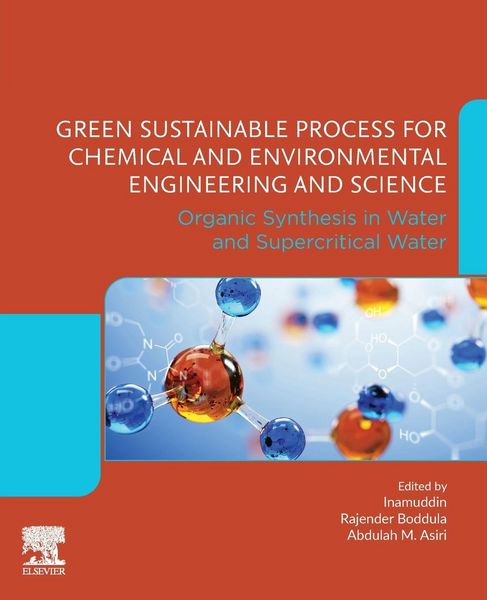
  • Produktbild: Green Sustainable Process for Chemical and Environmental Engineering and Science
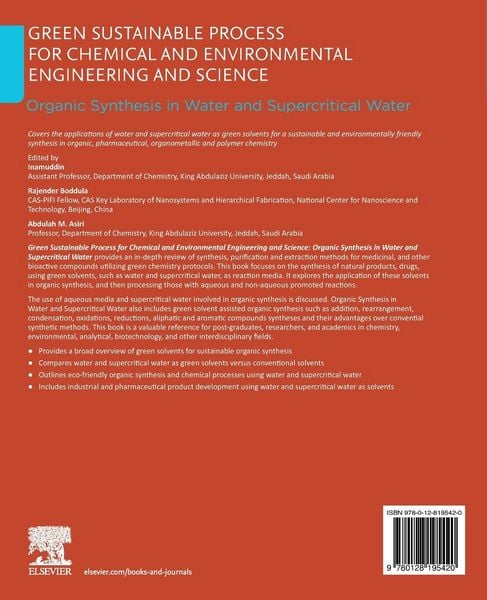
  • Produktbild: Green Sustainable Process for Chemical and Environmental Engineering and Science
  • 1. Introduction
    2. Oxidation and reduction reactions in water
    3. Oxidation and reduction reactions in supercritical water
    4. Micelle-assisted organic synthesis in water
    5. Organic synthesis in aqueous vs non-aqueous media
    6. Protection and deprotection reactions in water
    7. Regioselective synthesis in water
    8. Stereoselective organic synthesis in water
    9. Stereospecific organic synthesis in water
    10. Green organic synthesis in supercritical water
    11. Addition-type reactions in water
    12. Condensation reactions in water
    13. Alkylation reactions in water
    14. Ring-opening reactions in water
    15. Value-added chemical synthesis in supercritical water
    16. Organometallics synthesis in supercritical water
    17. Allylation reactions in water
    18. Olefin methasis in water
    19. Phenolic compounds synthesis in water
    20. Cycloadditions and Diels-Alder reactions in water
    21. Fluoroorganics in water
    22. Polymer synthesis in water and supercritical water
    23. Heterocyclics synthesis in water
    24. Hydrogenation reactions in water
    25. Cyclodextrin-assisted organic synthesis in water
    26. Biological-active organic synthesis in water
    27. Catalyst-free organic synthesis in water
    28. Multi component organic synthesis in water
    29. Grignard reactions in water
    30. C-H activation reactions in water
    31. Carbohydrate synthesis in supercritical water
    32. C-N formation reactions in water
    33. Coupling reactions in water
    34. Bio-fuel production in water
    35. Halide synthesis in water
    36. Employing green catalysis for organic synthesis in supercritical water
    37. State of the art and perspectives of aqueous organic synthesis