Gutscheinbedingungen

**Gültig vom 07.09.2026 bis 09.09.2026 | Gültig für nicht preisgebundene fremdsprachige Bücher | Einzelne Artikel können ausgeschlossen sein | Online auf www.bücher.de einlösbar | Click & Collect nur mit Online-Zahlung (Paypal/Kreditkarte) vorab | Nicht kombinierbar mit anderen Gutscheinen oder Preisaktionen | Nur einmal pro Einkauf einlösbar | Gutschein wird auf max. 500€ Bestellwert angerechnet | Keine Barauszahlung | Nicht gültig für Versandkosten und Services

  • Produktbild: Nanosensors for Smart Cities
  • Produktbild: Nanosensors for Smart Cities

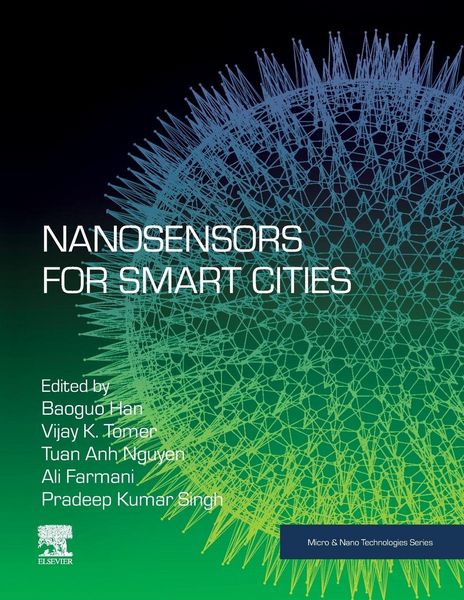
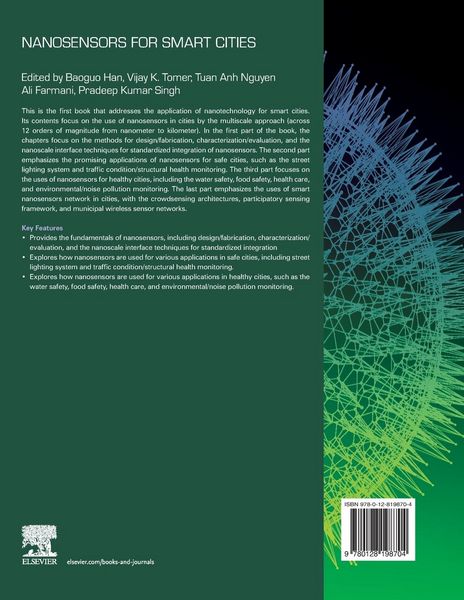
Nanosensors for Smart Cities

244,99 €

inkl. gesetzl. MwSt., Versandkostenfrei


Beschreibung

Produktdetails

Einband

Taschenbuch

Erscheinungsdatum

18.02.2020

Herausgeber

Baoguo Han + weitere

Verlag

Elsevier Science & Technology

Seitenzahl

588

Maße (L/B/H)

27,9/21,6/3 cm

Gewicht

1345 g

Sprache

Englisch

ISBN

978-0-12-819870-4

Beschreibung

Portrait

Baoguo Han is Professor of Civil Engineering, Dalian University of Technology, China. His research interests include multifunctional/smart materials and structures, high performance concrete and structures, and nanotechnology in civil engineering.
Vijay K. Tomer is a Fulbright-Nehru postdoctoral fellow at Berkeley Sensor & Actuator Center (BSAC), University of California, Berkeley, USA. His research focuses on nanostructures-based gas sensors for environmental monitoring.
Tuan Anh Nguyen is a Senior Principal Research Scientist at the Institute for Tropical Technology, Vietnam Academy of Science and Technology, Hanoi, Vietnam. He received a BS in physics from Hanoi University in 1992, a BS in economics from Hanoi National Economics University in 1997, and a PhD in chemistry from the Paris Diderot University, France, in 2003. He was a Visiting Scientist at Seoul National University, South Korea, in 2004, and the University of Wollongong, Australia, in 2005. He then worked as a Postdoctoral Research Associate and Research Scientist at Montana State University, United States in 2006-09. In 2012 he was appointed as the Head of the Microanalysis Department at the Institute for Tropical Technology. His research areas of interest include smart sensors, smart networks, smart hospitals, smart cities, complexiverse, and digital twins. He has edited more than 74 books for Elsevier, 12 books for CRC Press, 1 book for Springer, 1 book for RSC, and 2 books for IGI Global. He is the Editor-in-Chief of Kenkyu Journal of Nanotechnology & Nanoscience.
Dr. Ali Farmani is an Assistant Professor in the Department of Electrical Engineering at Lorestan University in Khorramabad, Iran. His research focuses on optical nanostructured materials.
Pradeep Kumar Singh is Assistant Professor at the Department of Computer Science & Engineering, Jaypee University of Information Technology, India. His research focuses on smart nanosensors for communication technologies.

Produktdetails

Einband

Taschenbuch

Erscheinungsdatum

18.02.2020

Herausgeber

Verlag

Elsevier Science & Technology

Seitenzahl

588

Maße (L/B/H)

27,9/21,6/3 cm

Gewicht

1345 g

Sprache

Englisch

ISBN

978-0-12-819870-4

Herstelleradresse

Libri GmbH
Europaallee 1
36244 Bad Hersfeld
DE

Email: gpsr@libri.de

Noch keine Bewertungen vorhanden

Verfassen Sie die erste Bewertung zu diesem Artikel

Helfen Sie anderen Kundinnen und Kunden durch Ihre Meinung.

Kundinnen und Kunden meinen

Bewertungen (0)

Die Leseprobe wird geladen.
  • Produktbild: Nanosensors for Smart Cities
  • Produktbild: Nanosensors for Smart Cities
  • PART 1: BASIC PRINCIPLES
    1. Nanosensors for smart cities: An introduction
    2. Advanced Methods for Design and Fabrication of nanosensors
    3. Methods for design and fabrication of nanosensors and their electrochemical applications on pharmaceutical compounds
    4. Methods for characterization and evaluation of Chemoresistive nanosensors
    5. Tools and techniques for characterization and evaluation of nanosensors
    6. Nanoscale interface techniques for standardized integration
    7. A novel triboelectric nanogenerator based on electrospun nanofibers and its application as a self-powered nanosensor

    PART 2: NANOSENSORS FOR MONITORING AND MANAGING THE REGULAR OPERATIONS AND SERVICES
    8. Conducting polymer based nanobiosensors
    9. Magnetic nanosensors and their potential applications
    10. Fabrication and functionalization of nanochannels for sensing applications
    11. Nanosensors for traffic condition monitoring
    12. Nanosensors for street lighting system
    13. Nanosensors for Structural Health Monitoring

    PART 3: NANOSENSORS FOR SAFE CITIES
    14. Nanosensors for monitoring indoor pollution in smart cities
    15. Nanosensors for Monitoring Environmental Pollutions
    16. Nanosensors for water safety
    17. Electrochemical virus detections with nanobiosensors
    18. Nanosensors for the detection of viruses
    19. Nanosensors for food safety
    20. Application of Nanosensors for Food safety
    21. Nanosensor Networks for Smart Health Care
    22. Nanosensor Networks for Health Care Applications
    23. Optical nanosensors for cancer and virus detections
    24. Nanosensors for health care
    25. SERS Nanosensor for Environmental Pollutions
    26. Nanosensors for exhaled breath monitoring as a possible tool for noninvasive diabetes detection
    27. Chemo/Bio nanosensors for medical applications

    PART 4: NANOSENSORS FOR HEALTHY CITIES
    28. Municipal Wireless Sensor Networks
    29. Crowdsensing architectures for smart cities
    30. Participatory Sensing Framework