
Fluid and Thermodynamics Volume 3: Structured and Multiphase Fluids
-
- Hardcover
- Taschenbuch ausgewählt
- eBook
-
Sprache:Englisch
-
Auflage:Softcover reprint of the original 1st ed. 2018
145,99 €
inkl. gesetzl. MwSt.,
Lieferung nach Hause
Beschreibung
Produktdetails
Einband
Taschenbuch
Erscheinungsdatum
11.02.2019
Verlag
SpringerSeitenzahl
627
Maße (L/B/H)
23,5/15,5/3,6 cm
Gewicht
991 g
Auflage
Softcover reprint of the original 1st ed. 2018
Sprache
Englisch
ISBN
978-3-030-08527-8
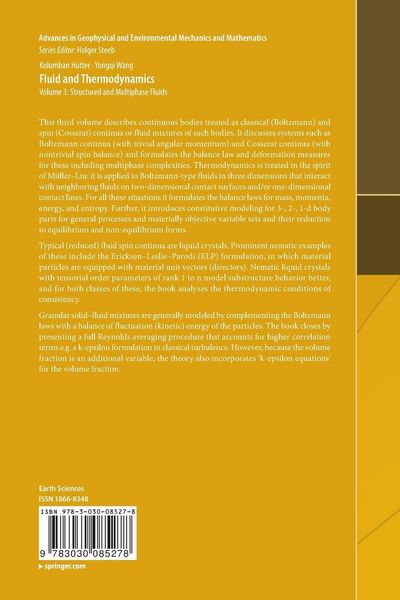
This third volume describes continuous bodies treated as classical (Boltzmann) and spin (Cosserat) continua or fluid mixtures of such bodies. It discusses systems such as Boltzmann continua (with trivial angular momentum) and Cosserat continua (with nontrivial spin balance) and formulates the balance law and deformation measures for these including multiphase complexities. Thermodynamics is treated in the spirit of Müller–Liu: it is applied to Boltzmann-type fluids in three dimensions that interact with neighboring fluids on two-dimensional contact surfaces and/or one-dimensional contact lines. For all these situations it formulates the balance laws for mass, momenta, energy, and entropy. Further, it introduces constitutive modeling for 3-, 2-, 3-d body parts for general processes and materially objective variable sets and their reduction to equilibrium and non-equilibrium forms.
Typical (reduced) fluid spin continua are liquid crystals. Prominent nematic examples of these include the Ericksen–Leslie–Parodi (ELP) formulation, in which material particles are equipped with material unit vectors (directors). Nematic liquid crystals with tensorial order parameters of rank 1 to n model substructure behavior better, and for both classes of these, the book analyzes the thermodynamic conditions of consistency.
Granular solid–fluid mixtures are generally modeled by complementing the Boltzmann laws with a balance of fluctuation (kinetic) energy of the particles. The book closes by presenting a full Reynolds averaging procedure that accounts for higher correlation terms e.g. a k-epsilon formulation in classical turbulence. However, because the volume fraction is an additional variable, the theory also incorporates ‘k-epsilon equations’ for the volume fraction.Kundinnen und Kunden meinen
Verfassen Sie die erste Bewertung zu diesem Artikel
Helfen Sie anderen Kund*innen durch Ihre Meinung
Kurze Frage zu unserer Seite
Vielen Dank für dein Feedback
Wir nutzen dein Feedback, um unsere Produktseiten zu verbessern. Bitte habe Verständnis, dass wir dir keine Rückmeldung geben können. Falls du Kontakt mit uns aufnehmen möchtest, kannst du dich aber gerne an unseren Kund*innenservice wenden.
zum Kundenservice