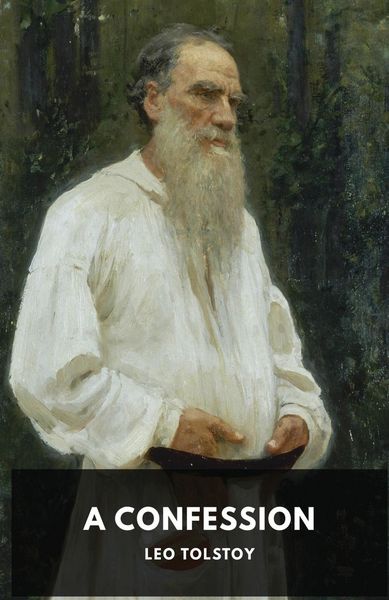
A Confession Leo Tolstoy
-
- Hardcover
- Taschenbuch ausgewählt
- eBook
- Hörbuch
-
Sprache:Englisch
- Englisch 19,99 € ausgewählt
- Französisch 9,90 €
-
Verlag:Les prairies numériques
- W. W. Norton & Company 14,99 €
- Penguin Books UK 10,59 €
- Binker North 13,99 €
- Merchant Books 11,99 €
- The Library of Alexandria 23,99 €
- True Sign Publishing House 15,99 €
- Dover Publications 7,99 €
- Aegypan 15,99 €
- Kessinger Publishing, LLC 19,99 €
- Les prairies numériques 19,99 € ausgewählt
- Martino Fine Books 11,99 €
- Culturea 19,95 €
19,99 €
inkl. gesetzl. MwSt.,
Beschreibung
Produktdetails
Einband
Taschenbuch
Erscheinungsdatum
13.07.2019
Verlag
Les prairies numériquesSeitenzahl
80
Maße (L/B/H)
19,8/12,9/0,5 cm
Gewicht
96 g
Sprache
Englisch
ISBN
978-2-491-25119-2
The book is a brief autobiographical story of the author's struggle with a mid-life existential crisis. It describes his search for the answer to the ultimate philosophical question: "If God does not exist, since death is inevitable, what is the meaning of life?." Without the answer to this, for him, life had become "impossible". The story begins with the Eastern fable of the dragon in the well. A man is chased by a beast into a well, at the bottom of which is a dragon. The man clings to a branch that is being gnawed on by two mice (one black, one white, representing night and day and the relentless march of time). The man is able to lick two drops of honey (representing Tolstoy's love of his family and his writing), but because death is inevitable, he no longer finds the honey sweet. Tolstoy goes on to describe four possible attitudes towards this dilemma. The first is ignorance. If one is oblivious to the fact that death is approaching, life becomes bearable. The problem with this for him personally is that he is not ignorant. Having become conscious of the reality of death, there is no going back. The second possibility is what Tolstoy describes as Epicureanism. Being fully aware that life is ephemeral, one can enjoy the time one has. Tolstoy's problem with this is essentially moral. He states that Epicureanism may work fine and well for the minority who can afford to live "the good life," but one would have to be morally empty to be able to ignore the fact that the vast majority of people do not have access to the wealth necessary to live this kind of life. Tolstoy next states that the most intellectually honest response to the situation would be suicide. In the face of the inevitability of death and assuming that God does not exist, why wait? Why pretend that this vale of tears means anything when one can just cut to the chase? For himself, however, Tolstoy admits he is too cowardly to follow through on the most logically consistent response. Finally, Tolstoy says that the fourth that he is taking is the one of just holding on, living despite the absurdity of it, because he is not willing or able to do anything else. So it seems utterly hopeless - at least without God. So Tolstoy turns to the question of God's existence. After despairing of his attempts to find answers in classic philosophical arguments for the existence of God (e.g. the Cosmological Argument, which reasons that God must exist based on the need to ascribe an original cause to the universe), Tolstoy turns to a more mystical, intuitive affirmation of God's presence. He states that as soon as he said "God is Life," life was once again suffused with meaning. This faith could be interpreted as a Kierkegaardian leap, or a disingenuous compromise, but Tolstoy actually seems to be describing a more Eastern approach to what God is. The identification of God with life suggests a more monistic (or panentheistic) metaphysics characteristic of Eastern religions, and this is why rational arguments ultimately fall short of establishing God's existence: by misidentifying God, philosophical arguments miss the point. Tolstoy's original title for this work indicates as much, and his own personal "conversion" is suggested by an epilogue that describes a dream he had some time after completing the body of the text, confirming that he had undergone a radical personal and spiritual transformation.
Noch keine Bewertungen vorhanden
Verfassen Sie die erste Bewertung zu diesem Artikel
Helfen Sie anderen Kundinnen und Kunden durch Ihre Meinung.
Kurze Frage zu unserer Seite
Vielen Dank für dein Feedback
Wir nutzen dein Feedback, um unsere Produktseiten zu verbessern. Bitte habe Verständnis, dass wir dir keine Rückmeldung geben können. Falls du Kontakt mit uns aufnehmen möchtest, kannst du dich aber gerne an unseren Kund*innenservice wenden.
zum Kundenservice