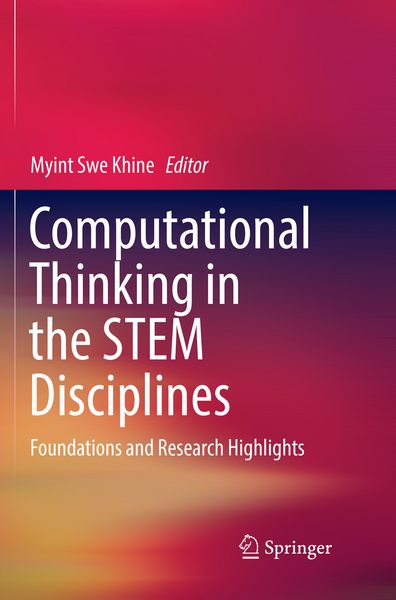
Computational Thinking in the STEM Disciplines Foundations and Research Highlights
-
- Hardcover
- Taschenbuch ausgewählt
- eBook
-
Sprache:Englisch
145,99 €
inkl. gesetzl. MwSt.,
Beschreibung
Produktdetails
Einband
Taschenbuch
Erscheinungsdatum
22.12.2018
Abbildungen
XVII, 325 p. 122 illus.
Herausgeber
Myint Swe KhineVerlag
SpringerSeitenzahl
325
Maße (L/B/H)
23,5/15,5/1,9 cm
Gewicht
522 g
Auflage
Softcover reprint of the original 1st edition 2018
Sprache
Englisch
ISBN
978-3-030-06683-3
This book covers studies of computational thinking related to linking, infusing, and embedding computational thinking elements to school curricula, teacher education and STEM related subjects. Presenting the distinguished and exemplary works by educators and researchers in the field highlighting the contemporary trends and issues, creative and unique approaches, innovative methods, frameworks, pedagogies and theoretical and practical aspects in computational thinking.
A decade ago the notion of computational thinking was introduced by Jeannette Wing and envisioned that computational thinking will be a fundamental skill that complements to reading, writing and arithmetic for everyone and represents a universally applicable attitude. The computational thinking is considered a thought processes involved in a way of solving problems, designing systems, and understanding human behaviour. Assimilating computational thinking at young age will assist them to enhance problem solving skills, improve logical reasoning, and advance analytical ability - key attributes to succeed in the 21st century.Educators around the world are investing their relentless effort in equipping the young generation with real-world skills ready for the demand and challenges of the future. It is commonly believed that computational thinking will play a pivotal and dominant role in this endeavour. Wide-ranging research on and application of computational thinking in education have been emerged in the last ten years. This book will document attempts to conduct systematic, prodigious and multidisciplinary research in computational thinking and present their findings and accomplishments.
Noch keine Bewertungen vorhanden
Verfassen Sie die erste Bewertung zu diesem Artikel
Helfen Sie anderen Kundinnen und Kunden durch Ihre Meinung.
Kurze Frage zu unserer Seite
Vielen Dank für dein Feedback
Wir nutzen dein Feedback, um unsere Produktseiten zu verbessern. Bitte habe Verständnis, dass wir dir keine Rückmeldung geben können. Falls du Kontakt mit uns aufnehmen möchtest, kannst du dich aber gerne an unseren Kund*innenservice wenden.
zum Kundenservice