KI-Beratung Beta

Gutscheinbedingungen

**Gültig vom 23.11. bis 30.11.2026 | Gültig für nicht preisgebundene fremdsprachige Bücher | Einzelne Artikel können ausgeschlossen sein | Online auf www.bücher.de einlösbar | Click & Collect nur mit Online-Zahlung (Paypal/Kreditkarte) vorab | Nicht kombinierbar mit anderen Gutscheinen oder Preisaktionen | Nur einmal pro Einkauf einlösbar | Gutschein wird auf max. 500€ Bestellwert angerechnet | Keine Barauszahlung | Nicht gültig für Versandkosten und Services

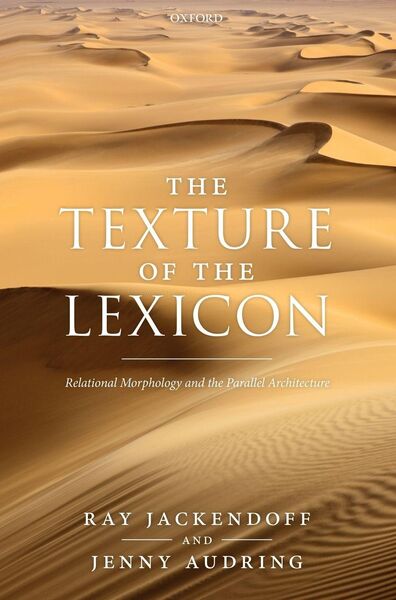
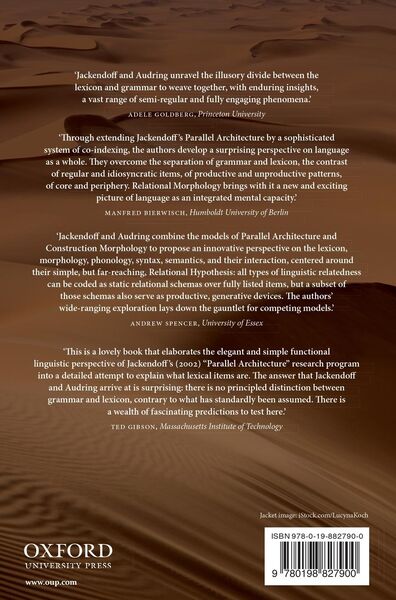
  • Produktbild: Texture of the Lexicon
  • Produktbild: Texture of the Lexicon

Texture of the Lexicon Relational Morphology and the Parallel Architecture

104,99 €

inkl. gesetzl. MwSt., Versandkostenfrei


Beschreibung

In this volume, Ray Jackendoff and Jenny Audring embark on a major reconceptualization of linguistic theory as seen through the lens of morphology. Their approach, Relational Morphology, extends the Parallel Architecture developed by Jackendoff in Foundations of Language (2002), Simpler Syntax (2005),...

Beschreibung

In this volume, Ray Jackendoff and Jenny Audring embark on a major reconceptualization of linguistic theory as seen through the lens of morphology. Their approach, Relational Morphology, extends the Parallel Architecture developed by Jackendoff in Foundations of Language (2002), Simpler Syntax (2005), and Meaning and the Lexicon (2010). The framework integrates morphology into the overall architecture of language, enabling it to interact insightfully with phonology, syntax, semantics, and above all, the lexicon. The first part of the book situates morphology in the language faculty, and introduces a novel formalism that unifies the treatment of all morphological patterns, inflectional or derivational, systematic or marginal. Central to the theory is the lexicon, which both incorporates the rules of grammar and explicitly encodes relationships among words and among grammatical patterns. Part II puts the theory to the test, applying it to a wide range of familiar and less familiar morphological phenomena. Part III connects Relational Morphology with issues of language processing and language acquisition, and shows how its formal tools can be extended to a variety of linguistic and nonlinguistic phenomena outside morphology. The value of Relational Morphology thus lies not only in the fact that it can account for a range of morphological phenomena, but also in how it integrates linguistic theory, psycholinguistics, and human cognition.

Rezension

The Texture of the Lexicon is a reader-friendly introduction to the framework of Relational Morphology that complements the Parallel Architecture approach. I believe that readers interested in morphology at large will find something interesting in this read. David M. Karaj, Linguist

Produktdetails

Einband

Gebundene Ausgabe

Erscheinungsdatum

18.02.2020

Verlag Oxford University Press
Seitenzahl

328

Produktdetails

Einband

Gebundene Ausgabe

Erscheinungsdatum

18.02.2020

Verlag Oxford University Press
Seitenzahl

328

Maße (L/B/H)

25/17,5/2,2 cm

Gewicht

690 g

Sprache

Englisch

ISBN

978-0-19-882790-0

Herstelleradresse

Libri GmbH
Europaallee 1
36244 Bad Hersfeld
DE

Email: gpsr@libri.de

Noch keine Bewertungen vorhanden

Verfassen Sie die erste Bewertung zu diesem Artikel

Helfen Sie anderen Kundinnen und Kunden durch Ihre Meinung.

Kundinnen und Kunden meinen

Bewertungen (0)

  • Produktbild: Texture of the Lexicon
  • Produktbild: Texture of the Lexicon
    • Part I: The Theory
    • 1: Situating morphology
    • 2: The functions of schemas
    • 3: Motivation in the lexicon
    • Part II: Using and refining the tools
    • 4: Formalizing morphological phenomena
    • 5: Formalizing inflection
    • 6: Morphologically conditioned phonological alternations
    • Part III: Beyond morphological theory
    • 7: Language processing and language acquisition through the lens of Relational Morphology
    • 8: Applying the tools to other domains
    • 9: Coda: What have we done?
    • References
    • Index of words and schemas
    • Index of authors and subjects