Gutscheinbedingungen

**Gültig vom 24.08.2026 bis 26.08.2026 | Gültig für nicht preisgebundene fremdsprachige Bücher | Einzelne Artikel können ausgeschlossen sein | Online auf www.bücher.de einlösbar | Click & Collect nur mit Online-Zahlung (Paypal/Kreditkarte) vorab | Nicht kombinierbar mit anderen Gutscheinen oder Preisaktionen | Nur einmal pro Einkauf einlösbar | Gutschein wird auf max. 500€ Bestellwert angerechnet | Keine Barauszahlung | Nicht gültig für Versandkosten und Services

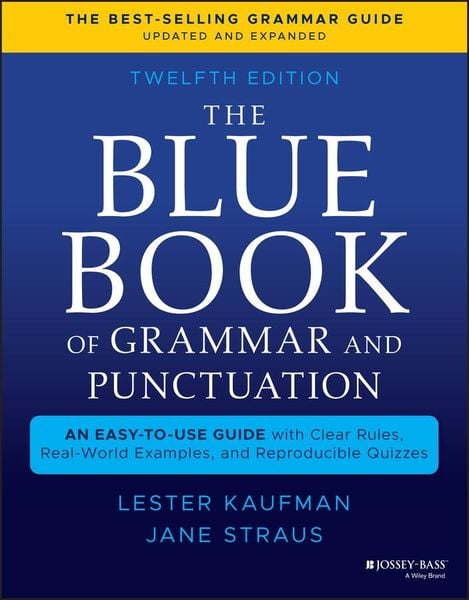
Produktbild: The Blue Book of Grammar and Punctuation

The Blue Book of Grammar and Punctuation An Easy-to-Use Guide with Clear Rules, Real-World Examples, and Reproducible Quizzes

17,99 €

inkl. gesetzl. MwSt., Versandkostenfrei


Beschreibung

Produktdetails

Einband

Taschenbuch

Erscheinungsdatum

24.06.2021

Verlag

John Wiley & Sons Inc

Seitenzahl

242

Maße (L/B/H)

21,5/27,2/1,5 cm

Gewicht

611 g

Farbe

Marine / Seidengrau

Auflage

12. Auflage

Sprache

Englisch

ISBN

978-1-119-65302-8

Beschreibung

Produktdetails

Einband

Taschenbuch

Erscheinungsdatum

24.06.2021

Verlag

John Wiley & Sons Inc

Seitenzahl

242

Maße (L/B/H)

21,5/27,2/1,5 cm

Gewicht

611 g

Farbe

Marine / Seidengrau

Auflage

12. Auflage

Sprache

Englisch

ISBN

978-1-119-65302-8

Herstelleradresse

Libri GmbH
Europaallee 1
36244 Bad Hersfeld
DE

Email: gpsr@libri.de

Noch keine Bewertungen vorhanden

Verfassen Sie die erste Bewertung zu diesem Artikel

Helfen Sie anderen Kundinnen und Kunden durch Ihre Meinung.

Kundinnen und Kunden meinen

Bewertungen (0)

Die Leseprobe wird geladen.
  • Produktbild: The Blue Book of Grammar and Punctuation
  • Preface and Acknowledgments xix

    About the Authors xxi

    Introduction xxiii

    1Grammar 1

    Finding Nouns, Verbs, and Subjects 1

    Definitions

    Noun

    Verb

    Subject

    Gerund

    Using verbs to find subjects

    Multiple subjects and verbs in a sentence

    Infinitives

    You as an understood subject

    Subject-Verb Agreement 4

    Singular vs. plural verbs

    Finding subjects before phrases beginning with of With or, either/or, and neither/nor

    Two singular subjects

    One singular and one plural subject

    With and

    With interrupting expressions

    With here or there

    With distances, periods of time, sums of money, etc.

    With portion words such as a lot, a majority, percent, some, all

    With collective nouns such as group, family, staff

    The subjunctive mood

    Irregular Verbs 9

    Clauses and Phrases 9

    Definitions

    Clause

    Independent clause

    Dependent clause

    Phrase

    Pronouns 10

    Definition: Pronoun

    Subject pronouns

    As the subject of the sentence

    Renaming the subject

    When who refers to a personal pronoun

    Object pronouns

    Subject and verb agreement with who, that, and which

    Subject and verb agreement with anyone, someone, each, etc.

    Following than or as

    Possessive pronouns

    Its vs. it's; who's vs. whose

    Reflexives: the -self pronouns

    Consistency with singular pronouns

    The singular they Pronouns linked with nouns by and

    Possessive adjectives vs. possessive pronouns

    Who vs. Whom 16

    They/Them method

    Common whom pitfall

    Whoever vs. Whomever 17

    Agreement with the verb in the dependent clause

    Dependent clause as the subject of the verb following the clause

    Who, That, Which 18

    Who, that, and which with people, groups, and things

    That with essential clauses

    Which with nonessential clauses

    When which can be used with essential clauses

    Adjectives and Adverbs 19

    Definitions

    Adjective

    Adverb

    Adjectives modifying nouns and pronouns

    Adverbs modifying verbs, adjectives, and adverbs

    When to add -ly

    Sense verbs: taste, smell, look, feel, etc.

    Good vs. well

    Well as an adjective when referring to health

    Comparisons, such as -er vs. -est and more vs. most This, that, these, and those

    Prepositions 22

    Definition: preposition

    Ending a sentence with a preposition

    Avoiding extra prepositions

    Like As, as if, as though, the way of vs. have Different from vs. different than In vs. into

    Effective Writing 25

    Concrete vs. vague language

    Active vs. passive voice

    Overuse of there is, there are, it is, it was, etc.

    Double negatives

    Parallel construction

    Dangling modifiers

    Misplaced modifiers

    Fragments

    Dialogue

    2 Punctuation 31

    Spacing with Punctuation 31

    Periods 31

    With complete sentences

    With abbreviations at the end of a sentence

    Replacing periods with question marks and exclamation points

    Commas 32

    To separate three or more items

    To separate adjectives

    With two independent clauses

    Run-on sentences or comma splices

    Joined by connectors such as and, or, but, etc.

    When the subject does not appear in front of the second verb

    With because

    Starting a sentence with a dependent clause vs. an independent clause

    With nonessential words, clauses, and phrases

    With sufficiently identified noun

    With introductory words

    To set off interrupting expressions

    With names

    With dates

    With city and state

    With Jr. and Sr.

    With degrees and titles

    With quotations

    T