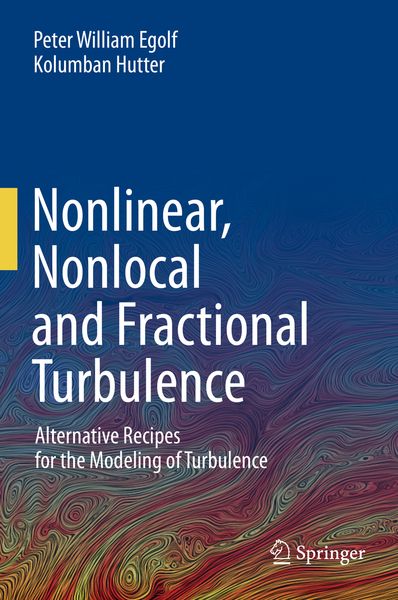
Nonlinear, Nonlocal and Fractional Turbulence Alternative Recipes for the Modeling of Turbulence
135,99 €
inkl. gesetzl. MwSt.,
Lieferung nach Hause
Beschreibung
Produktdetails
Einband
Gebundene Ausgabe
Erscheinungsdatum
03.04.2020
Abbildungen
XXXVII, 119 illus., 26 illus. in color., farbige Illustrationen, schwarz-weiss Illustrationen
Verlag
SpringerSeitenzahl
445
Maße (L/B/H)
24,1/16/3,1 cm
Gewicht
842 g
Auflage
1st ed. 2020
Sprache
Englisch
ISBN
978-3-030-26032-3
Experts of fluid dynamics agree that turbulence is nonlinear and nonlocal. Because of a direct correspondence, nonlocality also implies fractionality. Fractional dynamics is the physics related to fractal (geometrical) systems and is described by fractional calculus. Up-to-present, numerous criticisms of linear and local theories of turbulence have been published. Nonlinearity has established itself quite well, but so far only a very small number of general nonlocal concepts and no concrete nonlocal turbulent flow solutions were available.
This book presents the first analytical and numerical solutions of elementary turbulent flow problems, mainly based on a nonlocal closure. Considerations involve anomalous diffusion (Lévy flights), fractal geometry (fractal- β , bi-fractal and multi-fractal model) and fractional dynamics. Examples include a new ‘law of the wall’ and a generalization of Kraichnan’s energy-enstrophy spectrum that is in harmony with non-extensive and non-equilibrium thermodynamics (Tsallis thermodynamics) and experiments. Furthermore, the presented theories of turbulence reveal critical and cooperative phenomena in analogy with phase transitions in other physical systems, e.g., binary fluids, para-ferromagnetic materials, etc.; the two phases of turbulence identifying the laminar streaks and coherent vorticity-rich structures.
This book is intended, apart from fluids specialists, for researchers in physics, as well as applied and numerical mathematics, who would like to acquire knowledge about alternative approaches involved in the analytical and numerical treatment of turbulence.
Kundinnen und Kunden meinen
Verfassen Sie die erste Bewertung zu diesem Artikel
Helfen Sie anderen Kund*innen durch Ihre Meinung
Kurze Frage zu unserer Seite
Vielen Dank für dein Feedback
Wir nutzen dein Feedback, um unsere Produktseiten zu verbessern. Bitte habe Verständnis, dass wir dir keine Rückmeldung geben können. Falls du Kontakt mit uns aufnehmen möchtest, kannst du dich aber gerne an unseren Kund*innenservice wenden.
zum Kundenservice