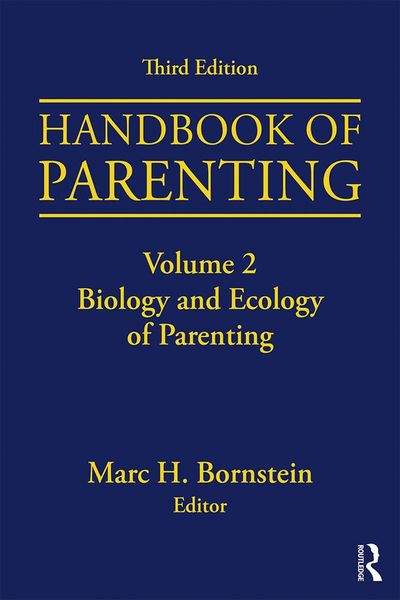
Handbook of Parenting Volume 2: Biology and Ecology of Parenting, Third Edition
-
- Hardcover
- Taschenbuch
- eBook ausgewählt
-
Form:Einzelkauf Download
-
Sprache:Englisch
-
eBook Format:PDF
- ePUB 3 125,99 €
- PDF 158,99 € ausgewählt
-
Auflage:3. Auflage
158,99 €
inkl. gesetzl. MwSt.Beschreibung
Produktdetails
Format
Kopierschutz
Ja
Family Sharing
Nein
Text-to-Speech
Nein
Erscheinungsdatum
08.03.2019
Herausgeber
Marc H. BornsteinVerlag
Taylor & Francis eBooksSeitenzahl
564 (Printausgabe)
Dateigröße
7989 KB
Auflage
3. Auflage
Sprache
Englisch
EAN
9780429685897
This highly anticipated third edition of the Handbook of Parenting brings together an array of field-leading experts who have worked in different ways toward understanding the many diverse aspects of parenting. Contributors to the Handbook look to the most recent research and thinking to shed light on topics every parent, professional, and policymaker wonders about. Parenting is a perennially "hot" topic. After all, everyone who has ever lived has been parented, and the vast majority of people become parents themselves. No wonder bookstores house shelves of "how-to" parenting books, and magazine racks in pharmacies and airports overflow with periodicals that feature parenting advice. However, almost none of these is evidence-based. The Handbook of Parenting is. Period. Each chapter has been written to be read and absorbed in a single sitting, and includes historical considerations of the topic, a discussion of central issues and theory, a review of classical and modern research, and forecasts of future directions of theory and research. Together, the five volumes in the Handbook cover Children and Parenting, the Biology and Ecology of Parenting, Being and Becoming a Parent, Social Conditions and Applied Parenting, and the Practice of Parenting.
Volume 2, Biology and Ecology of Parenting, relates parenting to its biological roots and sets parenting in its ecological framework. Some aspects of parenting are influenced by the organic makeup of human beings, and the chapters in Part I, on the Biology of Parenting, examine the evolution of parenting, the psychobiological determinants of parenting in nonhumans, and primate parenting, as well as the genetic, prenatal, neuroendocrinological, and neurobiological bases of human parenting. A deep understanding of what it means to parent also depends on the ecologies in which parenting takes place. Beyond the nuclear family, parents are embedded in, influence, and are themselves affected by larger social systems. The chapters in Part II, on the Ecology of Parenting, examine the ancient and modern histories of parenting as well as epidemiology, neighborhoods, educational attainment, socioeconomic status, culture, and environment to provide an overarching relational developmental contextual systems perspective on parenting.
Kundinnen und Kunden meinen
Verfassen Sie die erste Bewertung zu diesem Artikel
Helfen Sie anderen Kund*innen durch Ihre Meinung
Kurze Frage zu unserer Seite
Vielen Dank für dein Feedback
Wir nutzen dein Feedback, um unsere Produktseiten zu verbessern. Bitte habe Verständnis, dass wir dir keine Rückmeldung geben können. Falls du Kontakt mit uns aufnehmen möchtest, kannst du dich aber gerne an unseren Kund*innenservice wenden.
zum Kundenservice