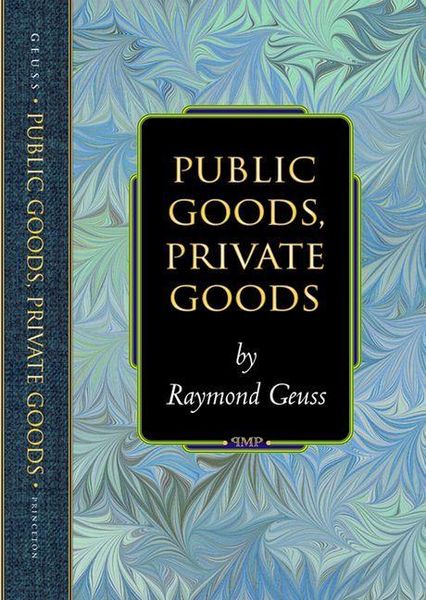
Public Goods, Private Goods
-
- Taschenbuch
- eBook ausgewählt
-
Form:Einzelkauf Download
-
Sprache:Englisch
40,99 €
inkl. gesetzl. MwSt.Beschreibung
Produktdetails
Format
Kopierschutz
Ja
Family Sharing
Ja
Text-to-Speech
Nein
Erscheinungsdatum
10.01.2009
Verlag
Princeton University PressSeitenzahl
176 (Printausgabe)
Dateigröße
320 KB
Sprache
Englisch
EAN
9781400824823
Much political thinking today, particularly that influenced by liberalism, assumes a clear distinction between the public and the private, and holds that the correct understanding of this should weigh heavily in our attitude to human goods. It is, for instance, widely held that the state may address human action in the ''public'' realm but not in the ''private.'' In Public Goods, Private Goods Raymond Geuss exposes the profound flaws of such thinking and calls for a more nuanced approach. Drawing on a series of colorful examples from the ancient world, he illustrates some of the many ways in which actions can in fact be understood as public or private.
The first chapter discusses Diogenes the Cynic, who flouted conventions about what should be public and what should be private by, among other things, masturbating in the Athenian marketplace. Next comes an analysis of Julius Caesar's decision to defy the Senate by crossing the Rubicon with his army; in doing so, Caesar asserted his dignity as a private person while acting in a public capacity. The third chapter considers St. Augustine's retreat from public life to contemplate his own, private spiritual condition. In the fourth, Geuss goes on to examine recent liberal views, questioning, in particular, common assumptions about the importance of public dialogue and the purportedly unlimited possibilities humans have for reaching consensus. He suggests that the liberal concern to maintain and protect, even at a very high cost, an inviolable ''private sphere'' for each individual is confused.
Geuss concludes that a view of politics and morality derived from Hobbes and Nietzsche is a more realistic and enlightening way than modern liberalism to think about human goods. Ultimately, he cautions, a simplistic understanding of privacy leads to simplistic ideas about what the state is and is not justified in doing.
Noch keine Bewertungen vorhanden
Verfassen Sie die erste Bewertung zu diesem Artikel
Helfen Sie anderen Kundinnen und Kunden durch Ihre Meinung.
Kurze Frage zu unserer Seite
Vielen Dank für dein Feedback
Wir nutzen dein Feedback, um unsere Produktseiten zu verbessern. Bitte habe Verständnis, dass wir dir keine Rückmeldung geben können. Falls du Kontakt mit uns aufnehmen möchtest, kannst du dich aber gerne an unseren Kund*innenservice wenden.
zum Kundenservice