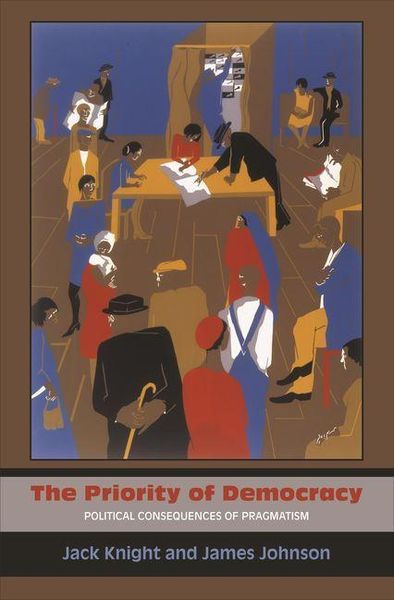
Priority of Democracy Political Consequences of Pragmatism
-
- Taschenbuch
- eBook ausgewählt
-
Form:Einzelkauf Download
-
Sprache:Englisch
33,99 €
inkl. gesetzl. MwSt.Beschreibung
Produktdetails
Format
Kopierschutz
Ja
Family Sharing
Ja
Text-to-Speech
Nein
Erscheinungsdatum
22.08.2011
Verlag
Princeton University PressSeitenzahl
348 (Printausgabe)
Dateigröße
406 KB
Sprache
Englisch
EAN
9781400840335
Why democracy is the best way of deciding how decisions should be made
Pragmatism and its consequences are central issues in American politics today, yet scholars rarely examine in detail the relationship between pragmatism and politics. In The Priority of Democracy, Jack Knight and James Johnson systematically explore the subject and make a strong case for adopting a pragmatist approach to democratic politics-and for giving priority to democracy in the process of selecting and reforming political institutions.
What is the primary value of democracy? When should we make decisions democratically and when should we rely on markets? And when should we accept the decisions of unelected officials, such as judges or bureaucrats? Knight and Johnson explore how a commitment to pragmatism should affect our answers to such important questions. They conclude that democracy is a good way of determining how these kinds of decisions should be made-even if what the democratic process determines is that not all decisions should be made democratically. So, for example, the democratically elected U.S. Congress may legitimately remove monetary policy from democratic decision-making by putting it under the control of the Federal Reserve.
Knight and Johnson argue that pragmatism offers an original and compelling justification of democracy in terms of the unique contributions democratic institutions can make to processes of institutional choice. This focus highlights the important role that democracy plays, not in achieving consensus or commonality, but rather in addressing conflicts. Indeed, Knight and Johnson suggest that democratic politics is perhaps best seen less as a way of reaching consensus or agreement than as a way of structuring the terms of persistent disagreement.
Noch keine Bewertungen vorhanden
Verfassen Sie die erste Bewertung zu diesem Artikel
Helfen Sie anderen Kundinnen und Kunden durch Ihre Meinung.
Kurze Frage zu unserer Seite
Vielen Dank für dein Feedback
Wir nutzen dein Feedback, um unsere Produktseiten zu verbessern. Bitte habe Verständnis, dass wir dir keine Rückmeldung geben können. Falls du Kontakt mit uns aufnehmen möchtest, kannst du dich aber gerne an unseren Kund*innenservice wenden.
zum Kundenservice