Gutscheinbedingungen

**Gültig bis 10.06.2026 / Gültig für gebrauchte Bücher / Mindestbestellwert 20,00 € / Einzelne Artikel können ausgeschlossen sein / Online auf www.bücher.de.de / Nicht kombinierbar mit anderen Gutscheinen oder Preisaktionen / Nur einmal pro Einkauf einlösbar / Gutschein wird auf max. 500€ Bestellwert angerechnet / Keine Barauszahlung / Nicht gültig für Versandkosten und Services

Beschreibung

Produktdetails

Einband

Gebundene Ausgabe

Erscheinungsdatum

19.12.2019

Abbildungen

XVI, 52 illus., 33 illus. in color., farbige Illustrationen, schwarz-weiss Illustrationen

Herausgeber

Paul M. Rea

Verlag

Springer

Seitenzahl

138

Maße (L/B/H)

26/18,3/1,4 cm

Gewicht

539 g

Auflage

1st ed. 2019

Sprache

Englisch

ISBN

978-3-030-24280-0

Beschreibung

Portrait

Paul is a Professor of Digital and Anatomical Education at the University of Glasgow. He is qualified with a medical degree (MBChB), a MSc (by research) in craniofacial anatomy/surgery, a PhD in neuroscience, the Diploma in Forensic Medical Science (DipFMS), and an MEd with Merit (Learning and Teaching in Higher Education). He is an elected Fellow of the Royal Society for the encouragement of Arts, Manufactures and Commerce (FRSA), elected Fellow of the Royal Society of Biology (FRSB), Senior Fellow of the Higher Education Academy, professional member of the Institute of Medical Illustrators (MIMI) and a registered medical illustrator with the Academy for Healthcare Science.Paul has published widely and presented at many national and international meetings, including invited talks. He sits on the Executive Editorial Committee for the Journal of Visual Communication in Medicine, is Associate Editor for the European Journal of Anatomy and reviews for 24 different journals/publishers.He is the Public Engagement and Outreach lead for anatomy coordinating collaborative projects with the Glasgow Science Centre, NHS and Royal College of Physicians and Surgeons of Glasgow. Paul is also a STEM ambassador and has visited numerous schools to undertake outreach work. His research involves a long-standing strategic partnership with the School of Simulation and Visualisation. The Glasgow School of Art. This has led to multi-million pound investment in creating world leading 3D digital datasets to be used in undergraduate and postgraduate teaching to enhance learning and assessment. This successful collaboration resulted in the creation of the worlds first taught MSc Medical Visualisation and Human Anatomy combining anatomy and digital technologies. The Institute of Medical Illustrators also accredits it. This degree, now into its 8th year, has graduated almost 100 people, and created college-wide, industry, multi-institutional and NHS research linked projects for students. Paul is the Programme Director for this degree.

Produktdetails

Einband

Gebundene Ausgabe

Erscheinungsdatum

19.12.2019

Abbildungen

XVI, 52 illus., 33 illus. in color., farbige Illustrationen, schwarz-weiss Illustrationen

Herausgeber

Paul M. Rea

Verlag

Springer

Seitenzahl

138

Maße (L/B/H)

26/18,3/1,4 cm

Gewicht

539 g

Auflage

1st ed. 2019

Sprache

Englisch

ISBN

978-3-030-24280-0

Herstelleradresse

Springer-Verlag GmbH
Tiergartenstr. 17
69121 Heidelberg
DE

Email: ProductSafety@springernature.com

Kundinnen und Kunden meinen

0 Bewertungen

Informationen zu Bewertungen

Zur Abgabe einer Bewertung ist eine Anmeldung im Konto notwendig. Die Authentizität der Bewertungen wird von uns nicht überprüft. Wir behalten uns vor, Bewertungstexte, die unseren Richtlinien widersprechen, entsprechend zu kürzen oder zu löschen.

Die Bewertungen sind nach Format, Anzahl Sterne und Datum sortiert.

Verfassen Sie die erste Bewertung zu diesem Artikel

Helfen Sie anderen Kund*innen durch Ihre Meinung

Kundinnen und Kunden meinen

0 Bewertungen filtern

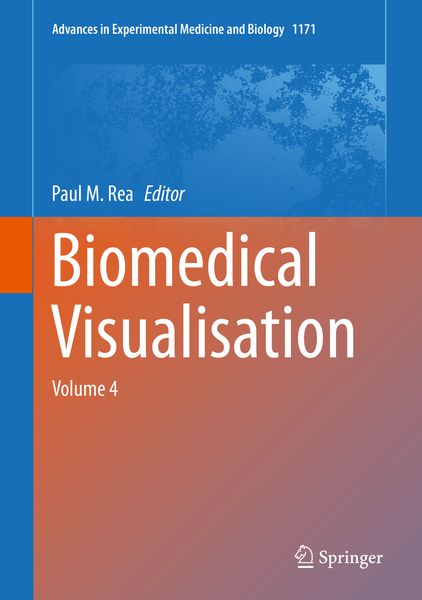
  • Produktbild: Biomedical Visualisation
  • Preface

    Chapter 1


    Assessing the Role of Screencasting and Video use in Anatomy Education


    Scott Border


    Chapter 2


    Exploring the Role of xR in Visualizations for Use in Medical Education


    Patrick Pennefather, Claudia Krebs


    Chapter 3


    Virtual Patients in Health Professions Education


    Nathaniel Patrick Andrew Quail and James Graham Boyle


    Chapter 4


    Student-created online teaching resources for students


    Camille Huser & Leah Marks & Aileen Linn & Sarah Meek


    Chapter 5


    Massive Open Online Courses: Current and future trends in biomedical sciences


    Jo-Anne Murray


    Chapter 6


    Applying geometric morphometrics to digital reconstruction and anatomical investigation


    Federica Landi, Paul O’Higgins


    Chapter 7


    Three-dimensional visualisation of skeletal cavities


    Alession Veneziano, Antonio Profico


    Chapter 8


    Recommended Workflow Methodology in the Creation of an Interactive Application for Patient’s Diagnosed with Pancreatic Cancer


    Olivia Knight, C Ross Carter, Brian Loranger, Paul Rea


    Chapter 9


    Evaluation of Child-Friendly Augmented Reality Tool for Patient-centered Education in Radiology and Bone Reconstruction


    Ruth Connaghan, Matthieu Poyade, Paul Rea


    Chapter 10


    Using technology to engage the public in biomedical sciences


    Adam M Taylor, Quenton Wessels


    Index.