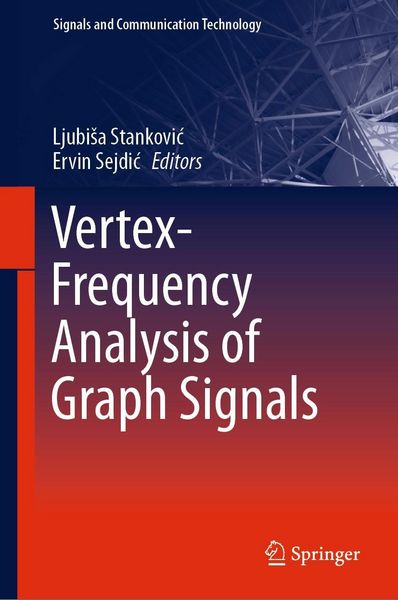
Vertex-Frequency Analysis of Graph Signals
160,49 €
inkl. gesetzl. MwSt.Beschreibung
Produktdetails
Format
Kopierschutz
Nein
Family Sharing
Nein
Text-to-Speech
Nein
Erscheinungsdatum
01.12.2018
Herausgeber
Ljubisa Stankovic + weitereVerlag
SpringerSeitenzahl
507 (Printausgabe)
Dateigröße
31130 KB
Sprache
Englisch
EAN
9783030035747
This book introduces new methods to analyze vertex-varying graph signals. In many real-world scenarios, the data sensing domain is not a regular grid, but a more complex network that consists of sensing points (vertices) and edges (relating the sensing points). Furthermore, sensing geometry or signal properties define the relation among sensed signal points. Even for the data sensed in the well-defined time or space domain, the introduction of new relationships among the sensing points may produce new insights in the analysis and result in more advanced data processing techniques. The data domain, in these cases and discussed in this book, is defined by a graph. Graphs exploit the fundamental relations among the data points. Processing of signals whose sensing domains are defined by graphs resulted in graph data processing as an emerging field in signal processing.
Although signal processing techniques for the analysis of time-varying signals are well established, the corresponding graph signal processing equivalent approaches are still in their infancy. This book presents novel approaches to analyze vertex-varying graph signals. The vertex-frequency analysis methods use the Laplacian or adjacency matrix to establish connections between vertex and spectral (frequency) domain in order to analyze local signal behavior where edge connections are used for graph signal localization. The book applies combined concepts from time-frequency and wavelet analyses of classical signal processing to the analysis of graph signals. Covering analytical tools for vertex-varying applications, this book is of interest to researchers and practitioners in engineering, science, neuroscience, genome processing, just to name a few. It is also a valuable resource for postgraduate students and researchers looking to expand their knowledge of the vertex-frequency analysis theory and its applications.The book consists of 15 chapters contributed by 41 leading researches in the field.
Noch keine Bewertungen vorhanden
Verfassen Sie die erste Bewertung zu diesem Artikel
Helfen Sie anderen Kundinnen und Kunden durch Ihre Meinung.
Kurze Frage zu unserer Seite
Vielen Dank für dein Feedback
Wir nutzen dein Feedback, um unsere Produktseiten zu verbessern. Bitte habe Verständnis, dass wir dir keine Rückmeldung geben können. Falls du Kontakt mit uns aufnehmen möchtest, kannst du dich aber gerne an unseren Kund*innenservice wenden.
zum Kundenservice