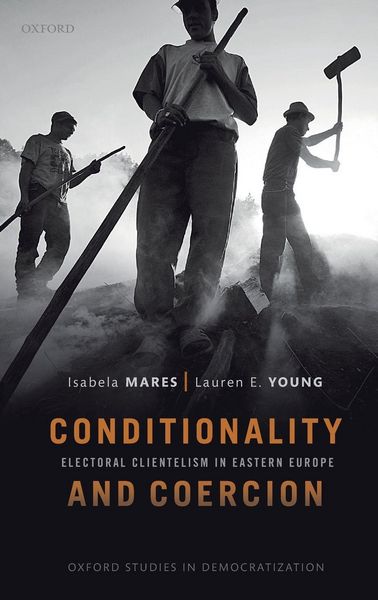
Conditionality & Coercion Electoral Clientelism in Eastern Europe
-
- Hardcover ausgewählt
- Taschenbuch
- eBook
-
Sprache:Englisch
146,99 €
inkl. gesetzl. MwSt.,
Beschreibung
Produktdetails
Einband
Gebundene Ausgabe
Erscheinungsdatum
17.12.2019
Verlag
Oxford AcademicSeitenzahl
338
Maße (L/B/H)
24/16,1/2,3 cm
Gewicht
672 g
Sprache
Englisch
ISBN
978-0-19-883277-5
In many recent democracies, candidates compete for office using illegal strategies to influence voters. In Hungary and Romania, local actors including mayors and bureaucrats offer access to social policy benefits to voters who offer to support their preferred candidates, and they threaten others with the loss of a range of policy and private benefits for voting the "wrong" way. These quid pro quo exchanges are often called clientelism. How can politicians and their accomplices get away with such illegal campaigning in otherwise democratic, competitive elections? When do they rely on the worst forms of clientelism that involve threatening voters and manipulating public benefits? Conditionality and Coercion: Electoral Clientelism in Eastern Europe uses a mixed method approach to understand how illegal forms of campaigning including vote buying and electoral coercion persist in two democratic countries in the European Union. It argues that we must disaggregate clientelistic strategies based on whether they use public or private resources, and whether they involve positive promises or negative threats and coercion. We document that the type of clientelistic strategies that candidates and brokers use varies systematically across localities based on their underlying social coalitions. We also show that voters assess and sanction different forms of clientelism in different ways. Voters glean information about politicians' personal characteristics and their policy preferences from the clientelistic strategies these candidates deploy. Most voters judge candidates who use clientelism harshly. So how does clientelism, including its most odious coercive forms, persist in democratic systems? This book suggests that politicians can get away with clientelism by using forms of it that are in line with the policy preferences of constituencies whose votes they need. Clientelistic and programmatic strategies are not as distinct as previous have argued. Oxford Studies in Democratization is a series for scholars and students of comparative politics and related disciplines. Volumes concentrate on the comparative study of the democratization process that accompanied the decline and termination of the cold war. The geographical focus of the series is primarily Latin America, the Caribbean, Southern and Eastern Europe, and relevant experiences in Africa and Asia. The series editor is Laurence Whitehead, Senior Research Fellow, Nuffield College, University of Oxford.
Noch keine Bewertungen vorhanden
Verfassen Sie die erste Bewertung zu diesem Artikel
Helfen Sie anderen Kundinnen und Kunden durch Ihre Meinung.
Kurze Frage zu unserer Seite
Vielen Dank für dein Feedback
Wir nutzen dein Feedback, um unsere Produktseiten zu verbessern. Bitte habe Verständnis, dass wir dir keine Rückmeldung geben können. Falls du Kontakt mit uns aufnehmen möchtest, kannst du dich aber gerne an unseren Kund*innenservice wenden.
zum Kundenservice