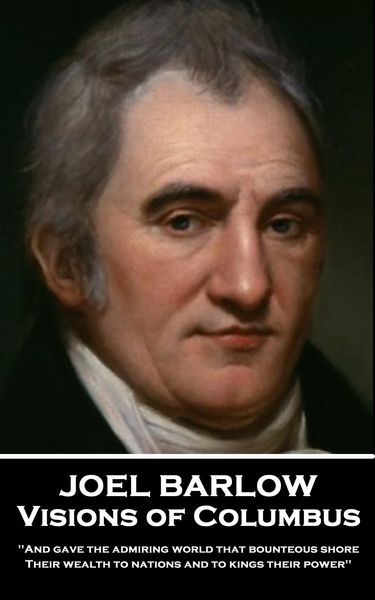
Visions of Columbus 'And gave the admiring world that bounteous shore, Their wealth to Nations and to Kings their power''
-
- Einzelkauf Download ausgewählt
-
Sprache:Englisch
2,99 €
inkl. gesetzl. MwSt.Beschreibung
Produktdetails
Format
ePUB
Kopierschutz
Ja
Family Sharing
Nein
Text-to-Speech
Ja
Erscheinungsdatum
19.02.2019
Verlag
Copyright GroupSeitenzahl
110 (Printausgabe)
Dateigröße
100 KB
Sprache
Englisch
EAN
9781787804692
Joel Barlow was born on March 24th 1754 in Redding, Fairfield County, Connecticut.
After a brief attendance at Dartmouth College he graduated from Yale College in 1778, although he continued his studies there for a further two years as a postgraduate student.
In 1778, he published an anti-slavery poem entitled 'The Prospect of Peace'.
The American War of Independence had started in 1776 and Barlow was an ardent proponent of its aims and ambitions. He served in the Battle of Long Island and was chaplain for the 4th Massachusetts Brigade from September 1780 until the war's close.
In 1783, Barlow moved to Hartford, Connecticut and by the following July had established the weekly paper, The American Mercury, and become a member of the group known as the 'Hartford Wits'.
By 1786 he had been admitted to the bar but continued to write and follow politics. He contributed a series of satirico-political papers to the Anarchiad. In 1787, he published a long and ambitious poem, 'The Vision of Columbus', which gave him a considerable literary reputation.
A blot on his reputation came when he worked as an agent for American speculator William Duer to set up the Scioto Company in Paris in 1788, selling worthless deeds to land it didn't own in the Northwest Territory. Accounts suggest he had no knowledge that the sales were fraudulent.
Barlow became a liberal in religion and a republican in politics. His over-riding belief? American civilization was world civilization. His involvement in the French Revolution went so far that he was elected to the French Assembly, and granted French citizenship in 1792. Although he had dedicated his 'Vision of Columbus to Louis XVI, he now called for his execution. Barlow also helped Thomas Paine publish the first part of 'The Age of Reason' whilst Paine was imprisoned during The Reign of Terror.
Barlow also spent time in London. There he was a member of the London Society for Constitutional Information and published various radical essays. One volume 'Advice to the Privileged Orders' (1792) was banned by the British government.
In 1793 he wrote and published the well-regarded poem 'The Hasty-Pudding'
Appointed as the American consul to Algiers he used State Department funds for bribes and ransoms to free more than 100 American merchant sailors held by Barbary pirates. He helped draft the Treaty of Tripoli in 1796, ending their attacks on North Africa city states. The treaty includes the phrase: "the Government of the United States of America is not, in any sense, founded on the Christian religion".
Barlow returned to the United States in 1805. By 1807, he had published the epic 'Columbiad', an extended edition of his 'Vision of Columbus'.
In 1811, Barlow was appointed as U.S. Minister to France and sailed across on the USS Constitution. He was tasked to negotiate an end to the Berlin and Milan Decrees, and obtain the release of American ships and crews held by the French during the Napoleonic wars.
The following year he set off for Vilnius to negotiate a treaty with the French foreign minister, who was based in Lithuania preparing for the invasion of Russia. Upon his arrival the French army was already in chaotic retreat from Moscow. He decided to take the southerly route back to Paris, via Krakow and Vienna. Shortly after setting off he contracted pneumonia.
Joel Barlow died on December 26th, 1812 in the Polish village of Zarnowiec.
Kundinnen und Kunden meinen
Verfassen Sie die erste Bewertung zu diesem Artikel
Helfen Sie anderen Kund*innen durch Ihre Meinung
Kurze Frage zu unserer Seite
Vielen Dank für dein Feedback
Wir nutzen dein Feedback, um unsere Produktseiten zu verbessern. Bitte habe Verständnis, dass wir dir keine Rückmeldung geben können. Falls du Kontakt mit uns aufnehmen möchtest, kannst du dich aber gerne an unseren Kund*innenservice wenden.
zum Kundenservice