Gutscheinbedingungen

**Gültig vom 20.07.2026 bis 22.07.2026 | Gültig für nicht preisgebundene fremdsprachige Bücher | Einzelne Artikel können ausgeschlossen sein | Nicht kombinierbar mit anderen Gutscheinen oder Preisaktionen | Nur einmal pro Einkauf einlösbar | Gutschein wird auf max. 500€ Bestellwert angerechnet | Keine Barauszahlung | Nicht gültig für Versandkosten und Services

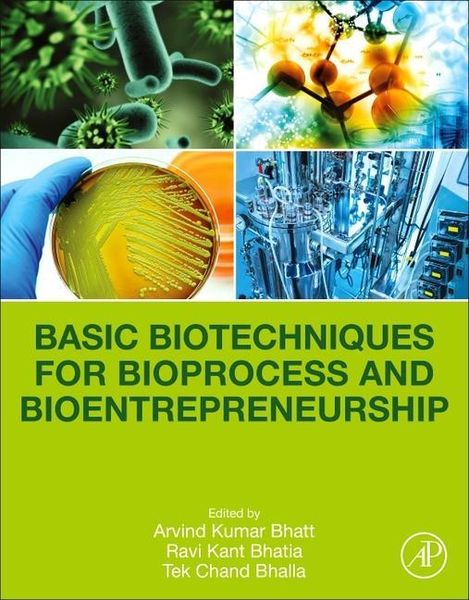
Produktbild: Basic Biotechniques for Bioprocess and Bioentrepreneurship
- 18%

Basic Biotechniques for Bioprocess and Bioentrepreneurship

18% sparen

151,99 € UVP 187,50 €

inkl. gesetzl. MwSt., Versandkostenfrei

Lieferung nach Hause

Beschreibung

Produktdetails

Einband

Taschenbuch

Erscheinungsdatum

06.02.2023

Herausgeber

Arvind Kumar Bhatt + weitere

Verlag

Elsevier Science & Technology

Seitenzahl

518

Maße (L/B/H)

27,6/21,6/3,6 cm

Gewicht

450 g

Sprache

Englisch

ISBN

978-0-12-816109-8

Beschreibung

Portrait

Dr. Arvind Kumar Bhatt has Ph.D. in Life Sc. with outstanding achievements in Academics, R&D, Industry and State Govt. departments where he has worked for more than last 26 years.. He is also Member of several Professional organizations, Editorial Board of Scientific Journals and has more than 40 research papers to his credit published in Scientific Journals of repute. He has guided/ guiding students for Ph. D. Degrees in Biotechnology/Microbiology/Life Sciences.

Produktdetails

Einband

Taschenbuch

Erscheinungsdatum

06.02.2023

Herausgeber

Verlag

Elsevier Science & Technology

Seitenzahl

518

Maße (L/B/H)

27,6/21,6/3,6 cm

Gewicht

450 g

Sprache

Englisch

ISBN

978-0-12-816109-8

Herstelleradresse

Libri GmbH
Europaallee 1
36244 Bad Hersfeld
DE

Email: gpsr@libri.de

Noch keine Bewertungen vorhanden

Verfassen Sie die erste Bewertung zu diesem Artikel

Helfen Sie anderen Kundinnen und Kunden durch Ihre Meinung.

Kundinnen und Kunden meinen

Bewertungen (0)

Die Leseprobe wird geladen.
  • Produktbild: Basic Biotechniques for Bioprocess and Bioentrepreneurship
  • Part I: Isolation, screening and culture maintenance
    1. Isolation of microorganisms
    2. Screening strategies
    3. Identification, morphological, biochemical, and genetic characterization of microorganisms
    4. Microbial activity and productivity enhancement strategies
    5. Culture maintenance, preservation, and strain improvement

    Part II: Laboratory techniques and instrumentation
    6. Biomolecules: Types, homogenization, bead beater, sonication
    7. Centrifugation: Basic principle, types
    8. Spectroscopy-Principle, types, and applications
    9. Protein purification: Basic principles and techniques
    10. Chromatography: Basic principle, types, and applications
    11. Electrophoresis: Basic principle, types, and applications

    Part III: Genomic and proteomic analysis
    12. DNA, RNA isolation, primer designing, sequence submission, and phylogenetic analysis
    13. RDT and genetic engineering: Basic of RDT method, PCR, and application
    14. Protein sequence analysis
    15. Computational strategies and tools for protein tertiary structure prediction
    16. Docking strategies
    17. A beginner's guide to measuring binding affinity during biomolecular interactions

    Part IV: Industrially important enzymes
    18. Enzymes and their significance in the industrial bioprocesses
    19. Enzyme kinetics: Industrially important enzymes
    20. Industrial enzymes: Basic information, assay, and applications

    Part V: Techniques in process development
    21. Fundamentals of fermentation technology
    22. Sterilization in bioprocesses
    23. Scale-up: Lab to commercial scale
    24. Bioprocess: Control, management, and biosafety issues
    25. Demonstration and industrial scale-up
    26. Downstream processing of biotechnology products
    27. Waste management and environment

    Part VI: Feasibility, marketing and biobusiness
    28. Biobusiness opportunities
    29. Feasibility analysis and business plan
    30. Patenting, IPR, and regulatory issues
    31. Commercialization and technology transfers of bioprocess
    32. Bioproduct marketing strategies