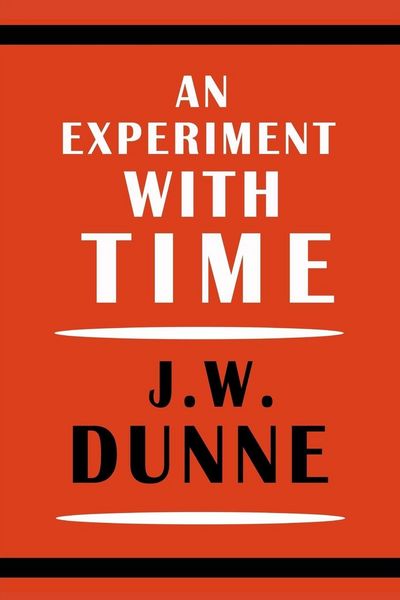
An Experiment with Time
-
- Hardcover
- Taschenbuch ausgewählt
- eBook
-
Sprache:Englisch
-
Verlag:Martino Fine Books
19,99 €
inkl. gesetzl. MwSt.,
Lieferung nach Hause
Beschreibung
Produktdetails
Einband
Taschenbuch
Erscheinungsdatum
11.03.2019
Verlag
Martino Fine BooksSeitenzahl
216
Maße (L/B/H)
23,4/15,6/1,4 cm
Gewicht
376 g
Sprache
Englisch
ISBN
978-1-68422-325-1
2019 Reprint of 1927 Edition. Full facsimile of the original edition, not reproduced with Optical Recognition software. Dunne, a British soldier, aeronautical engineer and philosopher describes in this work his experiment with precognitive dreams and builds on them a theory of time which he later called Serialism. First published in March 1927, the book was widely read and influenced the imaginative literature of the day. An Experiment with Time divides into two main topics. The first half of the book describes a number of precognitive dreams, most of which Dunne himself had experienced. His key conclusion was that such precognitive visions foresee future personal experiences by the dreamer and not more general events. The second half develops a theory to try and explain the dreams. Dunne's starting point is the observation that the moment of "now" is not described by science. Contemporary science described physical time as a fourth dimension and Dunne's argument led to an endless sequence of higher dimensions of time to measure our passage through the dimension below. Accompanying each level was a higher level of consciousness. At the end of the chain was a supreme ultimate observer. According to Dunne, our wakeful attention prevents us from seeing beyond the present moment, whilst when dreaming that attention fades and we gain the ability to recall more of our timeline. This allows fragments of our future to appear in pre-cognitive dreams, mixed in with fragments or memories of our past. Other consequences include the phenomenon known as deja-vu and the existence of life after death. Dunne’s ideas strongly influenced the J. R. R. Tolkien and C. S. Lewis. Both writers were members of the Inklings literary circle, and Tolkien also used Dunne's ideas about parallel time dimensions in the Lord of the Rings. Other important contemporary writers who used his ideas included John Buchan, James Hilton, his old friend H. G. Wells, Graham Greene and Rumer Godden.
Noch keine Bewertungen vorhanden
Verfassen Sie die erste Bewertung zu diesem Artikel
Helfen Sie anderen Kundinnen und Kunden durch Ihre Meinung.
Kurze Frage zu unserer Seite
Vielen Dank für dein Feedback
Wir nutzen dein Feedback, um unsere Produktseiten zu verbessern. Bitte habe Verständnis, dass wir dir keine Rückmeldung geben können. Falls du Kontakt mit uns aufnehmen möchtest, kannst du dich aber gerne an unseren Kund*innenservice wenden.
zum Kundenservice