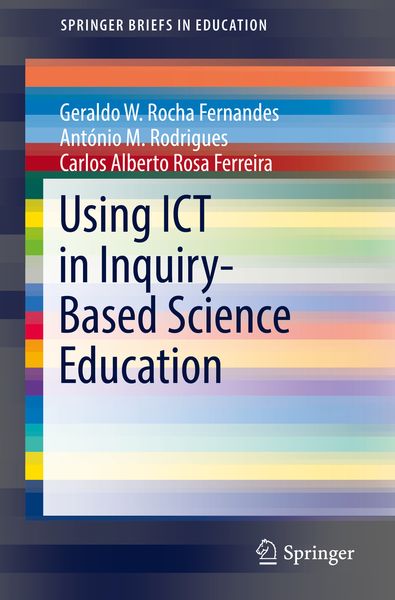
Using ICT in Inquiry-Based Science Education
-
- Taschenbuch ausgewählt
- eBook
-
Sprache:Englisch
49,99 €
inkl. gesetzl. MwSt.,
Beschreibung
Produktdetails
Einband
Taschenbuch
Erscheinungsdatum
31.05.2019
Abbildungen
X, 97 p. 1 illus.
Verlag
SpringerSeitenzahl
97
Maße (L/B/H)
23,5/15,5/0,7 cm
Gewicht
178 g
Sprache
Englisch
ISBN
978-3-030-17894-9
This book analyzes the main Information and Communication Technologies (ICT) used in science education and the main theoretical approaches that support science education mediated by ICT in order to show how digital technologies can be employed in Inquiry-Based Science Education. It presents the results of a comprehensive review of studies focusing both on the use and effects of digital technologies in science education and on the different theoretical approaches that support the use of ICTs in science teaching.By doing so, the book provides a useful summary of the current research in the field and a strong analysis of its limitations. It concludes that there are few studies that report strategies and didactics for the practical use of ICT in science classes and that the use of ICT in science education can’t be seen as an isolated action without a theoretical basis to support it.
Based on these conclusions, the volume identifies the main ICTs used in inquiry activities, the mainsteps in inquiry activities used in science education and their approaches to the use of ICT. It shows that the use of ICT in Inquiry-Based Science Education allows students to develop more active work styles, improved attitudes towards science, better conceptual and theoretical understanding, improved reasoning, better modelling capabilities, and improved teamwork, along with improvements in other abilities. Using ICT in Inquiry-Based Science Education
will be a valuable resource for science teachers and science teacher educators looking for an introductory text that presents an overview of the scientific research analyzing the implementation of digital technologies in science teaching and that provides useful insights to all educators interested in using digital technologies to introduce their students in the world of scientific inquiry and research.
Noch keine Bewertungen vorhanden
Verfassen Sie die erste Bewertung zu diesem Artikel
Helfen Sie anderen Kundinnen und Kunden durch Ihre Meinung.
Kurze Frage zu unserer Seite
Vielen Dank für dein Feedback
Wir nutzen dein Feedback, um unsere Produktseiten zu verbessern. Bitte habe Verständnis, dass wir dir keine Rückmeldung geben können. Falls du Kontakt mit uns aufnehmen möchtest, kannst du dich aber gerne an unseren Kund*innenservice wenden.
zum Kundenservice