Gutscheinbedingungen

**Gültig vom 24.08.2026 bis 26.08.2026 | Gültig für nicht preisgebundene fremdsprachige Bücher | Einzelne Artikel können ausgeschlossen sein | Online auf www.bücher.de einlösbar | Click & Collect nur mit Online-Zahlung (Paypal/Kreditkarte) vorab | Nicht kombinierbar mit anderen Gutscheinen oder Preisaktionen | Nur einmal pro Einkauf einlösbar | Gutschein wird auf max. 500€ Bestellwert angerechnet | Keine Barauszahlung | Nicht gültig für Versandkosten und Services

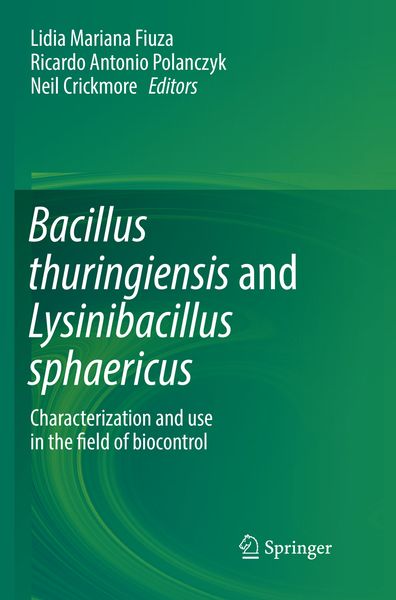
Produktbild: Bacillus thuringiensis and Lysinibacillus sphaericus
- 10%

Bacillus thuringiensis and Lysinibacillus sphaericus Characterization and use in the field of biocontrol

10% sparen

95,99 € UVP 106,99 €

inkl. gesetzl. MwSt., Versandkostenfrei


Beschreibung

Produktdetails

Einband

Taschenbuch

Erscheinungsdatum

12.08.2018

Abbildungen

VIII, 288 p. 32 illus., 15 illus. in color.

Herausgeber

Lidia Mariana Fiuza + weitere

Verlag

Springer

Seitenzahl

288

Maße (L/B/H)

23,5/15,5/1,7 cm

Gewicht

452 g

Auflage

1oftcover reprint of the origi

Sprache

Englisch

ISBN

978-3-319-85971-2

Beschreibung

Portrait

Dr. Lidia Mariana Fiuza – PhD (ENSAM-Montpellier/France), is currently Researcher at Instituto Riograndense do Arroz (IRGA) and member of the Agricultural Sciences Commitee at Research Foundation of Rio Grande do Sul, Brazil. She specializes in the areas of toxicology, microbiology, and entomology, with an emphasis in bacteriology and acting on the following topics: Bacillus thuringiensis and correlates; genes cry; insecticidal proteins; plants-Bt; toxin interactions; microbial control of pests and diseases. As innovation and technology activities, she is a partner in the Control_Agro_Bio Pesquisa e Defesa Agropecuária Ltda., which is currently accredited in the Brazilian Ministry of Agriculture as a Collaborating Center for Pest Risk Analysis – ARP, Section of Agricultural Defense, Department of Plant Protection.Dr. Ricardo Antonio Polanczyk – PhD (ESALQ/USP), is currently Assistant Professor at UNESP. Before this, he was at UFES, working with Dr. Pratissoli in IPM systems.  Microbial control of agricultural pests is his main field of research, including the interactions between microbial control agents and pesticides and Bt plants.  In 2014 he took part in the course "Risk Analysis: Role of Science in GMO Decision-making" in the International Centre for Genetic Engineering and Biotechnology (Trieste- Italy).Dr. Neil Crickmore – PhD (University of Warwick), is currently Senior Lecturer in Molecular Genetics, University of Sussex and Adjunct Professor State Key Laboratory for the Biology of Plant Diseases and Insect Pests, Institute of Plant Protection, Chinese Academy of Agricultural Sciences, Beijing, China. Before, he was Research Associate at University of Cambridge. Widely heralded today as a leading figure in Bacillus thuringiensis research. Chair and webmaster of International Bacillus thuringiensis toxin nomenclature committee; Convenor of the Bacterial Division of the IOBC/WPRS.  

Produktdetails

Einband

Taschenbuch

Erscheinungsdatum

12.08.2018

Abbildungen

VIII, 288 p. 32 illus., 15 illus. in color.

Herausgeber

Verlag

Springer

Seitenzahl

288

Maße (L/B/H)

23,5/15,5/1,7 cm

Gewicht

452 g

Auflage

1oftcover reprint of the origi

Sprache

Englisch

ISBN

978-3-319-85971-2

Herstelleradresse

Springer-Verlag KG
Sachsenplatz 4-6
1201 Wien
AT

Email: ProductSafety@springernature.com

Noch keine Bewertungen vorhanden

Verfassen Sie die erste Bewertung zu diesem Artikel

Helfen Sie anderen Kundinnen und Kunden durch Ihre Meinung.

Kundinnen und Kunden meinen

Bewertungen (0)

  • Produktbild: Bacillus thuringiensis and Lysinibacillus sphaericus

  • Chapter 1 - 
    Bacillus thuringiensis
    characterization: morphology, physiology, biochemistry, pathotype, cellular and molecular aspects.- Chapter 2 - The biology, ecology and taxonomy of
    Bacillus thuringiensis
    and related bacteria.- Chapter 3 - 
    Bacillus thuringiensis
    toxin classification.- Chapter 4 - Insecticidal proteins from
    Bacillus thuringiensis 
    and their mechanism of action.- Chapter 5 - Effect of
    Bacillus thuringiensis
    on parasitoids and predators.- Chapter 6 - Characterization of
    Bacillus thuringiensis
    using plasmid patterns, AFLP and rep-PCR.- Chapter 7 - New sequencing technologies and genomic analysis applied to
    Bacillus thuringiensis.- 
    Chapter 8 - Expression of
    Bacillus thuringiensis
     in insect cells.- Chapter 9 - 
    Bacillus thuringiensis
    : different targets and interactions.- Chapter 10 - Specificity and cross-order activity of 
    Bacillus thuringiensis
    pesticidal proteins.- Chapter 11 -  American
    Bacillus thuringiensis
    based biopesticides market.- Chapter 12 - Mass production, application, and market development of
    Bacillus thuringiensis
    biopesticides in China.- Chapter 13 - The role of Embrapa in the development of tools to control biological pests: a case of success.- Chapter 14 - 
    Bacillus
     entomopathogenic based biopesticides in vector control programs in Brazil.- Chapter 15 -  Resistance of mosquitoes to entomopathogenic bacteria based larvicides: current status and strategies for management.- Chapter 16 -  The importance of
    Bacillus thuringiensis
    in the context of genetically modified plants in Brazil.- Chapter 17 - Resistance of Spodoptera frugiperda to

    Bacillus thuringiensis proteins in

    in the Western Hemisphere.