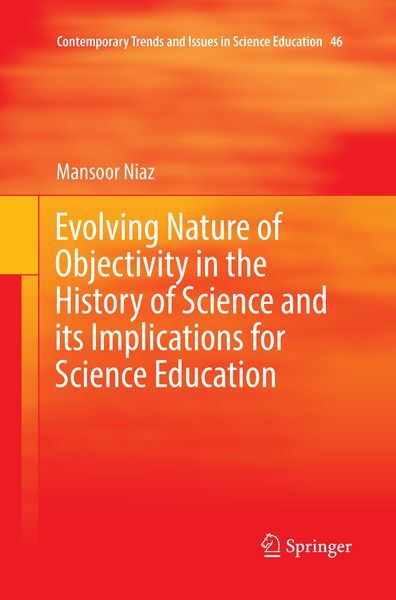
Evolving Nature of Objectivity in the History of Science and its Implications for Science Education
-
- Hardcover
- Taschenbuch ausgewählt
- eBook
-
Sprache:Englisch
49,99 €
inkl. gesetzl. MwSt.,
Lieferung nach Hause
Beschreibung
Produktdetails
Einband
Taschenbuch
Erscheinungsdatum
25.08.2018
Verlag
SpringerSeitenzahl
237
Maße (L/B/H)
23,5/15,5/1,5 cm
Gewicht
394 g
Auflage
Softcover reprint of the original 1st ed. 2018
Sprache
Englisch
ISBN
978-3-319-88476-9
This book explores the evolving nature of objectivity in the history of science and its implications for science education. It is generally considered that objectivity, certainty, truth, universality, the scientific method and the accumulation of experimental data characterize both science and science education. Such universal values associated with science may be challenged while studying controversies in their original historical context. The scientific enterprise is not characterized by objectivity or the scientific method, but rather controversies, alternative interpretations of data, ambiguity, and uncertainty. Although objectivity is not synonymous with truth or certainty, it has eclipsed other epistemic virtues and to be objective is often used as a synonym for scientific.
Recent scholarship in history and philosophy of science has shown that it is not the experimental data (Baconian orgy of quantification) but rather the diversity / plurality in a scientificdiscipline that contributes toward understanding objectivity. History of science shows that objectivity and subjectivity can be considered as the two poles of a continuum and this dualism leads to a conflict in understanding the evolving nature of objectivity.
The history of objectivity is nothing less than the history of science itself and the evolving and varying forms of objectivity does not mean that one replaced the other in a sequence but rather each form supplements the others.
This book is remarkable for its insistence that the philosophy of science, and in particular that discipline’s analysis of objectivity as the supposed hallmark of the scientific method, is of direct value to teac hers of science. Meticulously, yet in a most readable way, Mansoor Niaz looks at the way objectivity has been dealt with over the years in influential educational journals and in textbooks; it’s fascinating how certain perspectives fade, while basic questions show no sign of going away. There are few books that take both philosophy and education seriously – this one does!
Roald Hoffmann, Cornell University, chemist, writer and Nobel Laureate in Chemistry
Noch keine Bewertungen vorhanden
Verfassen Sie die erste Bewertung zu diesem Artikel
Helfen Sie anderen Kundinnen und Kunden durch Ihre Meinung.
Kurze Frage zu unserer Seite
Vielen Dank für dein Feedback
Wir nutzen dein Feedback, um unsere Produktseiten zu verbessern. Bitte habe Verständnis, dass wir dir keine Rückmeldung geben können. Falls du Kontakt mit uns aufnehmen möchtest, kannst du dich aber gerne an unseren Kund*innenservice wenden.
zum Kundenservice