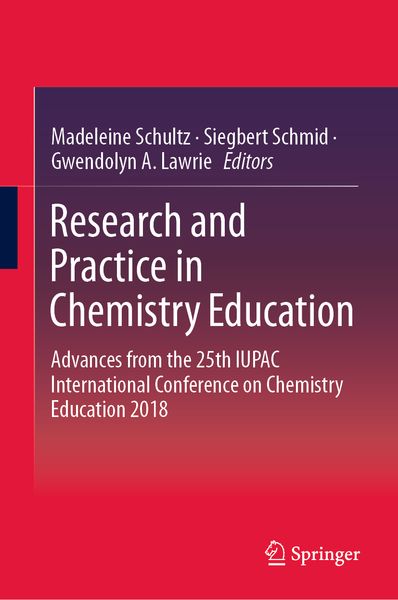
Produktbild: Research and Practice in Chemistry Education
- 12%

Research and Practice in Chemistry Education Advances from the 25th IUPAC International Conference on Chemistry Education 2018

12% sparen

93,99 € UVP 106,99 €

inkl. gesetzl. MwSt., Versandkostenfrei

Lieferung nach Hause

Beschreibung

Produktdetails

Einband

Gebundene Ausgabe

Erscheinungsdatum

18.04.2019

Abbildungen

VIII, 54 illus., 31 illus. in color., farbige Illustrationen, schwarz-weiss Illustrationen

Herausgeber

Madeleine Schultz + weitere

Verlag

Springer Singapore

Seitenzahl

274

Maße (L/B/H)

24,1/16/2,1 cm

Gewicht

594 g

Auflage

1st ed. 2019

Sprache

Englisch

ISBN

978-981-13-6997-1

Beschreibung

Portrait

Madeleine Schultz has completed significant projects in chemistry education that have generated important practical outcomes for tertiary teachers and have had a direct impact on the teaching practices of many Australian chemistry academics. She founded the Chemistry Discipline Network, an active community of practice of chemistry educators in Australia. Her recent work characterises the practices of expert teachers and collated teaching strategies to accelerate the development of novice tertiary chemistry teachers. In 2017 she was awarded a Citation from the Chemistry Education Division of the Royal Australian Chemical Institute. She moved to Deakin University in 2018.

Siegbert Schmid’s research interests at the University of Sydney’s School of Chemistry lie in the synthesis and structural characterisation of aperiodic and other materials with potential technological applications. At the same time, he supports a chemistry education research group, supervising both PhD and honours students. The focus of his education research is improving current teaching and assessment practices to demonstrate learning outcomes for tertiary level students. He was awarded the Chemistry Education Division of the Royal Australian Chemical Institute Commemorative Medal in 2016.

Gwen Lawrie is an Associate Professor at the School of Chemistry and Molecular Biosciences (SCMB) at the University of Queensland (UQ). Successfully translating from a bench chemistry research career to chemistry education research in 2006, her projects address the diversity and engagement of students through blended learning environments, collaborative inquiry tasks; and mechanisms for provision of formative feedback to support self-regulated learning in online environments. She is the recipient of a 2013 Australian Teaching Excellence Award and, in her role as Director of First Year Chemistry Curriculum & Assessment, led the teaching team to a 2017 National Award for Programs that Enhance Learning.

Produktdetails

Einband

Gebundene Ausgabe

Erscheinungsdatum

18.04.2019

Abbildungen

VIII, 54 illus., 31 illus. in color., farbige Illustrationen, schwarz-weiss Illustrationen

Herausgeber

Verlag

Springer Singapore

Seitenzahl

274

Maße (L/B/H)

24,1/16/2,1 cm

Gewicht

594 g

Auflage

1st ed. 2019

Sprache

Englisch

ISBN

978-981-13-6997-1

Herstelleradresse

Springer-Verlag KG
Sachsenplatz 4-6
1201 Wien
AT

Email: GPSR Kontakt

Noch keine Bewertungen vorhanden

Verfassen Sie die erste Bewertung zu diesem Artikel

Helfen Sie anderen Kundinnen und Kunden durch Ihre Meinung.

Kundinnen und Kunden meinen

Bewertungen (0)

  • Produktbild: Research and Practice in Chemistry Education
  • 1 Introduction.- 2 Revisiting the understanding of redox reactions through critiquing animations in variance.- 3 Reframing chemistry learning: The use of student-generated contexts.- 4 Interactive immersive virtual reality to enhance students' visualisation of complex molecules.- 5 Faculty motivation for scholarly teaching and innovative classroom practice: An empirical study.- 6 Lessons learnt from teaching and learning during disruptions.- 7 Bridging the gap between philosophy of science and student mechanistic reasoning.- 8 Assessing for chemical thinking.- 9 Assessment of practical chemistry in England: An analysis of scientific methods assessed in high stakes examinations.- 10 Deciphering students' thinking on Ionisation energy: Utilising a web-based diagnostic instrument.- 11 A longitudinal view of students' perspectives on their professional and career development, through optional Business Skills for Chemists modules, during their Chemistry Degree Programme.- 12 Raw Communications and Engagement (RACE): Teaching science communication through modular design.- 13 Constructive alignment beyond content: Assessing professional skills in student group interactions and written work.- 14 Students' perceptions of group communication skills in an active learning environment.- 15 Improving the assessment of transferable skills in chemistry through evaluation of current practice.