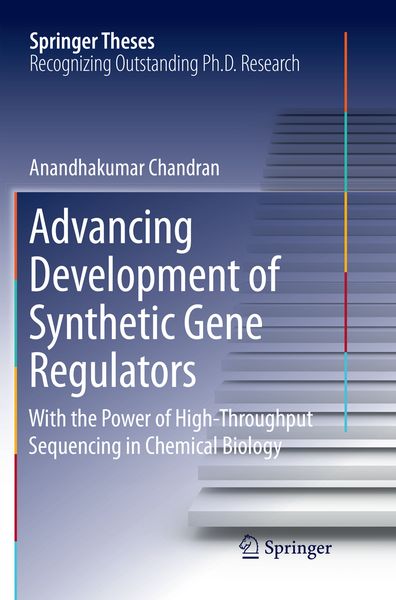
Advancing Development of Synthetic Gene Regulators With the Power of High-Throughput Sequencing in Chemical Biology
-
- Hardcover
- Taschenbuch ausgewählt
- eBook
-
Sprache:Englisch
93,99 €
UVP
106,99 €
inkl. gesetzl. MwSt.,
Beschreibung
Produktdetails
Einband
Taschenbuch
Erscheinungsdatum
26.01.2019
Abbildungen
XV, 114 p. 49 illus., 44 illus. in color.
Verlag
Springer SingaporeSeitenzahl
114
Maße (L/B/H)
23,5/15,5/0,8 cm
Gewicht
213 g
Auflage
Softcover reprint of the original 1st ed. 2018
Sprache
Englisch
ISBN
978-981-13-4899-0
This book focuses on an “outside the box” notion by utilizing the powerful applications of next-generation sequencing (NGS) technologies in the interface of chemistry and biology. In personalized medicine, developing small molecules targeting a specific genomic sequence is an attractive goal. N-methylpyrrole (P)–N-methylimidazole (I) polyamides (PIPs) are a class of small molecule that can bind to the DNA minor groove. First, a cost-effective NGS (ion torrent platform)-based Bind-n-Seq was developed to identify the binding specificity of PIP conjugates in a randomized DNA library. Their biological influences rely primarily on selective DNA binding affinity, so it is important to analyze their genome-wide binding preferences. However, it is demanding to enrich specifically the small-molecule-bound DNA without chemical cross-linking or covalent binding in chromatinized genomes. Herein is described a method that was developed using high-throughput sequencing to map the differential binding sites and relative enriched regions of non-cross-linked SAHA-PIPs throughout the complex human genome. SAHA-PIPs binding motifs were identified and the genome-level mapping of SAHA-PIPs-enriched regions provided evidence for the differential activation of the gene network. A method using high-throughput sequencing to map the binding sites and relative enriched regions of alkylating PIP throughout the human genome was also developed. The genome-level mapping of alkylating the PIP-enriched region and the binding sites on the human genome identifies significant genomic targets of breast cancer. It is anticipated that this pioneering low-cost, high through-put investigation at the sequence-specific level will be helpful in understanding the binding specificity of various DNA-binding small molecules, which in turn will be beneficial for the development of small-molecule-based drugs targeting a genome-level sequence.
Noch keine Bewertungen vorhanden
Verfassen Sie die erste Bewertung zu diesem Artikel
Helfen Sie anderen Kundinnen und Kunden durch Ihre Meinung.
Kurze Frage zu unserer Seite
Vielen Dank für dein Feedback
Wir nutzen dein Feedback, um unsere Produktseiten zu verbessern. Bitte habe Verständnis, dass wir dir keine Rückmeldung geben können. Falls du Kontakt mit uns aufnehmen möchtest, kannst du dich aber gerne an unseren Kund*innenservice wenden.
zum Kundenservice