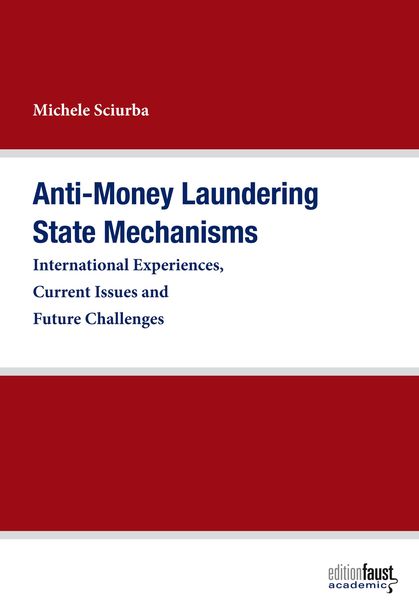
Anti-Money Laundering State Mechanisms International Experiences, Current Issues and Future Challenges
-
- Einzelkauf Download ausgewählt
-
Sprache:Englisch
47,99 €
inkl. gesetzl. MwSt.Beschreibung
Produktdetails
Format
ePUB
Kopierschutz
Nein
Family Sharing
Ja
Text-to-Speech
Ja
Erscheinungsdatum
01.05.2018
Verlag
Edition faustSeitenzahl
160 (Printausgabe)
Dateigröße
257 KB
Auflage
1. Auflage
Sprache
Englisch
EAN
9783945400623
This monograph offers a comprehensive analysis of the implementation of global anti-money laundering and counter-terrorism financing (AML/CTF) regulations in the United States and the European Union. It provides academics, legal professionals and interested readers with a deep understanding of the developments of the AML/CTF legal framework and guides them into the dimension of its most difficult relation with international and European human rights law.
The implementation of global anti-money laundering regulations in the United Stated and the European Union has essentially led to the suspension of laws governing privacy and bank secrecy. Banks and other financial institutions now operate as an extension of law enforcement. The current Anti-Money Laundering regime jeopardises the fundamental achievements of the constitutional state. The increasing centralisation and cooperation of the competent authorities in the exchange of personal data information creates a security architecture that leads to a considerable risk of freedom restriction. In particular, the extension of the authorities¿ power of intervention granting them access to citizens¿ personal data without the need for initial suspicion underlines that a substantial part of the constitutional state is at risk. Furthermore, banks appear to use these policies as an instrument to clear legitimate but less profitable customers, in particular those with a migration background. Consequently, the implementation of the AML/CTF legal framework appears to follow a discriminatory path and clearly discloses incompatibility features with respect to the European Convention on Human Rights and Article 21 of the Charter of Fundamental Human Rights of the European Union. This monograph further explores factors contributing to the inefficiency of AML/CTF regulatory and legislative measures. Such factors are identified in inconsistent rules, which make the cooperation among national investigative authorities within the EU and at an international level more challenging. As a result, this work acknowledges regulatory and legislative harmonisation with respect to AML/CTF regimes as a central tool to successfully improve the effectiveness of AML/CTF regimes, while preserving the individual right to privacy, due process and civil rights.
The implementation of global anti-money laundering regulations in the United Stated and the European Union has essentially led to the suspension of laws governing privacy and bank secrecy. Banks and other financial institutions now operate as an extension of law enforcement. The current Anti-Money Laundering regime jeopardises the fundamental achievements of the constitutional state. The increasing centralisation and cooperation of the competent authorities in the exchange of personal data information creates a security architecture that leads to a considerable risk of freedom restriction. In particular, the extension of the authorities¿ power of intervention granting them access to citizens¿ personal data without the need for initial suspicion underlines that a substantial part of the constitutional state is at risk. Furthermore, banks appear to use these policies as an instrument to clear legitimate but less profitable customers, in particular those with a migration background. Consequently, the implementation of the AML/CTF legal framework appears to follow a discriminatory path and clearly discloses incompatibility features with respect to the European Convention on Human Rights and Article 21 of the Charter of Fundamental Human Rights of the European Union. This monograph further explores factors contributing to the inefficiency of AML/CTF regulatory and legislative measures. Such factors are identified in inconsistent rules, which make the cooperation among national investigative authorities within the EU and at an international level more challenging. As a result, this work acknowledges regulatory and legislative harmonisation with respect to AML/CTF regimes as a central tool to successfully improve the effectiveness of AML/CTF regimes, while preserving the individual right to privacy, due process and civil rights.
Kundinnen und Kunden meinen
Verfassen Sie die erste Bewertung zu diesem Artikel
Helfen Sie anderen Kund*innen durch Ihre Meinung
Kurze Frage zu unserer Seite
Vielen Dank für dein Feedback
Wir nutzen dein Feedback, um unsere Produktseiten zu verbessern. Bitte habe Verständnis, dass wir dir keine Rückmeldung geben können. Falls du Kontakt mit uns aufnehmen möchtest, kannst du dich aber gerne an unseren Kund*innenservice wenden.
zum Kundenservice