• Produktbild: Machine Learning for Subsurface Characterization
  • Produktbild: Machine Learning for Subsurface Characterization
- 11%

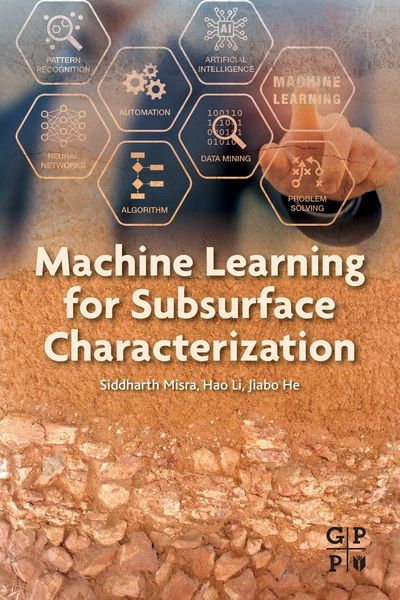
Machine Learning for Subsurface Characterization

11% sparen

126,99 € UVP 143,50 €

inkl. gesetzl. MwSt., Versandkostenfrei

Lieferung nach Hause

Beschreibung

Produktdetails

Einband

Taschenbuch

Erscheinungsdatum

29.10.2019

Verlag

Elsevier Science & Technology

Seitenzahl

442

Maße (L/B/H)

23/15,7/3 cm

Gewicht

660 g

Sprache

Englisch

ISBN

978-0-12-817736-5

Beschreibung

Produktdetails

Einband

Taschenbuch

Erscheinungsdatum

29.10.2019

Verlag

Elsevier Science & Technology

Seitenzahl

442

Maße (L/B/H)

23/15,7/3 cm

Gewicht

660 g

Sprache

Englisch

ISBN

978-0-12-817736-5

EU-Ansprechpartner

Zeitfracht Medien GmbH
Ferdinand-Jühlke-Straße 7|99095|Erfurt|DE
produktsicherheit@zeitfracht.de

Herstelleradresse

Elsevier Science & Technology
125 London Wall|EC2Y 5AS|London|GB
tradeorders@elsevier.com

Noch keine Bewertungen vorhanden

Verfassen Sie die erste Bewertung zu diesem Artikel

Helfen Sie anderen Kundinnen und Kunden durch Ihre Meinung.

Kundinnen und Kunden meinen

Bewertungen (0)

Die Leseprobe wird geladen.
  • Produktbild: Machine Learning for Subsurface Characterization
  • Produktbild: Machine Learning for Subsurface Characterization
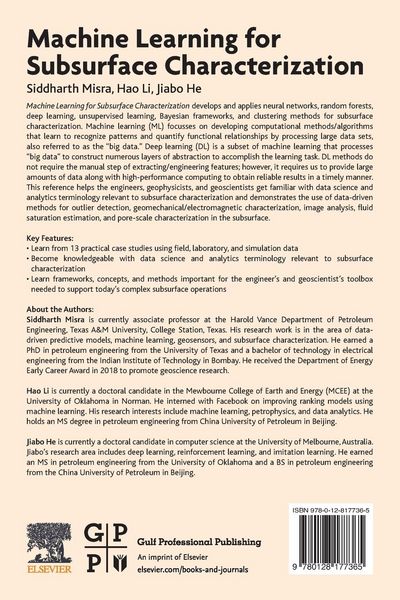
  • 1. Unsupervised outlier detection techniques for well logs and geophysical data2. Unsupervised clustering methods for noninvasive characterization of fracture-induced geomechanical alterations3. Shallow neural networks and classification methods for approximating the subsurface in situ fluid-filled pore size distribution4. Stacked neural network architecture to model themultifrequency conductivity/permittivity responses of subsurface shale formations5. Robust geomechanical characterization by analyzing the performance of shallow-learning regression methods using unsupervised clustering methods6. Index construction, dimensionality reduction, and clustering techniques for the identification of flow units in shale formations suitable for enhanced oil recovery using light-hydrocarbon injection7. Deep neural network architectures to approximate the fluid-filled pore size distributions of subsurface geological formations8. Comparative study of shallow and deep machine learning models for synthesizing in situ NMR T2 distributions9. Noninvasive fracture characterization based on the classification of sonic wave travel times10. Machine learning assisted segmentation of scanning electron microscopy images of organic-rich shales with feature extraction and feature ranking11. Generalization of machine learning assisted segmentation of scanning electron microscopy images of organic-rich shales12. Characterization of subsurface hydrocarbon/water saturation by processing subsurface electromagnetic logs using a modified Levenberg-Marquardt algorithm13. Characterization of subsurface hydrocarbon/water saturation using Markov-chain Monte Carlo stochastic inversion of broadband electromagnetic logs