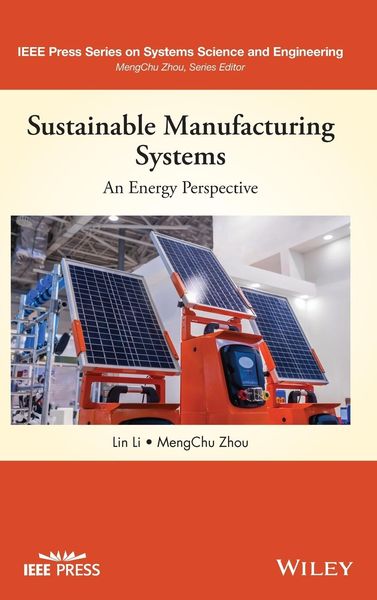
Sustainable Manufacturing Systems: An Energy Perspective
161,99 €
inkl. gesetzl. MwSt.,
Beschreibung
Produktdetails
Einband
Gebundene Ausgabe
Erscheinungsdatum
22.11.2022
Verlag
John Wiley & Sons IncSeitenzahl
432
Maße (L/B/H)
23,5/15,7/2,8 cm
Gewicht
775 g
Auflage
1. Auflage
Sprache
Englisch
ISBN
978-1-119-57824-6
Learn more about energy efficiency in traditional and advanced manufacturing settings with this leading and authoritative resource
Sustainable Manufacturing Systems: An Energy Perspective delivers a comprehensive analysis of energy efficiency in sustainable manufacturing. The book presents manufacturing modeling methods and energy efficiency evaluation and improvement methods for different manufacturing systems. It allows industry professionals to understand the methodologies and techniques being embraced around the world that lead to advanced energy management.
The book offers readers a comprehensive and systematic theoretical foundation for novel manufacturing system modeling, analysis, and control. It concludes with a summary of the insights and applications contained within and a discussion of future research issues that have yet to be grappled with.
Sustainable Manufacturing Systems answers the questions that energy customers, managers, decision makers, and researchers have been asking about sustainable manufacturing. The book's release coincides with recent and profound advances in smart grid applications and will serve as a practical tool to assist industrial engineers in furthering the green revolution. Readers will also benefit from:
* A thorough introduction to energy efficiency in manufacturing systems, including the current state of research and research methodologies
* An exploration of the development of manufacturing methodologies, including mathematical modeling for manufacturing systems and energy efficiency characterization in manufacturing systems
* An analysis of the applications of various methodologies, including electricity demand response for manufacturing systems and energy control and optimization for manufacturing systems utilizing combined heat and power systems
* A discussion of energy efficiency in advanced manufacturing systems, like stereolithography additive manufacturing and cellulosic biofuel manufacturing systems
Perfect for researchers, undergraduate students, and graduate students in engineering disciplines, especially for those majoring in industrial, mechanical, electrical, and environmental engineering, Sustainable Manufacturing Systems will also earn a place in the libraries of management and business students interested in manufacturing system cost performance and energy management.
Noch keine Bewertungen vorhanden
Verfassen Sie die erste Bewertung zu diesem Artikel
Helfen Sie anderen Kundinnen und Kunden durch Ihre Meinung.
Kurze Frage zu unserer Seite
Vielen Dank für dein Feedback
Wir nutzen dein Feedback, um unsere Produktseiten zu verbessern. Bitte habe Verständnis, dass wir dir keine Rückmeldung geben können. Falls du Kontakt mit uns aufnehmen möchtest, kannst du dich aber gerne an unseren Kund*innenservice wenden.
zum Kundenservice