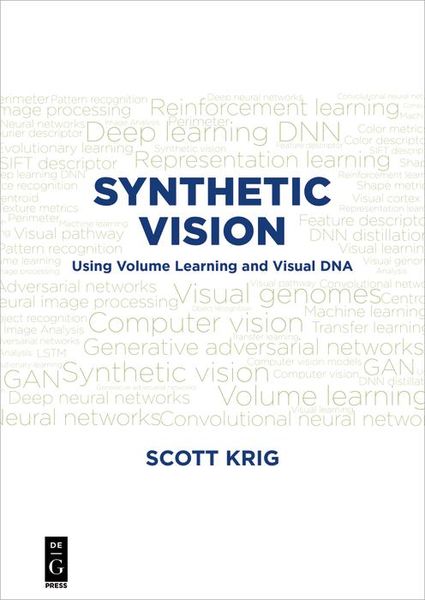
Synthetic Vision Using Volume Learning and Visual DNA
-
- Taschenbuch
- eBook ausgewählt
-
Form:Einzelkauf Download
-
Sprache:Englisch
-
eBook Format:PDF
- PDF 134,95 € ausgewählt
- ePUB 134,95 €
134,95 €
inkl. gesetzl. MwSt.Beschreibung
Produktdetails
Format
Kopierschutz
Nein
Family Sharing
Nein
Text-to-Speech
Nein
Erscheinungsdatum
06.08.2018
Verlag
De|G PressSeitenzahl
368 (Printausgabe)
Dateigröße
8502 KB
Auflage
1. Auflage
Sprache
Englisch
EAN
9781501505966
In Synthetic Vision: Using Volume Learning and Visual DNA, a holistic model of the human visual system is developed into a working model in C++, informed by the latest neuroscience, DNN, and computer vision research. The author's synthetic visual pathway model includes the eye, LGN, visual cortex, and the high level PFC learning centers. The corresponding visual genome model (VGM), begun in 2014, is introduced herein as the basis for a visual genome project analogous to the Human Genome Project funded by the US government. The VGM introduces volume learning principles and Visual DNA (VDNA) taking a multivariate approach beyond deep neural networks. Volume learning is modeled as programmable learning and reasoning agents, providing rich methods for structured agent classification networks. Volume learning incorporates a massive volume of multivariate features in various data space projections, collected into strands of Visual DNA, analogous to human DNA genes. VGM lays a foundation for a visual genome project to sequence VDNA as visual genomes in a public database, using collaborative research to move synthetic vision science forward and enable new applications. Bibliographical references are provided to key neuroscience, computer vision, and deep learning research, which form the basis for the biologically plausible VGM model and the synthetic visual pathway. The book also includes graphical illustrations and C++ API reference materials to enable VGM application programming. Open source code licenses are available for engineers and scientists.
Scott Krig founded Krig Research to provide some of the world's first vision and imaging systems worldwide for military, industry, government, and academic use. Krig has worked for major corporations and startups in the areas of machine learning, computer vision, imaging, graphics, robotics and automation, computer security and cryptography. He has authored international patents in the areas of computer architecture, communications, computer security, digital imaging, and computer vision, and studied at Stanford. Scott Krig is the author of the English/Chinese Springer book Computer Vision Metrics, Survey, Taxonomy and Analysis of Computer Vision, Visual Neuroscience, and Deep Learning, Textbook Edition, as well as other books, articles, and papers.
Noch keine Bewertungen vorhanden
Verfassen Sie die erste Bewertung zu diesem Artikel
Helfen Sie anderen Kundinnen und Kunden durch Ihre Meinung.
Kurze Frage zu unserer Seite
Vielen Dank für dein Feedback
Wir nutzen dein Feedback, um unsere Produktseiten zu verbessern. Bitte habe Verständnis, dass wir dir keine Rückmeldung geben können. Falls du Kontakt mit uns aufnehmen möchtest, kannst du dich aber gerne an unseren Kund*innenservice wenden.
zum Kundenservice