KI-Beratung Beta

  • Produktbild: Computational and Corpus Approaches to Chinese Language Learning
  • Produktbild: Computational and Corpus Approaches to Chinese Language Learning
- 12%

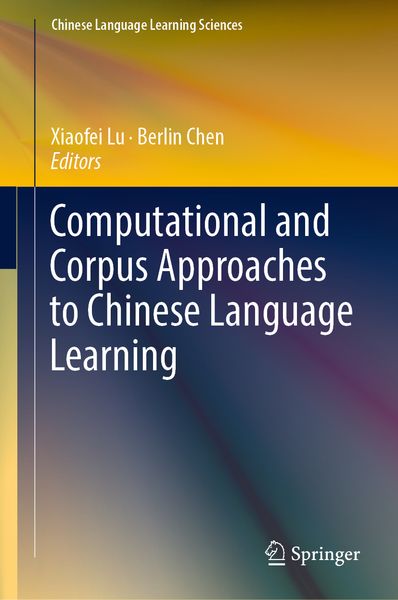
Computational and Corpus Approaches to Chinese Language Learning

12% sparen

93,99 € UVP 106,99 €

inkl. gesetzl. MwSt., Versandkostenfrei


Beschreibung

Produktdetails

Einband

Gebundene Ausgabe

Erscheinungsdatum

25.02.2019

Abbildungen

VIII, 269 p. 107 illus., 30 illus. in color.

Herausgeber

Xiaofei Lu + weitere

Verlag

Springer Singapore

Seitenzahl

269

Maße (L/B/H)

24,1/16/2,1 cm

Gewicht

536 g

Auflage

19001 Auflage 1st edition 2019

Sprache

Englisch

ISBN

978-981-13-3569-3

Beschreibung

Portrait


Xiaofei Lu is an Associate Professor of Applied Linguistics and Asian Studies at The Pennsylvania State University, where he directs the graduate programs in the Department of Applied Linguistics. His research interests include corpus linguistics, computational linguistics, intelligent computer-assisted language learning, English for academic purposes, and second language writing. He is the author of
Computational Methods for Corpus Annotation and Analysis
(Springer, 2014), and his work has been published in the
American Educational Research Journal
,
Applied Linguisti
cs,
Educational Researcher
,
English for Specific Purposes
,
International Journal of Corpus Linguistics
,
Journal of Pragmatics
,
Journal of Second Language Writing
,
Language Learning and Technology
,
Language Resources and Evaluation
,
Language Testing
,
ReCALL
,
TESOL Quarterly
, and
The Modern Language Journal
.


Berlin Chen is a Professor and Chair of the Computer Science and Information Engineering Department at National Taiwan Normal University. He received his Ph.D. in Computer Science and Information Engineering from National Taiwan University in June 2001, and joined NTNU as an Assistant Professor in August 2002. He became an Associate Professor in August 2006 and was promoted to the rank of Professor in February 2010. His research interests lie in the general areas of speech and natural language processing, multimedia information retrieval, and computer-assisted language learning. He is the author/coauthor of over 150 academic publications. Prof. Chen is a member of IEEE, ISCA and ACLCLP.

Produktdetails

Einband

Gebundene Ausgabe

Erscheinungsdatum

25.02.2019

Abbildungen

VIII, 269 p. 107 illus., 30 illus. in color.

Herausgeber

Verlag

Springer Singapore

Seitenzahl

269

Maße (L/B/H)

24,1/16/2,1 cm

Gewicht

536 g

Auflage

19001 Auflage 1st edition 2019

Sprache

Englisch

ISBN

978-981-13-3569-3

Herstelleradresse

Springer-Verlag GmbH
Europaplatz 3
69115 Heidelberg
DE

Email: ProductSafety@springernature.com

Noch keine Bewertungen vorhanden

Verfassen Sie die erste Bewertung zu diesem Artikel

Helfen Sie anderen Kundinnen und Kunden durch Ihre Meinung.

Kundinnen und Kunden meinen

Bewertungen (0)

Weitere Artikel findest du in

  • Produktbild: Computational and Corpus Approaches to Chinese Language Learning
  • Produktbild: Computational and Corpus Approaches to Chinese Language Learning

  • Part I Introduction.- Computational and Corpus Approaches to Chinese Language Learning: An Introduction.- Usage-based Theory of Language Learning Necessitates Computational and Corpus Methods in Language Teaching.- The Corpus Approach to the Teaching and Learning of Chinese as an L1 and an L2 in Retrospect.- Part II Tools, Resources and General Applications.- Academic Chinese: From Corpora to Language Teaching.- Pedagogical Applications of Chinese Parallel Corpora.- Data-driven Adapting for Fine-tuning Chinese Teaching Materials: Using Corpora as Benchmarks.- Part III Specific Applications.- Context Analysis for Computer-Assisted Near-Synonym Learning.- Visualization of Stylistic Differences between Chinese Synonyms.- Using Corpus-based Analysis of Neologisms on China's New Media for Teaching.- Part IV Learner Language Analysis and Assessment.- Acquisition of the Chinese Particle
    le
    by L2 Learners: A Corpus-based Approach.- Mandarin Chinese Mispronunciation Detection and Diagnosis Leveraging Deep Neural Network based Acoustic Modeling and Training Techniques.- Automated Chinese Error Diagnosis for Language Learners: Resources and Evaluations.- Automated Chinese Essay Scoring based on Multi-level Linguistic Features.