Produktbild: Handbook of Community Well-Being Research
- 12%

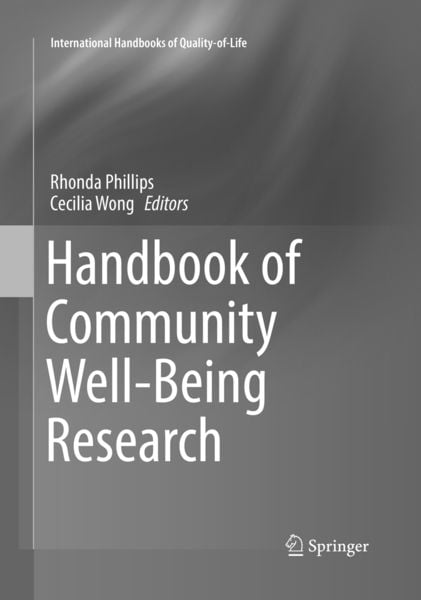
Handbook of Community Well-Being Research

12% sparen

356,99 € UVP 406,59 €

inkl. gesetzl. MwSt., Versandkostenfrei

Lieferung nach Hause

Beschreibung

Produktdetails

Einband

Taschenbuch

Erscheinungsdatum

20.07.2018

Abbildungen

XXXVIII, 82 illus., schwarz-weiss Illustrationen

Herausgeber

Rhonda Phillips + weitere

Verlag

Springer Netherland

Seitenzahl

592

Maße (L/B/H)

25,4/17,8/3,4 cm

Gewicht

1171 g

Auflage

Softcover reprint of the original 1st ed. 2017

Sprache

Englisch

ISBN

978-94-024-1425-7

Beschreibung

Rezension

“‘Handbook of Community Well-Being Research,’ edited by Ronda Phillips and Cecilia Wong (2017), brings together foundational and leading-edge research that reflects the complexity of the central notion mainstreaming the multidisciplinary approach of the work: community well-being and its expression in the geographical space. … the work invites us to assume shared initiatives with the academia, policymakers and the community at large to be able to move forward in the understanding of the achievement of well-being in all community dimensions.” (Marisa Cristina Sagua, Applied Research in Quality of Life, Vol. 13, 2018)


Portrait

Rhonda Phillips' research and outreach efforts focus on quality of life and well-being related to community and economic development. At Purdue, she serves as Dean of the Honors College, and a Professor in the Agricultural Economics Department. Rhonda is author or editor of 20 books, including Sustainable Communities, Creating a Durable Local Economy; Community Development Indicators Measuring Systems; and Introduction to Community Development. She is editor of the series Community Quality of Life and Well-Being. Formerly a Senior Sustainability Scientist with the Global Institute of Sustainability, Rhonda served as director and professor in the School of Community Resources and Development at Arizona State University, and founding director of the University of Florida’s Center for Building Better Communities. She is a member of the College of Fellows of the American Institute of Certified Planners (FAICP). She is currently President of the International Society for Quality-of-Life Studies and a co-researcher with the Community Wellbeing Institute, a Social Science Korea Project.

Cecilia Wong is Professor of Spatial Planning and Director of Centre for Urban Policy Studies at the University of Manchester. She is a Fellow of the UK Academy of Social Sciences, Co-Editor of Town Planning Review, and Member of the UK Economic and Social Research Council’s Grant Assessment Panel. She is a chartered town planner and received degrees from the Chinese University of Hong Kong, the University of Liverpool and the University of Manchester. Her research interests include quantitative indicators, spatial policy monitoring and analysis, urban and regional development, and housing and infrastructure planning. She has conducted major research projects for the UK central government departments, Economic and Social Research Council, Joseph Rowntree Foundation, Royal Town Planning Institute, and regional and local bodies. She was a commissioner of theUK Labour Party’s Lyons Housing Review and expert panel members of Department for Community and Local Government’s planning and housing panel, the European Commission’s Urban Audit II and the UN-Habitat City Prosperity Index (Middle East).
Produktdetails

Einband

Taschenbuch

Erscheinungsdatum

20.07.2018

Abbildungen

XXXVIII, 82 illus., schwarz-weiss Illustrationen

Herausgeber

Verlag

Springer Netherland

Seitenzahl

592

Maße (L/B/H)

25,4/17,8/3,4 cm

Gewicht

1171 g

Auflage

Softcover reprint of the original 1st ed. 2017

Sprache

Englisch

ISBN

978-94-024-1425-7

Herstelleradresse

Springer-Verlag KG
Sachsenplatz 4-6
1201 Wien
AT

Email: [email protected]

Kundinnen und Kunden meinen

0 Bewertungen

Informationen zu Bewertungen

Zur Abgabe einer Bewertung ist eine Anmeldung im Konto notwendig. Die Authentizität der Bewertungen wird von uns nicht überprüft. Wir behalten uns vor, Bewertungstexte, die unseren Richtlinien widersprechen, entsprechend zu kürzen oder zu löschen.

Die Bewertungen sind nach Format, Anzahl Sterne und Datum sortiert.

Verfassen Sie die erste Bewertung zu diesem Artikel

Helfen Sie anderen Kund*innen durch Ihre Meinung

Kundinnen und Kunden meinen

0 Bewertungen filtern

  • Produktbild: Handbook of Community Well-Being Research
  • Part I. Foundations.- Chapter 1. Community Functioning that Fosters Sustainable Personal Well Being, Ronald E. Anderson.- Chapter 2. Self-Expression and Elite-Challenging Activities:  A Punk Rock Approach to Community Well- Being; Craig Talmage, C. Bjorn Peterson and Richard Knopf.- Chapter 3. The ART of Hope: Healing the Wounded City; Derek Cook.-  Chapter 4. A  Multi-Dimensional Model of Community Well-being from a Public Service Delivery Perspective.- Chapter 5. Sustainable Neighborhoods for Happiness: A Framework for a Sustainable Future; Scott Cloutier and Deirdre Pfeiffer.- Part II. Engaging and Participating for Well-Being.- Chapter 6. Community-University Engagement for Community Well-Being with Métis Settlements in Alberta, Canada; Fay Fletcher, Alice Hibbert and Brent Hammer.- Chapter 7. Achieving Development and Community Well-being through Participatory Governance: The Case of Saemaul [New Community] Movement; Seung Jong Lee, Seoul National University, and Yunji Kim.- Chapter 8. A Citizen-Led Approach to Enhancing Community Well-Being; Sylvia Cheuy, Tamarack, Leesa Fawcett, Karen Hutchinson and Tracey Robertson.- Chapter 9. Digital Communications and Community Well-being; Claire Wallace and Kathryn Vincent.- Chapter 10. Festivity, Play, Well-Being: A Relationship and its Implications for Community Development; Vern Biaett.- Part III. The “Health” of Well-Being.- Chapter 11. What We Can Learn from America’s Highest Well-Being Communities; Dan Witters.- Chapter 12. Public Health and Urban Planning: Challenging Options for Well-Being; Sabine Baumgart.- Chapter 13. Community-Driven Health Impact Assessment and Asset Based Community Development: An Innovative Path to Community Well-Being; Colleen Cameron and Tanya Wasacase.- Chapter 14. The Human Development Approach Stimulates a Fact-Based Conversation in Sonoma County, California; Sarah Burd-Sharps, Patrick Nolan Guyer and Kristen Lewis.- Chapter 15. Community Capacity in End of Life Care: Can a Community Development Model Address Suffering and Enhance Well-Being?; Kyle Whitfield and Martin LaBrie.- Part IV. Planning, Design, and Measuring.- Chapter 16. From National to Local: Measuring Well-Being at the Community Level; Bryan Smale and Margo Hilbrecht.- Chapter 17. Building Well-Being: Community Flourishing and Tools for Collaborative Urban Design; Jamie Anderson and Cathy Baldwin.- Chapter 18. Stakeholder Preferences on a Working Waterfront: Quality of Life, Land Uses and Planning Processes in Chelsea, Massachusetts; Justin Hollander and Jessica Soule.- Chapter 19. LISADEMAS: A Life Satisfaction Decision Making System for Integrated Community Development Planning; Vaios Kotsios.- Chapter 20. A Geographic and Mixed Methods Approach to Capture Unequal Quality of Life Conditions; Javier Martinez, Jeroen Verplanke and Gianluca Miscione.- Chapter 21. Community Quality-of-Life Indicators: Distinguishing Distressed Communities from Flourishing Communities; M. Joseph Sirgy, Don R. Rahtz, and Clifford J. Shultz II.- Chapter 22. Integrating Community Well-being and Happiness: Applications in Seoul, Korea and Frankfurt, Germany; Yunji Kim and Kai Ludwigs.-  Chapter 23. Delivering Community Well-Being from the Happy City Concept: A Practical Approach to Urban Planning and Design; Tzu-Yuan Stessa Chao with students at the Department of Urban Planning (Shao-Kuan Liu, Balint Kalman, Hsin-Chieh Cindy Lu, Miaoqi Cai).- Part V. Community Concepts and Applications.- Chapter 24. The Role of Community Based Organizations in Poverty Reduction and Improving Community Well-being: The Case of the Saemaul Women’s Club; Oe-Chool Choi.- Chapter 25. Material and Sociocultural Disconnections: Perceptions of Well-Being in Rural Wales; Paul Milbourne and Brian Webb.- Chapter 26. The Role of Spirituality and Religion in Building Capacity for Women’s Leadership in Crisis Conditions:  A Community Level Analysis of Burma; Phyusin Myint.- Chapter 27. The Decisive Contribution of Youth to Community Well-Being; Ilya Shodjaee-Zrudlo and Hoda Farahmandpour.- Chapter 28. Community Well-being and National Well-being: The Opinion of Young People; Graciela Tonon.- Chapter 29. Understanding the Success of Alberta’s Early Child Development Community Coalitions; Samantha Berger and Launa Clark.- Chapter 30. The Green Machine Mobile Food Market: An Innovative Response to Inner City Food Security, Antonio Raciti and Kenneth M. Reardon.- Chapter 31. Is Living Wage Always a Burden for Employers? A Study of Living Wage Effects on Work Performance Indicators in Hamilton; Zhaocheng Zeng and Benson Honig.