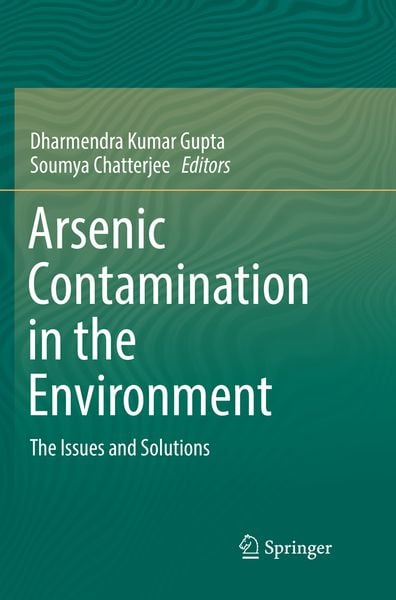
Arsenic Contamination in the Environment The Issues and Solutions
-
- Hardcover
- Taschenbuch ausgewählt
- eBook
-
Sprache:Englisch
97,99 €
inkl. gesetzl. MwSt.,
Lieferung nach Hause
Beschreibung
Produktdetails
Einband
Taschenbuch
Erscheinungsdatum
02.08.2018
Abbildungen
XV, 18 illus., 17 illus. in color., farbige Illustrationen, schwarz-weiss Illustrationen
Herausgeber
Dharmendra Kumar Gupta + weitereVerlag
SpringerSeitenzahl
218
Maße (L/B/H)
23,5/15,5/1,3 cm
Gewicht
365 g
Auflage
Softcover reprint of the original 1st ed. 2017
Sprache
Englisch
ISBN
978-3-319-85377-2
This book provides an overview to researchers, graduate, and undergraduate students, as well as academicians who are interested in arsenic. It covers human health risks and established cases of human ailments and sheds light on prospective control measures, both biological and physico-chemical.
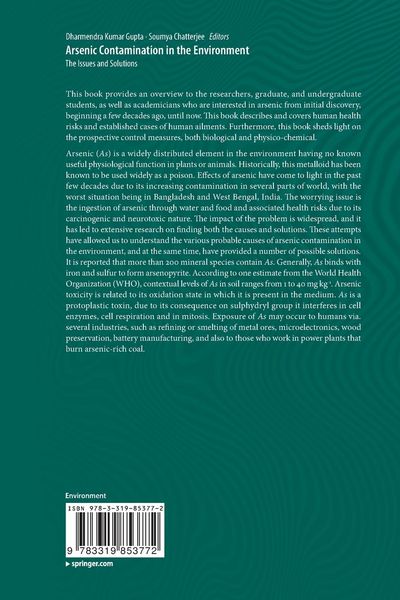
Arsenic ( As ) is a widely distributed element in the environment having no known useful physiological function in plants or animals. Historically, this metalloid has been known to be used widely as a poison. Effects of arsenic have come to light in the past few decades due to its increasing contamination in several parts of world, with the worst situation being in Bangladesh and West Bengal, India. The worrying issue is the ingestion of arsenic through water and food and associated health risks due to its carcinogenic and neurotoxic nature. The impact of the problem is widespread, and it has led to extensive research on finding both the causes and solutions. These attempts have allowed us to understand the various probable causes of arsenic contamination in the environment, and at the same time, have provided a number of possible solutions. It is reported that more than 200 mineral species contain As . Generally, As binds with iron and sulfur to form arsenopyrite. According to one estimate from the World Health Organization (WHO), contextual levels of As in soil ranges from 1 to 40 mg kg -1 . Arsenic toxicity is related to its oxidation state which is present in the medium. As is a protoplastic toxin, due to its consequence on sulphydryl group it interferes in cell enzymes, cell respiration and in mitosis. Exposure of As may occur to humans via several industries, such as refining or smelting of metal ores, microelectronics, wood preservation, battery manufacturing, and also to those who work in power plants that burn arsenic-rich coal.
Kundinnen und Kunden meinen
Verfassen Sie die erste Bewertung zu diesem Artikel
Helfen Sie anderen Kund*innen durch Ihre Meinung
Kurze Frage zu unserer Seite
Vielen Dank für dein Feedback
Wir nutzen dein Feedback, um unsere Produktseiten zu verbessern. Bitte habe Verständnis, dass wir dir keine Rückmeldung geben können. Falls du Kontakt mit uns aufnehmen möchtest, kannst du dich aber gerne an unseren Kund*innenservice wenden.
zum Kundenservice