KI-Beratung Beta

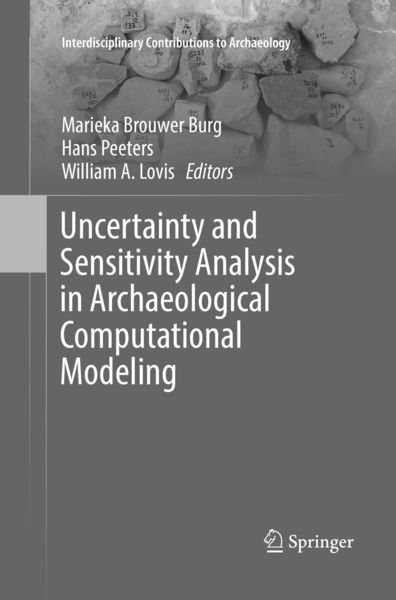
Produktbild: Uncertainty and Sensitivity Analysis in Archaeological Computational Modeling

Uncertainty and Sensitivity Analysis in Archaeological Computational Modeling

51,99 €

inkl. gesetzl. MwSt., Versandkostenfrei


Beschreibung

This volume deals with the pressing issue of uncertainty in archaeological modeling. Detecting where and when uncertainty is introduced to the modeling process is critical, as are strategies for minimizing, reconciling, or accommodating such uncertainty. Included chapters provide unique perspectives on uncertainty...

Beschreibung

This
volume deals with the pressing issue of uncertainty in archaeological modeling.
Detecting where and when uncertainty is introduced to the modeling process is
critical, as are strategies for minimizing, reconciling, or accommodating such
uncertainty. Included chapters provide unique perspectives on uncertainty in
archaeological modeling, ranging in both theoretical and methodological
orientation. The strengths and weaknesses of various identification and
mitigation techniques are discussed, in particular sensitivity analysis. The
chapters demonstrate that for archaeological modeling purposes, there is no
quick fix for uncertainty; indeed, each archaeological model requires intensive
consideration of uncertainty and specific applications for calibration and
validation. As very few such techniques have been problematized in a systematic
manner or published in the archaeological literature, this volume aims to
provide guidance and direction to other modelers in the field by distilling
some basic principles for model testing derived from insight gathered in the
case studies presented. Additionally, model applications and their attendant
uncertainties are presented from distinct spatio-temporal contexts and will
appeal to a broad range of archaeological modelers. This volume will also be of
interest to non-modeling archaeologists, as consideration of uncertainty when
interpreting the archaeological record is also a vital concern for the
development of non-formal (or implicit) models of human behavior in the past.


Portrait


Marieka Brouwer Burg
(Ph.D. 2011
Michigan State University)

is
Lecturer of Anthropology in the Department of Anthropology at the University of
New Hampshire, New Hampshire, USA. She is interested in the effects of
landscape evolution and climate change on human communities, as well as
reconstructing decision processes and perceptions of landscape in the past. She
uses GIS-based archaeological computational modeling to explore these processes
in both Old and New World contexts. Her current research focuses on investigating
the spatiotemporal dimensions of ancient Maya mobility and socioeconomic
interactions in the central Belize River Valley, Belize.

J.H.M. Peeters
(Ph.D. 2007 University of Amsterdam) is Associate Professor of Prehistoric Archaeology at the Groningen Institute of Archaeology, University of Groningen.  Research interests include Hunter-Gatherer Archaeology and Ethnography; Landscape Archaeology; Lithic Technology; Computational Modeling; Site Formation Dynamics and Fractal Geometry.  Current research projects include Late Glacial and Holocene Hunter-Gatherer Landscape Use of the North Sea Basin; Mesolithic Lithic Technology; Hunter-Gatherer Pyro-Technology; Dynamics of Intra-Site Spatial Patterning.

William A. Lovis
(Ph.D. 1973 Michigan
State University) is Professor and Curator of Anthropology in the Department of
Anthropology and MSU Museum at Michigan State University, Michigan, USA. His research
interests include Hunter-Gatherer Archaeology and Ethnography; The Transition
to Horticulture; Applied Theory, Analytic Methods and Research Design; Human-Environment
Interactions and Regional Taphonomy; Paleoenvironmental Change; Public Policy
including Forensic Archaeology, Law Enforcement Training, and Repatriation; Great
Lakes/Midwest and Europe. Current research projects include archaeological site
taphonomy and preservation in the Lake Michigan coastal dunes, Mesolithic
regional settlement and mobility in Yorkshire, northern England, and hemispheric
climate impacts on Great Lakes coastal dune evolution and activation cycling.

Produktdetails

Einband

Taschenbuch

Erscheinungsdatum

26.05.2018

Abbildungen

XVI, 175 p. 31 illus., 7 illus. in color.

Herausgeber Marieka Brouwer Burg + weitere

Produktdetails

Einband

Taschenbuch

Erscheinungsdatum

26.05.2018

Abbildungen

XVI, 175 p. 31 illus., 7 illus. in color.

Herausgeber
Verlag Springer
Seitenzahl

175

Maße (L/B/H)

23,5/15,5/1,1 cm

Gewicht

300 g

Auflage

Softcover reprint of the original 1st ed. 2016

Sprache

Englisch

ISBN

978-3-319-80225-1

Herstelleradresse

Springer-Verlag GmbH
Tiergartenstr. 17
69121 Heidelberg
DE

Email: ProductSafety@springernature.com

Noch keine Bewertungen vorhanden

Verfassen Sie die erste Bewertung zu diesem Artikel

Helfen Sie anderen Kundinnen und Kunden durch Ihre Meinung.

Kundinnen und Kunden meinen

Bewertungen (0)

  • Produktbild: Uncertainty and Sensitivity Analysis in Archaeological Computational Modeling

  • Preface.- Chapter 1:Introduction (
    Marieka
    Brouwer Burg, J.H.M. Peeters, and William A. Lovis
    ).- Chapter 2: Is
    There a Research Design Role for Sensitivity Analysis (SA) in Archaeological Modeling? (
    William
    A. Lovis
    ).- Chapter 3: Epistemic
    Considerations About Uncertainty and Model Selection in Computational
    Archaeology: A Case Study on Exploratory Modeling (
    J.H.M. 
    Peeters and Jan-Willem Romeijn
    ).- Chapter 4: GIS-Based
    Modeling of Archaeological Dynamics (GMAD): Weaknesses, Strengths, and the
    Utility of Sensitivity Analysis (
    Marieka Brouwer Burg
    ).- Chapter 5: Assessing Nonlinear Behaviors in an
    Agent Based Model (
    Jon W. Carroll
    ).- Chapter 6: Scale
    Dependency in Agent-Based Modeling: How Many Time Steps? How Many Simulations?
    How Many Agents? (
    Joshua Watts
    ).- Chapter 7: The
    Sensitivity of Demographic Characteristics to the Strength of the Population
    Stabilizing Mechanism in a Model Hunter-Gatherer System(
    Andrew A. White
    ).- Chapter 8: Archaeological
    Simulation and the Testing Paradigm (
    Thomas G. Whitley
    ).- Chapter 9: “Uncertainties” (
    Sander van der Leeuw)
    .