Produktbild: Soil Science Working for a Living

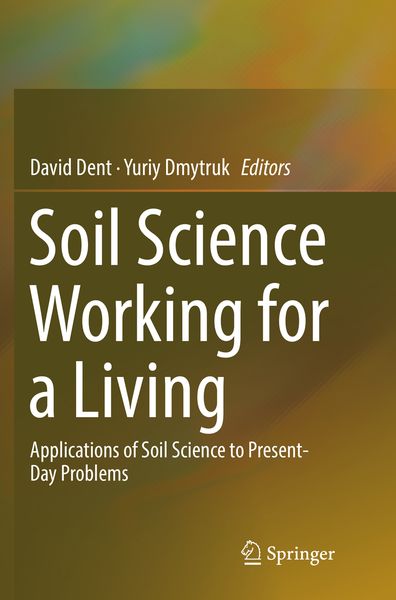
Soil Science Working for a Living Applications of soil science to present-day problems

147,99 €

inkl. gesetzl. MwSt., Versandkostenfrei

Lieferung nach Hause

Beschreibung

Produktdetails

Einband

Taschenbuch

Erscheinungsdatum

29.04.2018

Abbildungen

XIII, 89 illus., 50 illus. in color., farbige Illustrationen, schwarz-weiss Illustrationen

Herausgeber

David Dent + weitere

Verlag

Springer

Seitenzahl

290

Maße (L/B/H)

23,5/15,5/1,6 cm

Gewicht

519 g

Auflage

Softcover reprint of the original 1st edition 2017

Sprache

Englisch

ISBN

978-3-319-83288-3

Beschreibung

Produktdetails

Einband

Taschenbuch

Erscheinungsdatum

29.04.2018

Abbildungen

XIII, 89 illus., 50 illus. in color., farbige Illustrationen, schwarz-weiss Illustrationen

Herausgeber

Verlag

Springer

Seitenzahl

290

Maße (L/B/H)

23,5/15,5/1,6 cm

Gewicht

519 g

Auflage

Softcover reprint of the original 1st edition 2017

Sprache

Englisch

ISBN

978-3-319-83288-3

Herstelleradresse

Springer-Verlag GmbH
Tiergartenstr. 17
69121 Heidelberg
DE

Email: [email protected]

Kundinnen und Kunden meinen

0 Bewertungen

Informationen zu Bewertungen

Zur Abgabe einer Bewertung ist eine Anmeldung im Konto notwendig. Die Authentizität der Bewertungen wird von uns nicht überprüft. Wir behalten uns vor, Bewertungstexte, die unseren Richtlinien widersprechen, entsprechend zu kürzen oder zu löschen.

Die Bewertungen sind nach Format, Anzahl Sterne und Datum sortiert.

Verfassen Sie die erste Bewertung zu diesem Artikel

Helfen Sie anderen Kund*innen durch Ihre Meinung

Kundinnen und Kunden meinen

0 Bewertungen filtern

  • Produktbild: Soil Science Working for a Living
  • Editors' introduction.- Part I: Soil development: properties and qualities.- Chapter 1. The factors and conditions of soil formation: a critical analysis of equivalence.- Chapter 2. Redoximorphic features in Albeluvisols from south-western Ukraine.- Chapter 3. Fractal properties of coarse/fine-related distribution in forest soils on colluvium.- Part II: Assessment of resources and risks.-  Chapter 4. The last steppes: new perspectives on an old challenge.- Chapter 5. Using multispectral satellite imagery for parameterization of eroded Chernozem.- Chapter 6. Pedo-geochemical assessment of a Holsteinian occupation site.- Chapter 7. Using geostatistics, DEM and remote sensing to clarify soil cover maps of Ukraine.- Chapter 8. Making better soil maps using models of tangential curvature.- Chapter 9. Determination of soil-loss tolerance for Chernozem of right-bank Ukraine.- Chapter 10. Assessment of problems of soil contamination using environmental indicators.- Chapter 11.Mathematical tools to assess soil contamination by deposition of technogenic emissions.- Part III: Soil fertility, degradation and improvement.- Chapter 12. Theoretical problems of improving agrochemical terminology.- Chapter 13. Criteria and parameters for forecasting the direction of irrigated soil evolution.- Chapter 14. Sustainability of soil fertility in the southern steppe of the Ukraine depending on fertilizers and irrigation.- Chapter 15. Evolution of potassium reserves in Chernozem under different fertilizer strategies, and indicators of potency.- Chapter 16. Ecological reclamation of acid soils.- Chapter 17. Composition of mobile phosphate fractions in soils of the Pre-Carpathians influenced by drainage, lime and phosphate fertilizer.- Part IV: Soil contamination, monitoring and remediation.- Chapter 18. Toxic soil contamination and its mitigation in Ukraine.- Chapter 19. Heavy metals in soils under the heel of heavy industry.- Chapter 20. Dangerous mercury contamination around the former Radikal chemicals factory in Kyiv and possible ways of rehabilitating this area.- Chapter 21. Comparison of groundwater and surface water quality in the area of the Bilanovo iron deposit.- Chapter 22. Estimation of soil radiation in the country around the Bilanovo iron and Kremenchug uranium deposits.- Chapter 23. Estimation of soil radiation in the country around the Dibrova uranium-thorium-rare earth deposit.- Chapter 24. Lead and zinc speciation in soils and their transfer in vegetation.- Chapter 25. Copper and zinc in the soils of the Olviya archaeological site.- Chapter 26. Environmental assessment of soil based on fractional-group composition of heavy metals.- Chapter 27. Regularity of transformations of oil-contaminated microbial ecosystems by super-oxidation technology and subsequent bio-remediation.- Chapter 28. Transformation of non-polar hydrocarbons in soils.