• Produktbild: Broadening the Scope of Research on Mathematical Problem Solving
  • Produktbild: Broadening the Scope of Research on Mathematical Problem Solving

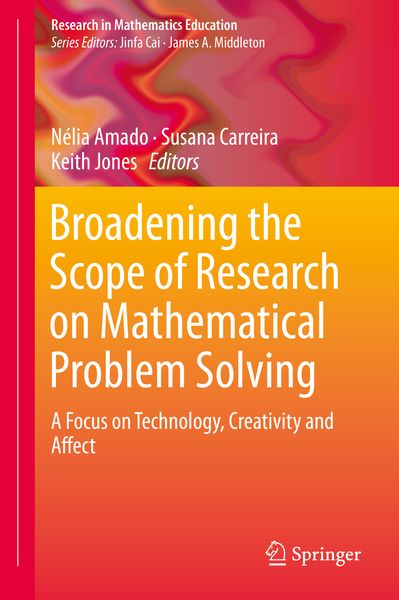
Broadening the Scope of Research on Mathematical Problem Solving A Focus on Technology, Creativity and Affect

105,99 €

inkl. gesetzl. MwSt., Versandkostenfrei

Lieferung nach Hause

Beschreibung

Produktdetails

Einband

Gebundene Ausgabe

Erscheinungsdatum

13.12.2018

Abbildungen

XI, 224 illus., 141 illus. in color., farbige Illustrationen, schwarz-weiss Illustrationen

Herausgeber

Nélia Amado + weitere

Verlag

Springer

Seitenzahl

579

Maße (L/B/H)

24,1/16/3,8 cm

Gewicht

1045 g

Auflage

1st ed. 2018

Sprache

Englisch

ISBN

978-3-319-99860-2

Beschreibung

Rezension

“This collection is a valuable resource for researchers and non-researchers alike – researchers will find insights on which to build further inquiry and just about all mathematicians and mathematics educators (regardless of research area) will find many problem-solving gems that will tantalize students and professionals alike.” (Steve Benson, MAA Reviews, September 6, 2020)

Portrait

Nélia Amado is an Assistant Professor in the Department of Mathematics in the Faculty of Sciences and Technology at the University of Algarve, in Faro, Portugal. She is member of the research unit of the Institute of Education at the University of Lisbon (UIDEF). Her research interests focus on pre-service teacher education, assessment in mathematics education, technologies in mathematics teaching and learning, and problem solving, including the affective dimensions of mathematics learning and parental involvement, namely in the context of mathematical competitions. She is involved with various research projects, including the Problem@Web project, funded by FCT (Portugal), and a bilateral project Portugal-Brazil on Technologies in Mathematics and Science Teaching and Learning, with Univates – Universidade do Vale do Taquari, Brazil. She has participated in several joint research activities in mathematics education involving universities in Brazil and Argentina. For many years, she has been actively engaged in projects with schools, both supporting teachers’ training and professional development and acting as a consultant supervisor of national educational projects and reforms. 

Susana Carreira is an Associate Professor in the Department of Mathematics in the Faculty of Sciences and Technology at the University of Algarve, in Faro, Portugal. She is member of the research unit (UIDEF) and invited Associate Professor of the Institute of Education at the University of Lisbon. Her research interests include technologies in teaching and learning mathematics, modelling in mathematics teaching, mathematical competitions, problem solving, namely in the study of young students’ mathematical creativity. She is the principal investigator of the Problem@Web project, at the University of Lisbon, and member of the bilateral project Technologies in Mathematics and Science Teaching and Learning, with Univates – Universidade do Vale do Taquari, Brazil. She is memberof the Executive Committee of the International Community of Teachers of Mathematical Modelling and Applications and has been active in international conferences related to modelling and applications in mathematics teaching, namely at ICTMA conferences, and at CERME and ICME congresses. She collaborates with several universities in Brazil and Argentina.

Keith Jones is an Associate Professor in the School of Education at the University of Southampton. His primary research foci are technologies in teaching and learning mathematics, problem solving, geometrical and spatial reasoning, and mathematics teacher professional development. He is involved in various research projects, including an EU funded project - Computational Environment to Stimulate and Enhance Creative Designs for Mathematical Creativity, Mathematical Problem Solving: Perspectives on an Interactive Web-based Competition, and Key Understandings in Secondary School Mathematics – funded by the Nuffield Foundation.

Produktdetails

Einband

Gebundene Ausgabe

Erscheinungsdatum

13.12.2018

Abbildungen

XI, 224 illus., 141 illus. in color., farbige Illustrationen, schwarz-weiss Illustrationen

Herausgeber

Verlag

Springer

Seitenzahl

579

Maße (L/B/H)

24,1/16/3,8 cm

Gewicht

1045 g

Auflage

1st ed. 2018

Sprache

Englisch

ISBN

978-3-319-99860-2

Herstelleradresse

Springer-Verlag GmbH
Tiergartenstr. 17
69121 Heidelberg
DE

Email: ProductSafety@springernature.com

Kundinnen und Kunden meinen

0 Bewertungen

Informationen zu Bewertungen

Zur Abgabe einer Bewertung ist eine Anmeldung im Konto notwendig. Die Authentizität der Bewertungen wird von uns nicht überprüft. Wir behalten uns vor, Bewertungstexte, die unseren Richtlinien widersprechen, entsprechend zu kürzen oder zu löschen.

Die Bewertungen sind nach Format, Anzahl Sterne und Datum sortiert.

Verfassen Sie die erste Bewertung zu diesem Artikel

Helfen Sie anderen Kund*innen durch Ihre Meinung

Kundinnen und Kunden meinen

0 Bewertungen filtern

Weitere Artikel findest du in

  • Produktbild: Broadening the Scope of Research on Mathematical Problem Solving
  • Produktbild: Broadening the Scope of Research on Mathematical Problem Solving
  • The use of digital tools in web-based mathematical problem solving competitions: Different levels of sophistication in solving-and-expressing.- Solving probabilistic problems with technologies in middle and high school: the French case.- Prospective high school teachers’ use of a dynamic geometry system to understand mathematical concepts and engage in problem solving activities.- The interactive whiteboard and the development of dialogic interaction in the context of problem solving.- Designing learning scenarios with robots for the learning of mathematics.- Developing geometrical exploration skills through dynamic geometry.- Reacting Chapter.- Highlighting creativity in children’s solutions to mathematical problem solving beyond the school.- Creative mathematical thinking while solving a multiple solution task with infinitely many solutions.- Problem solving, creativity and visualization: The power of seeing.- Creativity and problem solving with early childhood future teachers.- Stimulating mathematical creativity through constraints in problem solving.- Mathematical creativity: Views from the field.- Mathematical research projects: Creative processes, actions and mediations.- Creativity and problem-solving: Perspectives for mathematics education.- Reacting chapter.- Students’ attitudes in mathematical problem solving competitions.- Roles of aesthetics and affect in mathematical problem solving.- On choice, collaboration and closeness in problem solving: aesthetic experiences of pre-service teachers.- Facebook and WebQuests as tools for engagement with mathematics: The emotions experienced in the Math@XXI gymkhana.- Engagement and perseverance in mathematical problem solving.- Positioning and emotions in learning Algebra: the case of high and middle achieving students.- Reacting chapter.- Problem solving in a context of middle-school students doing computer programming tasks; connections to mathematics, affect and creativity.- Towards a more comprehensive approachto research on mathematical problem solving.