• Produktbild: The Cambridge Handbook of Play
  • Produktbild: The Cambridge Handbook of Play

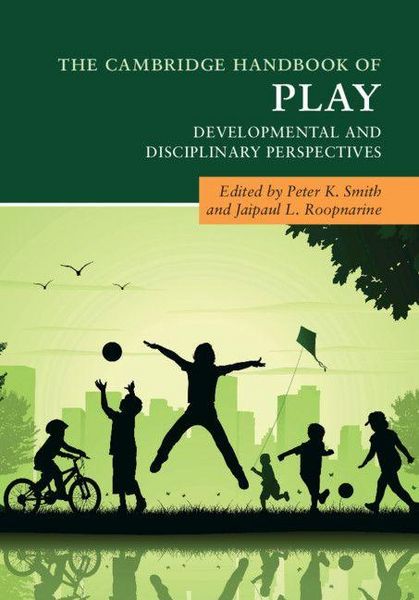
The Cambridge Handbook of Play Developmental and Disciplinary Perspectives

269,99 €

inkl. gesetzl. MwSt., Versandkostenfrei

Lieferung nach Hause

Beschreibung

Produktdetails

Einband

Gebundene Ausgabe

Erscheinungsdatum

18.04.2019

Herausgeber

Peter K. Smith + weitere

Verlag

Cambridge Academic

Seitenzahl

760

Maße (L/B/H)

25/17,5/4,5 cm

Gewicht

1460 g

Sprache

Englisch

ISBN

978-1-107-19251-5

Beschreibung

Produktdetails

Einband

Gebundene Ausgabe

Erscheinungsdatum

18.04.2019

Herausgeber

Verlag

Cambridge Academic

Seitenzahl

760

Maße (L/B/H)

25/17,5/4,5 cm

Gewicht

1460 g

Sprache

Englisch

ISBN

978-1-107-19251-5

Herstelleradresse

Libri GmbH
Europaallee 1
36244 Bad Hersfeld
DE

Email: Libri GmbH

Kundinnen und Kunden meinen

0 Bewertungen

Informationen zu Bewertungen

Zur Abgabe einer Bewertung ist eine Anmeldung im Konto notwendig. Die Authentizität der Bewertungen wird von uns nicht überprüft. Wir behalten uns vor, Bewertungstexte, die unseren Richtlinien widersprechen, entsprechend zu kürzen oder zu löschen.

Die Bewertungen sind nach Format, Anzahl Sterne und Datum sortiert.

Verfassen Sie die erste Bewertung zu diesem Artikel

Helfen Sie anderen Kund*innen durch Ihre Meinung

Kundinnen und Kunden meinen

0 Bewertungen filtern

Die Leseprobe wird geladen.
  • Produktbild: The Cambridge Handbook of Play
  • Produktbild: The Cambridge Handbook of Play
  • 1. Editorial introduction Peter K. Smith and Jaipaul L. Roopnarine; Part I. Evolution of Play: 2. New directions in studying the evolution of play Gordon M. Burghardt and Sergio M. Pellis; 3. The neurochemistry of social play behaviour in rats Viviana Trezza, E. J. Marijke Achterberg and Louk J. M. J. Vanderschuren; 4. Fur, fun and future fitness: the evolution of play in mammals Lynda Sharpe; 5. Nonhuman primate social play: coping with costs Akie Yanagi and Carol Berman; 6. Evolutionary functions of play: practice, resilience, innovation, and cooperation Peter Gray; 7. Human-animal play: play with pets Gail Melson; Part II. Development of Play in Humans: 8. Infant sensorimotor play: development of socio-cultural competence and enactive cognition Doris Bergen; 9. Mother-child and father-child play in different cultural contexts Jaipaul L. Roopnarine, Elif Dede Yildirim and Kimberly L. Davidson; 10. Object use in childhood: development and possible functions Tony Pellegrini; 11. Pretend and social pretend play: complexities, continuities, and controversies of a research field Ageliki Nicolopoulu; 12. Rough play: past, present and potential Jennifer L. Hart and Michelle T. Tannock; 13. Playing games with rules in early child care and beyond Ditte Winther-Lindqvist; 14. Troublesome binaries: playful learning on screen and off Fiona Scott; 15. Playing and imagining across the life course: a sociocultural perspective Jennifer A. Vadeboncoeur and Artin Gönçü; Part III. Historical and Anthropological Context: 16. Play at play in Western Europe, 1500 and 1800 Linda Pollock; 17. Play in foraging societies Adam Howell Boyette; 18. Play in South American indigenous children Yumi Gosso, Briseida D. Resende and Ana M. A. Carvalho; 19. Play in societies influenced by Confucian values Eunjoo Jung and Sophia Han; Part IV. Theories of Play and Research Methodology: 20. Classic theories of play Thomas S. Henricks; 21. Brian Sutton-Smith's views on play Anna Beresin, Fraser Brown and Michael M. Patte; 22. Methods of studying play James E. Johnson and Pool Ip Dong; Part V. Play and Learning: 23. Play and learning in everyday family contexts Marilyn Fleer; 24. Leading children in their 'leading activity': a Vygotskian approach to play Elena Bodrova, Deborah J. Leong, Carrie Germeroth and Crystal Day-Hess; 25. The adult as mediator of development in children's play Pentti Hakkarainen and Milda Bredikyte; 26. Play, learning and teaching in early childhood education Niklas Pramling, Anne Kultti and Ingrid Pramling-Samuelson; 27. Toddlers' play in early childhood education settings Maritta Hännikäinen and Hilkka Munter; 28. Adult and child learning in playworlds Beth Ferholt, Robert Lecusay and Monica Nilsson; 29. Play-literacy: knowns and unknowns in a changing world Kathleen Roskos; 30. The problems of play Susan Engel; Part VI. Play with Special Groups: 31. Play and children with autism: insights from research and implications for practice Despina Papoudi and Lila Kossyvaki; 32. Play and children with sensory impairments P. Margaret Brown and Anna Bortoli; 33. Play and children with physical impairments Cynthia J. Cress; 34. A typology of play in medical settings Colleen Baish-Cameron and Michael M. Patte; 35. Play therapy: theory and practice Elise Cuschieri; 36. Political violence (war and terrorism) and children's play Esther Cohen; Part VII. Play Spaces and the Rights of Children: 37. Play spaces: indoors and out John A. Sutterby; 38. Recess: supporting a culture of meaningful play at school Lauren McNamara; 39. Playwork: a unique way of working with children Fraser Brown, Alexandra Long and Mike Wragg; 40. The right to childhood and the ethos of play Lacey E. Peters and Beth Blue Swadener.