• Produktbild: Decolonizing Native American Rhetoric
  • Produktbild: Decolonizing Native American Rhetoric
Band 36

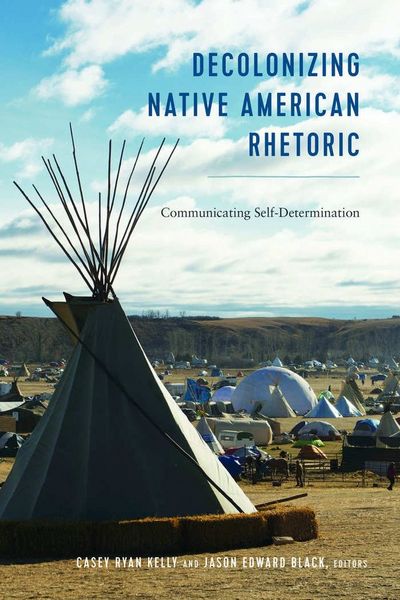
Decolonizing Native American Rhetoric Communicating Self-Determination

152,75 €

inkl. gesetzl. MwSt., Versandkostenfrei

Lieferung nach Hause

Beschreibung

Produktdetails

Einband

Gebundene Ausgabe

Erscheinungsdatum

31.05.2018

Abbildungen

Illustrationen, nicht spezifiziert

Herausgeber

Casey Ryan Kelly + weitere

Verlag

Peter Lang Publishing Inc. New York

Seitenzahl

370

Maße (L/B/H)

23,1/15,5/2,6 cm

Gewicht

600 g

Auflage

1

Sprache

Englisch

ISBN

978-1-4331-4798-2

Beschreibung

Portrait

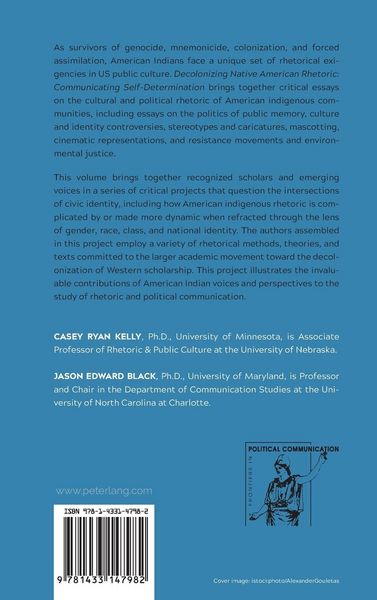
Casey Ryan Kelly, Ph.D., University of Minnesota, is Associate Professor of Rhetoric & Public Culture at the University of Nebraska.
Jason Edward Black, Ph.D., University of Maryland, is Professor and Chair in the Department of Communication Studies at the University of North Carolina at Charlotte.

Produktdetails

Einband

Gebundene Ausgabe

Erscheinungsdatum

31.05.2018

Abbildungen

Illustrationen, nicht spezifiziert

Herausgeber

Verlag

Peter Lang Publishing Inc. New York

Seitenzahl

370

Maße (L/B/H)

23,1/15,5/2,6 cm

Gewicht

600 g

Auflage

1

Sprache

Englisch

ISBN

978-1-4331-4798-2

EU-Ansprechpartner

Zeitfracht Medien GmbH
Ferdinand-Jühlke-Straße 7
99095 Erfurt
DE
produktsicherheit@zeitfracht.de

Herstelleradresse

Peter Lang
Avenue du Théâtre 7
1005 Lausanne
CH
orders@peterlang.com

Noch keine Bewertungen vorhanden

Verfassen Sie die erste Bewertung zu diesem Artikel

Helfen Sie anderen Kundinnen und Kunden durch Ihre Meinung.

Kundinnen und Kunden meinen

Bewertungen (0)

Die Leseprobe wird geladen.
  • Produktbild: Decolonizing Native American Rhetoric
  • Produktbild: Decolonizing Native American Rhetoric
  • List of Illustrations – Acknowledgments – Mary E. Stuckey: Foreword: The Questions of Decolonization – Casey Ryan Kelly/Jason Edward Black: Introduction: Decolonizing Native American Rhetoric – Part One: Time, Memory, and Identity – Randall A. Lake/Tyler Hiebert/Chris Robbins: Chapter One: Decolonizing Reconciliation: Art and Conciliation from the Ground Up Among Canadian Aboriginal Peoples – Catherine Palczewski: Chapter Two: Women at the Greasy Grass/Little Bighorn Battlefield National Monument: Remapping the Gendered/Sexed Circumference of Memory – Lee M. Pierce: Chapter Three: Melancholic Mirages and Ethopoeic Enemies: Reconsidering Temporality in Canada’s Apologies to First Peoples – Matthew Brigham/Paul Mabrey: Chapter Four: “The Original Homeland Security, Fighting Terrorism Since 1492”: A Public Chrono-Controversy – Part Two: Representations, Caricatures, and the Popular – Christopher J. Gilbert: Chapter Five: Decolonizing Caricature: Prosopographia in the Comic Politics of Marty Two Bulls, Sr. – Amanda Morris/Casey R. Schmitt: Chapter Six: Indians Aren’t Funny: Native Stand-Up as Contact Zone – Danielle Endres: Chapter Seven: A Critical Rhetorical History of the Utes Nickname – Raymond Blanton: Chapter Eight: Survive or Surrender: The Rhetoric of Indigenous Land in Hell or High Water and Wind River – Part Three: “Rhetorics of Resistance” – Stephanie Houston Grey: Chapter Nine: The Tail of the Black Snake: Social Protest and Survivance in South Louisiana – Margret McCue-Enser: Chapter Ten: Intersectional Rhetoric and the Perversity of Form: Ada Deer’s Confirmation Statement as Resistive Rhetoric – Kelly Young: Chapter Eleven: The Rhetorical Persona of the Water Protectors: Anti-Dakota Pipeline Resistance with Mirror Shields – Rachel Presley: Chapter Twelve: Between a Rock and a Hard Place: Rhetorical Strategies for Environmental Protection and Tribal Resistance in the Dakota Access Pipeline Movement – Kristine Warrenburg Rome: Chapter Thirteen: Counterpublicity and the Trail of Broken Treaties: Why Not “AIM” for New Sites of Deliberation? – Anthony Sutton: Chapter Fourteen: Farming, Fieldwork, and Sovereignty: Addressing Colonialist Systems with Participatory Critical Rhetoric – Contributor Biographies – Index.