
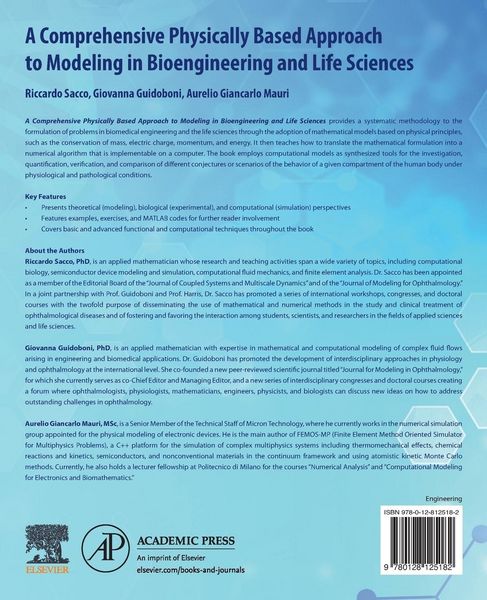
• Produktbild: A Comprehensive Physically Based Approach to Modeling in Bioengineering and Life Sciences
  • Produktbild: A Comprehensive Physically Based Approach to Modeling in Bioengineering and Life Sciences

A Comprehensive Physically Based Approach to Modeling in Bioengineering and Life Sciences

231,99 €

inkl. gesetzl. MwSt., Versandkostenfrei

Lieferung nach Hause

Beschreibung

Produktdetails

Einband

Taschenbuch

Erscheinungsdatum

26.07.2019

Verlag

Elsevier Inc

Seitenzahl

856

Maße (L/B/H)

23,6/18,9/4,5 cm

Gewicht

1687 g

Sprache

Englisch

ISBN

978-0-12-812518-2

Beschreibung

Produktdetails

Einband

Taschenbuch

Erscheinungsdatum

26.07.2019

Verlag

Elsevier Inc

Seitenzahl

856

Maße (L/B/H)

23,6/18,9/4,5 cm

Gewicht

1687 g

Sprache

Englisch

ISBN

978-0-12-812518-2

Herstelleradresse

Libri GmbH
Europaallee 1
36244 Bad Hersfeld
DE

Email: gpsr@libri.de

Kundinnen und Kunden meinen

0 Bewertungen

Informationen zu Bewertungen

Zur Abgabe einer Bewertung ist eine Anmeldung im Konto notwendig. Die Authentizität der Bewertungen wird von uns nicht überprüft. Wir behalten uns vor, Bewertungstexte, die unseren Richtlinien widersprechen, entsprechend zu kürzen oder zu löschen.

Die Bewertungen sind nach Format, Anzahl Sterne und Datum sortiert.

Verfassen Sie die erste Bewertung zu diesem Artikel

Helfen Sie anderen Kund*innen durch Ihre Meinung

Kundinnen und Kunden meinen

0 Bewertungen filtern

  • Produktbild: A Comprehensive Physically Based Approach to Modeling in Bioengineering and Life Sciences
  • Produktbild: A Comprehensive Physically Based Approach to Modeling in Bioengineering and Life Sciences
  • Part I. Mathematical, Computational, and Physical Foundations1. Elements of Mathematical Modeling2. Elements of Mathematical Methods3. Elements of computational methods4. Elements of Physics

    Part II. Balance Laws5. The Rational Continuum Mechanics Approach to Matter in Motion6. Balance laws in integral form7. Balance laws in local form8. Continuum Approach for Multicomponent Mixtures

    Part III. Constitutive Relations9. Preliminary Considerations on Constitutive Modeling10. Constitutive Relations for Fluids11. Constitutive Relations for Solids12. Constitutive Relations for Multicomponent Mixtures13. Constitutive Relations in Electromagnetism and Ion Electrodynamics

    Part IV. Model Reduction of System Complexity14. Reduction of the Maxwell Partial Differential System15. Electric Analogy to Fluid Flow

    Part V. Mathematical Models of Basic Biological Units and Complex Systems16. Cellular Components and Functions: A Brief Overview17. Mathematical Modeling of Cellular Electric Activity18. Mathematical Modeling of Electric Propagation Along Nerve Fibers19. Differential Models in Cellular Functions

    Part VI. Advanced Mathematical and Computational Methods20. Functional Spaces and Functional Inequalities21. Functional Iterations for Nonlinear Coupled Systems of Partial Differential Equations22. Time Semidiscretization and Weak Formulations for Initial Value/Boundary Value Problems of Advection-Diffusion-Reaction Type23. Finite Element Approximations of Boundary Value Problems of Advection-Diffusion-Reaction Type24. Finite Element Approximations of Initial Value/Boundary Value Problems of Advection-Diffusion-Reaction Type25. Finite Element Approximation of a Unified Model for Linear Elastic Materials

    Part VII. Simulation Examples and Clinical Applications26. Ion Dynamics in Cellular Membranes27. Interaction Between Hemodynamics and Biomechanics in Ocular Perfusion

    Part VIII. Examples, Exercises, and Projects28. Coding of Examples Using Matlab Scripts29. Matlab Functions for Algorithm Implementation30. Homework: Exercises and Projects

    Appendix A. Elements of Differential Geometry and Balance Laws in Curvilinear Coordinates