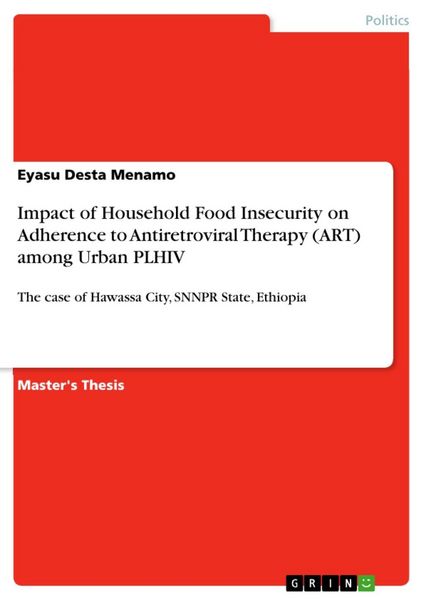
Impact of Household Food Insecurity on Adherence to Antiretroviral Therapy (ART) among Urban PLHIV The case of Hawassa City, SNNPR State, Ethiopia
-
- Taschenbuch
- eBook ausgewählt
-
Form:Einzelkauf Download
-
Sprache:Englisch
-
eBook Format:ePUB
- PDF 44,99 €
- ePUB 44,99 € ausgewählt
44,99 €
inkl. gesetzl. MwSt.Beschreibung
Produktdetails
Format
ePUB
Kopierschutz
Nein
Family Sharing
Nein
Text-to-Speech
Ja
Erscheinungsdatum
23.01.2013
Verlag
GRINSeitenzahl
88 (Printausgabe)
Dateigröße
1525 KB
Auflage
1. Auflage
Sprache
Englisch
EAN
9783656357858
Master's Thesis from the year 2012 in the subject Politics - Topic: Development Politics, grade: Excellent , Hawassa University, course: Development Management , language: English, abstract: Background: ARV adherence is a strong predictor of biologic (virologic and immunologic) and
clinical outcomes in HIV, including quality of life, HIV progression, hospitalizations, and death.
Consistent adherence to antiretroviral therapy (ART) is the cornerstone of effective HIV
treatment. This study explores the interrelationship between food insecurity and access and
adherence to ARV treatment. Such studies will help inform policy maker in the study area on
ways of improving or maintaining adherence to ARV and scale up the treatment level.
Objective: The main objective of the study is to assess the prevalence of ARV adherence and
associated factors (with particular focus on household food insecurity) among urban PLHIV.
Method: PLHIV association based cross-sectional study was conducted from January, 2012 to
May, 2012 in Hawassa city. Both quantitative and qualitative data were used to triangulate one
with another. Adult PLWHA on ARV therapy for at least 3 months were the study participants.
A purposive sampling method used to select the study participants. Bivariate and multivariate
logistic regressions were computed to assess the factors associated with ARV therapy nonadherence
among adult PLHIV in the study area.
Result: Data were collected using structured questionnaire with open and closed type questions
where a total of 325 participants were interviewed. Two focus group discussions with 6- 8
members each were conducted. Key informant interviews for PLHIV association's coordinator
and healthcare providers at ART clinic were conducted. Data was presented using frequency
tables and graphs. Data was analyzed using SPSS software version 16.0. Results show that that
the prevalence of adherence to ART was 82.5 %( that is non -adherence level 17.5%), was suboptimal(
less than 95%).Both dietary diversity and meal frequency score were less than mean (
48.6% and 60.6%) respectively. Based on household food insecurity access module (63.7%)
were food in secured. Household food insecurity was associated with ART adherence. Factors
significantly associated with non- adherence to ARV therapy were religious status, protestant
and catholic (COR 3.74, 95% CI 1.43-9.78) and (COR 2.11, 95%CI 1.11-4.02) respectively;
marital status, divorced (AOR 3.88(1.48-10.20).[...]
clinical outcomes in HIV, including quality of life, HIV progression, hospitalizations, and death.
Consistent adherence to antiretroviral therapy (ART) is the cornerstone of effective HIV
treatment. This study explores the interrelationship between food insecurity and access and
adherence to ARV treatment. Such studies will help inform policy maker in the study area on
ways of improving or maintaining adherence to ARV and scale up the treatment level.
Objective: The main objective of the study is to assess the prevalence of ARV adherence and
associated factors (with particular focus on household food insecurity) among urban PLHIV.
Method: PLHIV association based cross-sectional study was conducted from January, 2012 to
May, 2012 in Hawassa city. Both quantitative and qualitative data were used to triangulate one
with another. Adult PLWHA on ARV therapy for at least 3 months were the study participants.
A purposive sampling method used to select the study participants. Bivariate and multivariate
logistic regressions were computed to assess the factors associated with ARV therapy nonadherence
among adult PLHIV in the study area.
Result: Data were collected using structured questionnaire with open and closed type questions
where a total of 325 participants were interviewed. Two focus group discussions with 6- 8
members each were conducted. Key informant interviews for PLHIV association's coordinator
and healthcare providers at ART clinic were conducted. Data was presented using frequency
tables and graphs. Data was analyzed using SPSS software version 16.0. Results show that that
the prevalence of adherence to ART was 82.5 %( that is non -adherence level 17.5%), was suboptimal(
less than 95%).Both dietary diversity and meal frequency score were less than mean (
48.6% and 60.6%) respectively. Based on household food insecurity access module (63.7%)
were food in secured. Household food insecurity was associated with ART adherence. Factors
significantly associated with non- adherence to ARV therapy were religious status, protestant
and catholic (COR 3.74, 95% CI 1.43-9.78) and (COR 2.11, 95%CI 1.11-4.02) respectively;
marital status, divorced (AOR 3.88(1.48-10.20).[...]
Noch keine Bewertungen vorhanden
Verfassen Sie die erste Bewertung zu diesem Artikel
Helfen Sie anderen Kundinnen und Kunden durch Ihre Meinung.
Kurze Frage zu unserer Seite
Vielen Dank für dein Feedback
Wir nutzen dein Feedback, um unsere Produktseiten zu verbessern. Bitte habe Verständnis, dass wir dir keine Rückmeldung geben können. Falls du Kontakt mit uns aufnehmen möchtest, kannst du dich aber gerne an unseren Kund*innenservice wenden.
zum Kundenservice